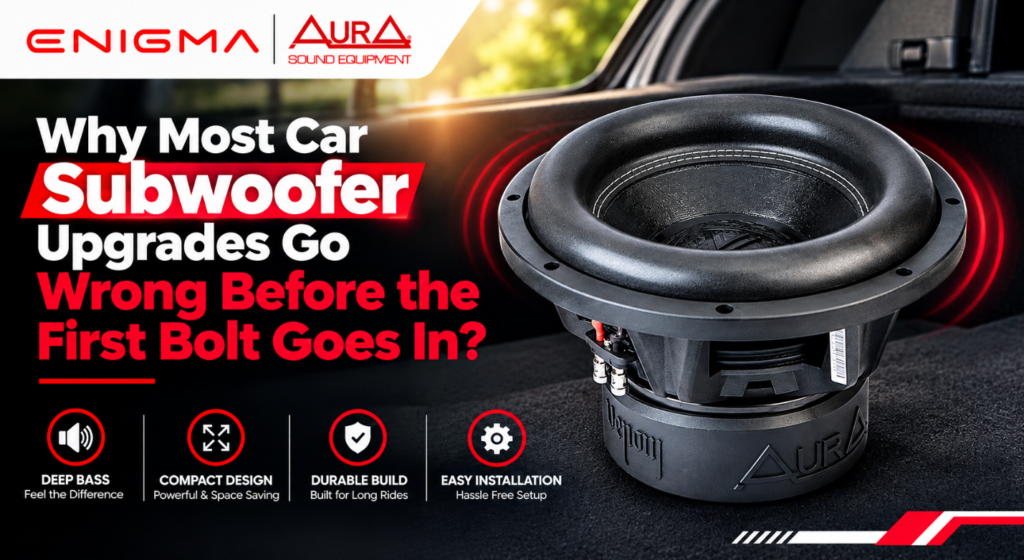
What actually kills a subwoofer install before the first screw goes in? Rarely the subwoofer itself. Somebody skipped measuring the boot, or the head unit just doesn’t have the voltage to push a clean signal. Car Subwoofers don’t behave like a phone mount you snap in and forget about. Get the enclosure wrong, and even a genuinely good driver ends up sounding flabby — worse, it rattles the parcel shelf on every speed bump.
Space decides more than budget does
Everyone walks in with a number stuck in their head. Two thousand, five thousand, doesn’t really matter — that’s not the actual constraint. Usable space under the seat or inside the boot decides more, because it quietly rules out half the market before price ever gets a say.
Hatchbacks and compact sedans mostly can’t fit a sealed 12-inch box without eating straight into luggage room. That’s the exact case for an underseat subwoofer for car buyers who aren’t willing to give up boot space. Sits flush under the seat, wiring runs along the floor trim, nothing left sitting in the boot to trip over. Output takes a hit though. Underseat units still trail a boxed 10- or 12-inch woofer for raw pressure, even if amplifier improvements over the last couple of years have narrowed that gap somewhat.
Fitted one into a four-door hatchback last year where a normal enclosure simply wasn’t going to survive the weekly grocery run. Held up fine. The owner wanted tighter bass, not something that shakes the windows, and that’s really the whole point of going underseat in the first place.
Defining “best” depends on who’s asking
Type best subwoofer for car into any search bar and every single listing claims the title. Doesn’t tell you much on its own. Everyone selling Car Subwoofers acts like they’ve solved the problem outright, but a sedan owner chasing clean vocals on the commute wants something different from someone chasing SPL scores at a meet on Sunday. RMS rating, sensitivity in dB, enclosure size — all of it shifts what “best” even means here.
Odd thing is a 100W RMS driver in a properly sized sealed box will usually sound tighter than a 300W unit shoved into whatever space is left over. Amp matching counts for just as much. Underpower a sub, and you don’t get silence. You get distortion at moderate volume, and that’s the mistake most first-timers make without even realizing it.
Aura Subwoofers delivered by Enigma built their underseat line around exactly this trade-off — decent low-end for daily listening, compact enough that nobody has to touch the seat rails during install. Not a fix for every situation, and it was never meant to be. But for buyers who want better bass without redoing their entire boot layout, it’s a reasonable place to start.
Sealed, ported, or underseat — habits decide, not trends
Sealed boxes stay accurate and forgive a smaller enclosure. Ported ones go louder on the same power but need more room, and can sound a bit loose depending on the track playing. A subwoofer speaker for car audio won’t perform the same in both setups — the same driver, sealed versus ported, can come out sounding like two entirely different products.
Podcast listeners and anyone mostly playing vocals or acoustic tracks tend to prefer sealed. Heavy bass playlists on loop, mostly electronic, sometimes hip-hop, usually do better ported, or with a slightly bigger Aura car subwoofer setup if the boot has room to spare.
Don’t get too caught up in brand debates either. Wiring gauge, fuse rating, and a properly grounded amp chassis affect sound quality more than most people expect going in. Watched a mid-range subwoofer beat an expensive one purely because the installer bothered running proper 4-gauge power wire instead of whatever thin cable came bundled in the box.
FAQs
Is an underseat subwoofer loud enough for regular listening, or just background bass?
For daily driving at normal volumes, plenty loud enough — vocals and mid-bass presence come through fine. SPL competition is its own world; that crowd still wants a boxed setup.
Does a bigger subwoofer always sound better in a car?
Not really. Box volume and how well the amp matches the driver count for more than raw size does. A properly installed 8-inch can beat a poorly fitted 12-inch without much effort at all.
Can I install a subwoofer myself or do I need a professional?
Underseat kits are close to plug-and-play if the car already has RCA outs or a line-out converter — Aura Subwoofers ships their underseat units with most of the wiring already sorted. Custom boxed enclosures are a different job entirely, better left to someone who’s actually done fabrication before.
How much boot space does going underseat actually save?
Depends on the seat design, but most owners report getting their whole boot back since nothing sits in the trunk. True for Aura car subwoofers underseat models specifically — the entire unit lives under the seat itself.
Will running a subwoofer drain the car battery faster?
Only really an issue if you’re blasting it at high volume with the engine off for a long stretch. Normal driving use barely registers once the alternator’s running.