Every fleet manager knows the pressure. When a Grove crane breaks down, the spreadsheet stares back at you. The OEM column shows one figure. The aftermarket column shows another—usually friendlier to your budget. The temptation to cut that check for less is powerful. But this choice involves far more than a simple price comparison.
“Will-fit” sounds like a promise. It whispers that everything will work out fine. Yet physical fitment is just the first chapter of a much longer story. Buried beneath are questions of alloy composition, thermal tolerance, and dynamic load response. This isn’t a debate about brand loyalty. It’s about understanding what keeps your crew safe and your machine earning. Let’s dig into the real differences.
The Truth Behind “Will-Fit”
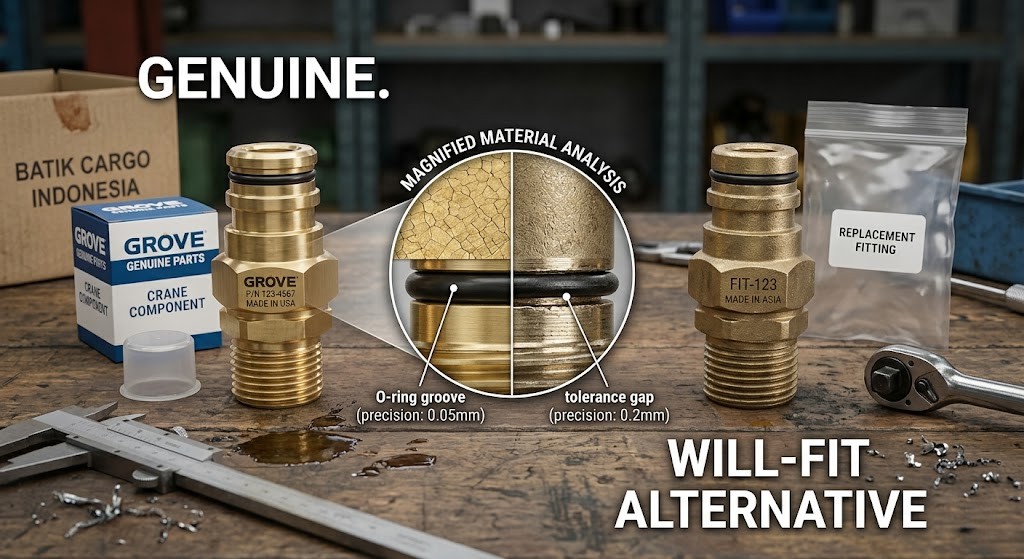
Let’s define our terms clearly. “Will-fit” means the part occupies the same space. Bolt patterns match. Ports align. Thread pitch corresponds. That’s the extent of the guarantee. It doesn’t speak to operational efficiency. It doesn’t address service life. It doesn’t mention safety factors or fatigue limits.
Aftermarket producers study OEM parts and recreate them. Some achieve remarkable accuracy. Others overlook nuances that only reveal themselves under full load or after months of vibration. Genuine Grove crane parts are manufactured to the original engineering drawings. They undergo validation testing within complete assemblies. That engineering discipline matters more than the initial price differential indicates.
When Geometry Hides Performance Gaps
A part can drop into place yet create cascading problems. Precision is the invisible factor. Factory components hold to exact tolerances. An O-ring has specific compression set characteristics. A roller bearing maintains precise internal radial clearance. These micro-specifications govern survival under pressure, heat cycling, and harmonic stress.
A substitute seal might install without resistance. But once the system pressurizes, material relaxation accelerates. Fluid migration begins. Before long, you’re scheduling another teardown, absorbing cleanup costs, and losing billable hours. The technician time to R&R a component typically exceeds the component’s purchase price. That apparent $70 savings evaporates into $700 of labor and opportunity cost.
Your crane parts supplier should help you model these total-cost scenarios before you commit to a purchase.
Materials: What Lies Beneath the Surface
Visual parity means nothing in critical applications. Two hydraulic cylinders might share identical external dimensions. Internally, the chrome plating thickness, piston seal compound, and rod metallurgy could differ dramatically. Genuine Grove crane parts specify materials proven through accelerated life testing. They tolerate thermal shock, ozone attack, and repetitive motion stress.
Budget alternatives sometimes substitute lesser materials to hit aggressive price points. The chrome may be thinner, prone to flaking. The seals may use a generic compound that hardens in cold conditions. For load-bearing or pressure-containing elements, these shortcuts prove catastrophic. A pendant line anchor forged from improper steel could part under shock loading. The parts counter hides this flaw. The accident report reveals it.
The Safety-Performance Connection
Certain components serve as the nervous system and reflexes of your crane. Load sensors, pilot valves, and friction brake assemblies belong to this critical class. If an aftermarket pressure transducer drifts slightly, the rated capacity limiter may permit unsafe configurations. If brake friction material degrades prematurely, emergency stopping distances extend beyond safe margins.
Genuine Grove crane parts maintain the precise calibration harmony designed into the machine’s control architecture. They preserve the safety buffers engineered into every circuit. Aftermarket substitutes may function adequately during light-duty cycles. But introduce adversity—subzero mornings, maximum boom angles, double shifts—and the performance deltas become dangerous. Is marginal savings worth elevated risk to your operators and rigging crews?
A seasoned crane parts supplier becomes your risk mitigation partner here, identifying where specification fidelity is non-negotiable.
Warranty: The Fine Print Reality
Consider the aftermath of premature failure. With genuine Grove crane parts, resolution follows established protocols. Manufacturer warranty provides replacement authorization. Technical service bulletins offer diagnostic guidance.
Aftermarket warranty landscapes are fragmented. Some vendors provide robust coverage with responsive claims handling. Others hide behind restrictive clauses and limited liability. Frequently, warranty obligation terminates at the failed component’s replacement cost, excluding consequential damage. When an economy hydraulic drive motor grenades, sending shrapnel through your valve stack and filter bank, who funds the cascade repair? OEM support ecosystems absorb these scenarios more comprehensively. That security premium has measurable value.
Your crane parts supplier should transparently map these warranty coverage gaps against your operational risk profile.
Smart Aftermarket Applications
This analysis doesn’t reject all independent manufacturing. Quality-focused aftermarket producers exist. For strategically selected applications, their products optimize maintenance economics. Consumable categories—breather elements, work lights, cabin trim, standard hardware—often perform satisfactorily from non-OEM channels.
When a recognized independent brand produces an air filter meeting identical efficiency and restriction specifications, the purchase is sound. When wear items like floor covering or labeling require refresh, premium sourcing adds no value. Concentrate authentic procurement investment where precision governs function. Direct dollars toward hydraulic systems, electronic controls, and structural interfaces. Deploy aftermarket sourcing for consumables and appearance items. Specification verification remains your responsibility regardless of brand.
Building Supplier Intelligence
Your procurement relationship shapes your maintenance outcomes. A sophisticated crane parts supplier transcends order fulfillment. They possess deep Grove platform knowledge. They distinguish between applications where aftermarket alternatives perform adequately and domains demanding factory specification.
Cultivating partnership with a capable crane parts supplier simplifies this equilibrium. They expedite genuine component acquisition for critical needs. They curate quality aftermarket alternatives for appropriate categories. They monitor supply chain velocity. They track manufacturer quality trends. Avoid transactional website purchasing driven solely by price. Invest in vendor relationships characterized by equipment expertise and operational understanding.
Developing Your Selection Protocol
Decision discipline requires structured inquiry. Does the component influence safety-critical or revenue-critical functions? Is replacement access complicated? When substantial disassembly precedes installation, specify premium sourcing. Repeated labor events destroy any material savings.
Is replacement straightforward? Is functional impact peripheral? Then verified aftermarket procurement may prove satisfactory. Research field performance data. Solicit your crane parts supplier’s empirical observations. They witness failure patterns and longevity outcomes. Their practical intelligence informs better decisions.
Maintain elementary documentation. Record procurement sources and service intervals. When aftermarket hose assemblies require semiannual replacement while authentic equivalents operate for eighteen months, capture the discrepancy. Historical data refines future strategy.
The Strategic View
Ultimately, this represents risk-adjusted cost management. Genuine Grove crane parts minimize outcome variance. They achieve proper integration. They demonstrate extended operational lifespan. They include comprehensive support infrastructure. “Will-fit” alternatives offer immediate expenditure reduction while introducing performance uncertainty.
Exclusive commitment to either category suboptimizes results. Strategic combination maximizes value. Protect critical operational systems with genuine Grove crane parts. Deploy quality aftermarket alternatives for non-critical applications. Collaborate with a crane parts supplier comprehending this nuanced equilibrium.
Your Grove crane constitutes substantial capital commitment. Honor that investment. Exercise economy where appropriate. Nevertheless, maintain integrity on components ensuring safe, reliable operation. Ultimately, availability assurance and operational confidence outweigh preliminary savings.