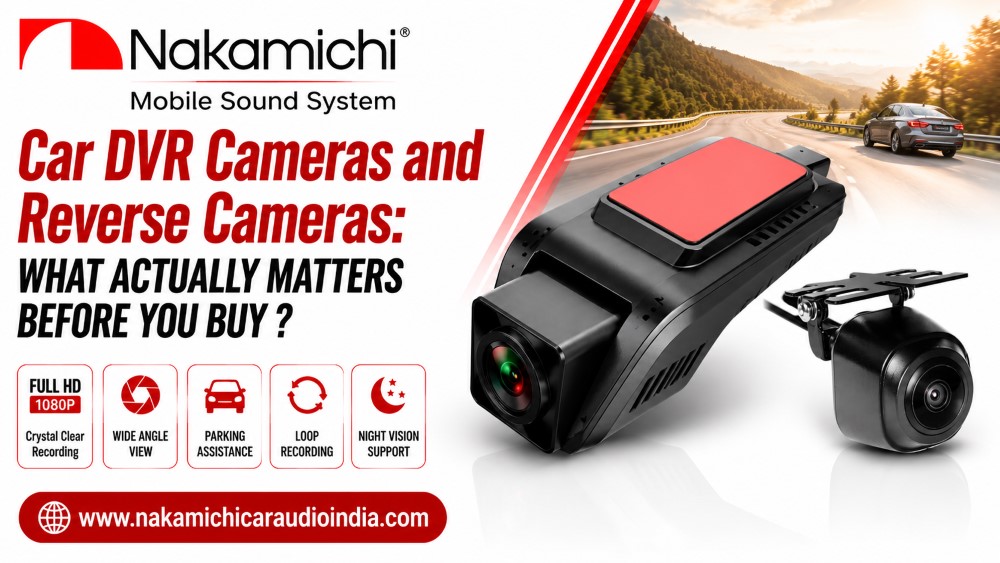
Nobody thinks about a reverse camera until they scrape a bumper. Usually backing out of a tight spot. By then, there’s no footage to prove what happened either way. A proper car reverse camera paired with a real DVR closes that gap completely — front, rear, sometimes both, running quietly in the background on every drive.
Why a Car DVR Camera Matters More Than People Think
Dash cars sit low on most Indian car owners’ priority lists. Right until an insurance dispute comes up. Or a hit-and-run leaves someone with nothing but their own word against another driver’s. That’s when a car dvr camera front and rear setup actually earns its cost. Storage isn’t something to worry about either — loop recording overwrites old footage automatically once the card fills, so there’s no manual file management involved.
Resolution matters here too. A 1080p feed is the minimum worth considering, and some newer units push to 2K or even 4K on the front channel specifically, since that’s the angle most likely to matter in an accident claim.
What a Real Reverse Camera Setup Should Include
A car reverse camera with night vision isn’t optional in India anymore, mostly because a huge share of parking scrapes and reversing incidents happen after dark or in dim basement parking. Wide viewing angle matters just as much — 120 degrees is the bare minimum, 170 degrees ideal, since anything narrower leaves blind spots exactly where they’re least convenient.
A few non-negotiables for any serious setup:
- Night vision performance that actually works in near-total darkness, not just dim light
- Wide-angle coverage, 170 degrees where possible
- Waterproofing rated for monsoon conditions, since the camera sits outside year-round
- Compatibility confirmed with the existing head unit before buying
Where Nakamichi Fits into This
Nakamichi, sold in India through Supreme Audiotronics Pvt Ltd, has built a genuinely solid lineup here rather than a single generic dash cam badge-slapped across different products. The ND430W runs 2K front recording paired with a rear channel, while the ND435W pushes further with 4K front and 1080p rear — a real jump in clarity for anyone who wants crisp footage of license plates and road signs, not just a blurry general impression of what happened.
For drivers who don’t want a separate camera cluttering the windscreen, the ND795 and ND590 take a different approach entirely. Both mount directly onto the existing rear-view mirror, recording at 1080p with a 170-degree front viewing angle and a VGA rear feed, doubling as a parking monitor built right into the mirror surface itself. No extra hardware stuck to the glass, no obstructed view while driving.
Car DVR Camera in India: What to Check Before Buying
Shopping for a car DVR camera in Indian market specifically means paying attention to conditions most international spec sheets don’t account for — extreme heat, dust, monsoon humidity, and inconsistent parking lot lighting all stress a camera differently than a controlled lab test would suggest. Nakamichi’s ND-series cameras are built with exactly those conditions in mind, not adapted from a design meant for a milder climate elsewhere.
A support network matters here too. Supreme Audiotronics backs the Nakamichi lineup with actual service infrastructure, which counts for something the day a unit needs troubleshooting or replacement under warranty, rather than a generic import with no local accountability.
FAQs
What resolution should a car DVR camera record at?
1080p is the practical minimum for usable footage, though 2K or 4K on the front channel gives noticeably sharper detail for license plates and fine road detail during disputes.
Does a car reverse camera with night vision really make a difference?
Yes, significantly. Most reversing incidents happen in low-light or enclosed parking areas, and standard cameras without proper night vision often produce unusable footage in those exact conditions.
Can a car DVR camera record front and rear at the same time?
Yes, dual-channel units like Nakamichi’s ND430W and ND435W record both angles simultaneously, giving a complete record of the drive rather than just one direction.
Is a mirror-mounted DVR better than a separate windscreen camera?
It depends on preference. Mirror-mounted units like the ND795 and ND590 avoid extra clutter on the windscreen and double as a parking monitor, while separate cameras sometimes offer more flexible mounting angles.
How important is waterproofing for a car reverse camera in India?
Very important, given monsoon conditions across most of the country. A reverse camera lives outside the vehicle permanently, so weatherproofing directly affects how long it lasts before failing.