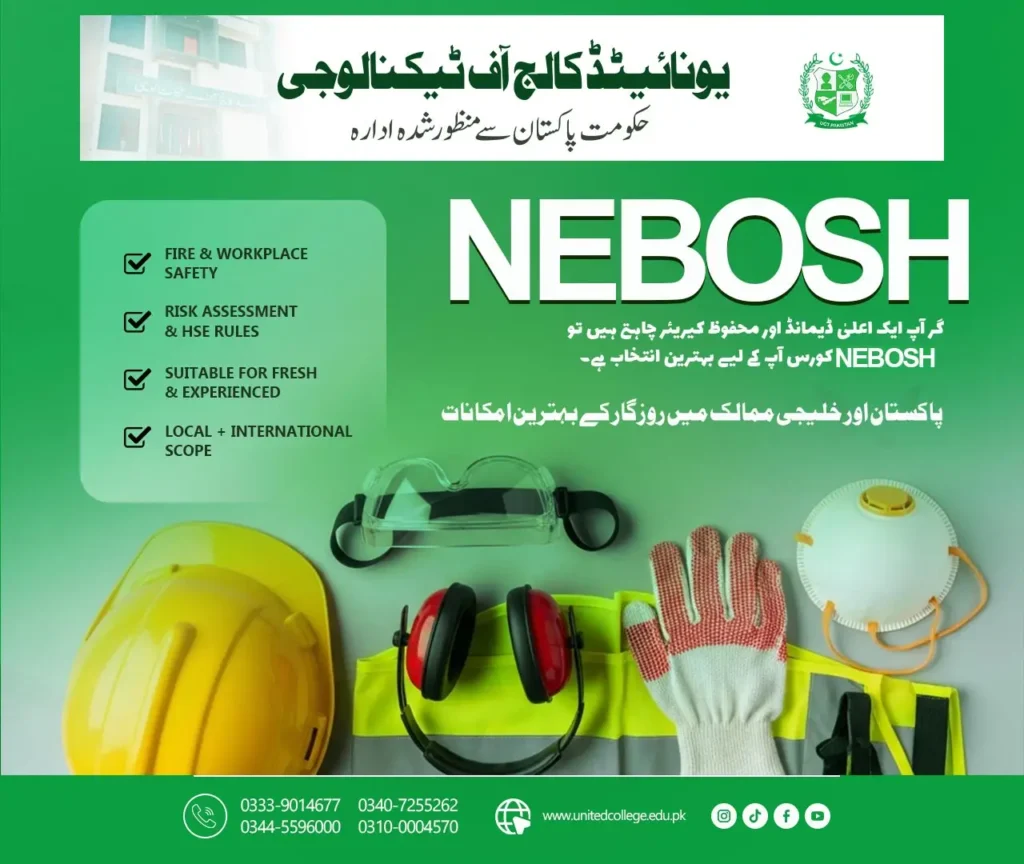
What Do You Learn During a NEBOSH Safety Course?
A workplace accident can happen in seconds, but preventing it often requires knowledge, planning, and the right safety practices. This is where a NEBOSH Course in Rawalpindi can help students and working professionals develop a better understanding of workplace health and safety.
NEBOSH training focuses on recognizing hazards, assessing risks, and understanding how to protect people at work. It helps learners understand why accidents happen and what can be done to prevent them in places such as construction sites, factories, offices, and industrial workplaces.
For people interested in a safety-related career, knowing what the course covers can help them decide whether it matches their learning and career goals.
What Makes NEBOSH Training Useful in Real Workplaces?
NEBOSH is known for occupational health and safety qualifications. Its courses help learners understand how workplace risks can be identified, evaluated, and controlled.
Rather than focusing only on safety rules, NEBOSH learning encourages students to understand the reasons behind those rules. For example, a safety professional should know why an unprotected floor opening is dangerous and what steps can reduce the risk.
The exact subjects depend on the NEBOSH qualification. A common starting point is the NEBOSH International General Certificate, which covers managing health and safety, identifying workplace hazards, and applying safety knowledge in practical situations.
Key Skills You Can Learn During a NEBOSH Safety Course
1. Identifying Workplace Hazards
One of the first skills learners develop is recognizing hazards that could cause injury or illness. These hazards may include unsafe machinery, electrical faults, working at height, poor housekeeping, or exposure to harmful substances.
For example, on a construction site, loose cables across a walking path can create a tripping hazard. A trained safety professional should be able to identify the problem, understand who could be affected, and recommend suitable control measures.
2. Conducting a Workplace Risk Assessment
Risk assessment is an important part of health and safety training. It involves identifying hazards, considering who may be harmed, evaluating the level of risk, and deciding what precautions are needed.
During a NEBOSH Course in Rawalpindi, learners can build an understanding of how risk assessments support safer working conditions.
For example, before workers begin a task at height, a risk assessment may consider fall hazards, access equipment, worker training, and suitable protective measures. The purpose is to reduce risks before the work begins.
3. Understanding Health and Safety Management
Workplace safety requires planning, communication, and proper management. NEBOSH learners study how organizations can develop safety policies, assign responsibilities, monitor performance, and improve working practices.
This knowledge is useful because safety is not only the responsibility of one safety officer. Managers, supervisors, workers, and employers all have roles in maintaining a safe workplace.
4. Learning How to Prevent Common Workplace Accidents
Students explore different types of workplace hazards and ways to control them. These may include slips, trips, falls, fire risks, electrical hazards, manual handling, and unsafe equipment.
The course helps learners understand that accident prevention requires more than simply warning workers to be careful. Suitable equipment, safe procedures, training, supervision, and regular checks are also important.
Practical Learning Helps Connect Theory With Real Work
Health and safety concepts become easier to understand when learners apply them to workplace situations. Depending on the qualification and learning provider, students may complete practical activities, scenario-based exercises, or a workplace risk assessment.
These activities help learners practice identifying hazards, explaining risks, and suggesting realistic control measures.
For instance, a learner may review a construction-site scenario and identify unsafe access, missing barriers, or poor material storage. They can then recommend suitable actions to improve safety.
The exact practical assessment requirements depend on the NEBOSH qualification being studied.
Who Can Benefit From NEBOSH Training?
NEBOSH qualifications may suit people who want to enter the health and safety field, as well as professionals who already have workplace responsibilities.
Construction workers, engineers, supervisors, safety assistants, and people interested in occupational health and safety may find the training relevant. However, the most suitable qualification depends on a learner’s background and career goals.
A NEBOSH Course in Rawalpindi may be worth exploring for students who want to study locally. United College of Technology (UCT) offers NEBOSH training. Before enrolling, students should confirm the current qualification, course duration, fee, class schedule, learning format, and assessment requirements with the institute.
What Career Paths Can NEBOSH Knowledge Support?
NEBOSH training can help learners build knowledge relevant to safety-related roles. Depending on their qualifications and experience, they may explore positions such as safety assistant, health and safety officer, or safety supervisor.
Some roles require additional education, practical experience, or employer-specific certifications. Completing a course does not automatically guarantee a job, but it can help learners develop knowledge that is relevant to workplace safety responsibilities.
Frequently Asked Questions
1. What subjects are covered in a NEBOSH Safety Course?
Subjects depend on the qualification. The NEBOSH International General Certificate covers health and safety management, workplace hazards, risk assessment, and practical application of safety knowledge.
2. Is NEBOSH difficult for new students?
Some topics may be challenging at first, especially risk assessment and technical safety terms. Regular study, practical examples, and understanding the concepts can make the learning process easier.
3. Do I need previous safety experience to study NEBOSH?
Many learners start without formal safety experience. However, students should check the entry guidance for their chosen qualification and make sure they can understand the course language and assessment requirements.
4. How long does a NEBOSH Safety Course take?
The duration depends on the qualification, learning provider, and study schedule. Ask UCT for the latest course duration and batch details before admission.
5. Does NEBOSH training include practical assessment?
Some NEBOSH qualifications include practical assessments, such as a workplace risk assessment. The assessment format depends on the specific qualification, so students should check the official requirements before enrolling.
6. Can NEBOSH help me get a safety job in Pakistan?
NEBOSH can help build health and safety knowledge relevant to safety-related jobs. However, employment depends on factors such as education, experience, practical skills, and the requirements of each employer.
Build a Strong Foundation in Workplace Safety
A NEBOSH Course in Rawalpindi can help learners understand how to identify hazards, assess risks, prevent accidents, and support safer working conditions. These skills are useful across many industries, particularly where workers face occupational risks.
For students considering NEBOSH training at United College of Technology (UCT), the next step is to confirm the qualification being offered and review its course and assessment details. With consistent learning and practical experience, students can build a foundation for further development in occupational health and safety.