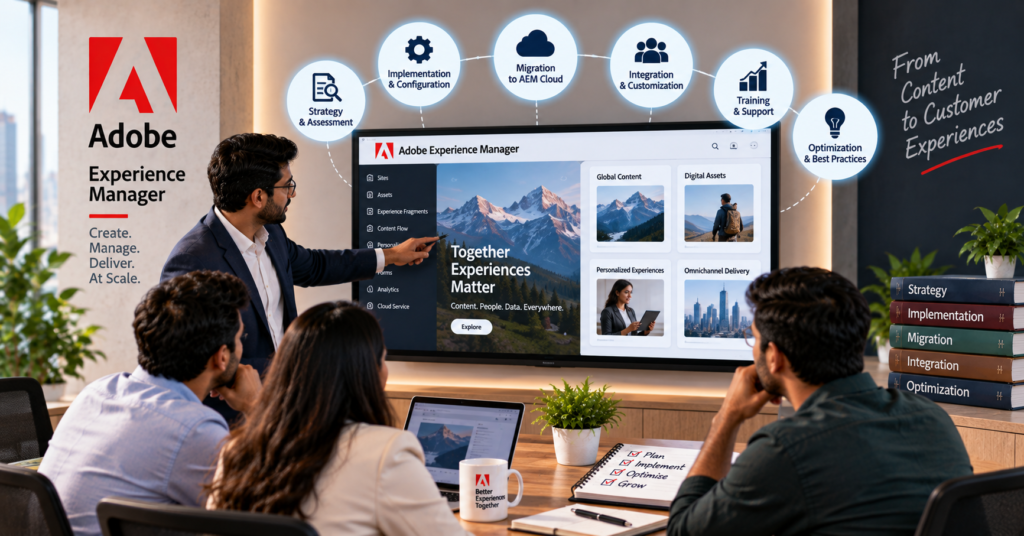
Adobe Experience Manager consulting can help enterprises plan, implement, migrate, integrate, customize, and optimize AEM for scalable digital experiences.
Adobe Experience Manager consulting helps enterprises plan, implement, migrate, customize, and optimize Adobe Experience Manager (AEM) according to their digital experience requirements. While AEM provides powerful content management and digital experience capabilities, enterprise implementations can involve complex architecture, integrations, content migration, workflows, development, and ongoing optimization.
Adobe’s current AEM as a Cloud Service documentation describes implementation as a structured process involving development, deployment, content readiness, migration, and ongoing management.
For businesses evaluating AEM, understanding what consulting services include and what influences implementation costs can make project planning much easier.
What Is Adobe Experience Manager Consulting?
Adobe Experience Manager consulting is a professional service designed to help organizations get more value from AEM.
Consulting can cover the complete AEM lifecycle, including:
- AEM strategy and planning
- Technical architecture
- AEM implementation
- Cloud migration
- Content migration
- Custom component development
- Workflow configuration
- Third-party integrations
- Performance optimization
- Security and governance
- Testing and quality assurance
- Training and documentation
- Ongoing support
The exact scope depends on whether an organization is implementing AEM for the first time, upgrading an existing environment, or moving an existing deployment to AEM as a Cloud Service.
Why Do Enterprises Need AEM Consulting?
AEM is designed for enterprise-scale digital experiences, but implementing the platform successfully requires more than configuring a CMS.
Organizations may have:
- Multiple websites
- Different brands
- Global markets
- Multiple languages
- Large content libraries
- Digital assets
- Complex approval workflows
- Ecommerce integrations
- CRM integrations
- Analytics platforms
- Marketing technology stacks
- Existing legacy AEM environments
Without proper planning, customization and integration requirements can increase project complexity.
Adobe’s migration guidance recommends assessing existing deployments, estimating effort and resources, defining project KPIs, and planning the transition before execution begins.
Key Adobe Experience Manager Consulting Services
1. AEM Strategy and Discovery
The first stage of an AEM project is understanding the business and technical requirements.
A consulting team may assess:
- Current CMS
- Business objectives
- Website architecture
- Content structure
- Digital asset requirements
- Authoring workflows
- User roles
- Integration requirements
- SEO requirements
- Personalization requirements
- Cloud readiness
The outcome is typically a roadmap that connects business requirements with the proposed AEM architecture.
2. AEM Architecture Consulting
AEM architecture determines how the platform will support content creation, delivery, integrations, development, and future growth.
Architecture consulting may cover:
- Author and publish architecture
- Content architecture
- Component architecture
- Templates
- Content fragments
- Experience fragments
- Dispatcher configuration
- CDN requirements
- API architecture
- Integration patterns
- Security
- Deployment strategy
For AEM as a Cloud Service, Adobe provides a cloud-native architecture with components such as author and publish tiers, Dispatcher, CDN, Cloud Manager, and related cloud services.
A well-planned architecture can reduce unnecessary customization and make future development easier.
3. AEM Implementation Services
AEM implementation services cover the actual configuration and development of the platform.
Typical implementation work can include:
- AEM setup
- Templates
- Core components
- Custom components
- Content models
- Workflows
- Forms
- Permissions
- Search configuration
- APIs
- Third-party integrations
- Development environments
- Testing
- Production deployment
Adobe provides dedicated implementation documentation for AEM as a Cloud Service covering development, customization, deployment, and related technical requirements.
4. AEM Cloud Migration Consulting
Many organizations use Adobe Experience Manager consulting when moving from an existing AEM deployment to AEM as a Cloud Service.
Adobe’s migration journey is structured around readiness, implementation, go-live, and post-go-live activities.
Consultants can help with:
- Existing environment assessment
- Best Practices Analyzer review
- Code assessment
- Cloud readiness
- Code refactoring
- Content migration
- Dispatcher conversion
- Index conversion
- Testing
- Migration planning
- Production migration
- Post-migration validation
Adobe also provides modernization and migration tools to help organizations prepare their code and content for Cloud Service.
5. Content Migration Services
Moving content from an existing CMS or legacy AEM environment can be one of the most important parts of an AEM project.
Migration may include:
- Pages
- Assets
- Tags
- Content fragments
- User groups
- Workflows
- Metadata
- Digital documents
- Structured content
Adobe’s Content Transfer Tool can be used to move content from an existing AEM instance to AEM as a Cloud Service. Adobe notes that content migration requires planning, tracking, and collaboration between teams.
A consulting team can help determine what should be migrated, what should be archived, and what should be redesigned rather than simply transferred.
6. Custom AEM Development
Out-of-the-box AEM capabilities may not cover every enterprise requirement.
Consultants and developers can create customized:
- Components
- Templates
- Workflows
- Forms
- Content models
- APIs
- Integrations
- Search functionality
- Authoring features
However, customization should be planned carefully.
AEM as a Cloud Service has specific development requirements, including separation of code and content and restrictions around immutable repository areas.
This makes cloud-aware development important when building or modernizing an AEM implementation.
7. AEM Integration Services
Enterprise websites rarely operate independently.
AEM may need to communicate with:
- CRM systems
- Ecommerce platforms
- Adobe Analytics
- Adobe Target
- Adobe Real-Time CDP
- Product information systems
- Search platforms
- Marketing automation tools
- Customer databases
- Business intelligence platforms
A consultant can design integration architecture, define APIs, map data, and coordinate testing across systems.
The complexity of these integrations can have a direct effect on the overall project scope and implementation cost.
8. AEM Performance Optimization
Performance consulting focuses on making the digital experience faster, more stable, and easier to maintain.
Consultants may review:
- Page performance
- Component efficiency
- Caching
- Dispatcher configuration
- CDN behavior
- Queries
- Repository structure
- Image delivery
- API performance
- Front-end assets
- Third-party scripts
Performance should be considered during architecture and development rather than treated only as a post-launch activity.
9. AEM SEO Consulting
AEM can support large enterprise websites, but SEO requirements need to be incorporated into the implementation.
AEM SEO consulting can cover:
- URL architecture
- Metadata
- Canonical tags
- XML sitemaps
- Robots.txt
- Structured data
- Internal linking
- Breadcrumbs
- Redirects
- International SEO
- Pagination
- JavaScript rendering
- Core Web Vitals
- Content governance
For organizations managing multiple countries or brands, consistent SEO governance can become particularly important.
10. AEM Training and Knowledge Transfer
Technology adoption does not end when the implementation goes live.
Consulting teams can provide training for:
- Content authors
- Administrators
- Developers
- Marketing teams
- SEO teams
- IT teams
Training can cover content authoring, workflows, permissions, components, publishing, reporting, and platform administration.
Documentation and knowledge transfer also help internal teams become more self-sufficient.
Adobe Experience Manager Consulting Cost
The Adobe Experience Manager consulting cost depends heavily on project scope.
There is no universal consulting fee because projects can range from a focused audit to a global enterprise implementation or cloud migration.
Important cost factors include:
| Cost factor | Potential impact |
|---|---|
| Project scope | Determines overall consulting effort |
| Number of websites | More sites can increase architecture and development work |
| Content volume | Can affect migration and validation |
| Digital assets | Large DAM repositories may require additional migration work |
| Custom components | Increases development effort |
| Integrations | Complex integrations require additional technical resources |
| Migration | Legacy code and content can increase project complexity |
| Number of markets | Localization and governance add scope |
| Workflows | Complex approval processes require configuration |
| SEO requirements | Enterprise SEO can require additional architecture and development |
| Training | More teams and users can increase enablement requirements |
| Ongoing support | Adds recurring consulting and optimization work |
What Makes AEM Implementation More Expensive?
Several factors can increase the overall Adobe Experience Manager implementation cost.
Legacy Customizations
Older AEM installations may contain custom code that needs refactoring before moving to Cloud Service.
Large Content Repositories
Millions of pages, assets, tags, or documents can increase migration planning and validation requirements.
Complex Integrations
Connecting AEM with multiple enterprise platforms can require significant development and testing.
Multiple Markets
Global websites may require different languages, domains, content structures, permissions, and publishing workflows.
Custom Components
The more custom functionality required, the greater the development and testing effort.
Poor Existing Architecture
An organization may need to clean up content, repository structures, code, and workflows before migration.
Adobe specifically recommends assessing repository health, content, users, groups, assets, pages, and other factors during migration preparation.
AEM Consulting vs AEM Implementation
These terms are related but not identical.
AEM consulting generally focuses on strategy, architecture, planning, assessment, optimization, and guidance.
AEM implementation focuses more directly on configuring, developing, integrating, testing, and deploying the platform.
For example:
| Consulting | Implementation |
|---|---|
| Business requirements | AEM configuration |
| Technical architecture | Component development |
| Migration strategy | Content migration |
| SEO strategy | SEO implementation |
| Integration planning | API development |
| Governance | Workflow configuration |
| Technology assessment | Deployment |
| Roadmap | Testing |
Many enterprise projects require both.
AEM Cloud Migration: What Should You Plan?
If you are moving an existing AEM deployment to Cloud Service, Adobe recommends a phased approach.
Phase 1: Readiness
Assess the existing environment, architecture, code, content, and compatibility requirements.
Phase 2: Implementation
Make code and content ready for Cloud Service. This can include code refactoring and content-transfer preparation.
Phase 3: Migration and Go-Live
Perform production migration, validate content, and coordinate the final transition.
Phase 4: Post-Go-Live
Monitor the environment, troubleshoot issues, and continue performance and development improvements.
Adobe also provides Cloud Acceleration Manager to support organizations through planning and migration activities.
How to Choose an AEM Consulting Partner
Before selecting a consulting team, evaluate:
AEM Technical Expertise
Check experience with AEM Sites, Assets, Cloud Service, components, templates, workflows, Dispatcher, and Cloud Manager.
Cloud Experience
If moving to AEM as a Cloud Service, confirm that the team understands cloud-specific development and deployment requirements.
Migration Experience
Ask how the consultant handles content migration, code refactoring, testing, and go-live planning.
Integration Capabilities
Review experience with the Adobe ecosystem and other enterprise technologies used by your organization.
SEO Knowledge
For websites where organic search is important, make sure SEO requirements are incorporated into the technical architecture.
Documentation and Training
A good implementation should leave the internal team with useful documentation and knowledge rather than a mysterious box of custom code.
How to Reduce AEM Implementation Costs
Organizations can manage project costs by planning the implementation carefully.
Define Requirements Early
Document business, content, technical, SEO, and integration requirements before development begins.
Reuse AEM Core Capabilities
Avoid unnecessary custom development where standard AEM capabilities can meet the requirement.
Clean Legacy Content
Remove outdated content and unused assets before migration where appropriate.
Plan Migration Early
Migration should be treated as a project workstream, not a final step.
Use Adobe Migration Tools
Adobe provides tools such as the Content Transfer Tool, Dispatcher Converter, Repository Modernizer, Index Converter, and other modernization utilities to support cloud migration.
Establish Governance
Clear standards for components, templates, content models, code, and integrations can help prevent unnecessary technical debt.
Questions to Ask an Adobe Experience Manager Consultant
Before signing a consulting agreement, ask:
- What AEM versions and deployment models have you worked with?
- Do you support AEM as a Cloud Service?
- How will you assess our current implementation?
- What is included in the discovery phase?
- How will you estimate migration effort?
- How will existing custom code be evaluated?
- How will content migration be tested?
- Which integrations are included?
- How will SEO requirements be handled?
- What documentation and training will we receive?
- What post-launch support is available?
- How will project KPIs and success criteria be measured?
FAQs About Adobe Experience Manager Consulting
What does Adobe Experience Manager consulting include?
It can include strategy, architecture, implementation planning, migration, custom development, integrations, performance optimization, SEO, training, governance, and ongoing support.
How much does AEM consulting cost?
There is no universal consulting price. Cost depends on project scope, implementation complexity, migration requirements, integrations, customization, number of websites, content volume, and required services.
Is AEM consulting needed for a cloud migration?
It is not mandatory in every case, but complex migrations may require specialized architecture, code-refactoring, content-migration, testing, and deployment expertise.
What is included in AEM implementation?
Implementation can include platform configuration, templates, components, workflows, integrations, content models, testing, deployment, and related development work.
Can an AEM consultant help with SEO?
Yes. A consultant can incorporate technical SEO requirements such as URL architecture, metadata, canonicalization, redirects, structured data, international SEO, sitemaps, and performance into the AEM implementation.
How long does an AEM implementation take?
There is no standard timeline. Project duration depends on the number of sites, content volume, integrations, customization, migration requirements, team size, and scope.
Can existing AEM code be migrated to AEM Cloud Service?
Existing code often needs assessment and, where necessary, refactoring to meet Cloud Service requirements. Adobe provides specific modernization and code-refactoring tools as part of its migration process.
Conclusion
Adobe Experience Manager consulting covers much more than basic CMS configuration. Enterprise consulting can span strategy, architecture, implementation, migration, custom development, integrations, SEO, performance, training, and post-launch optimization.
For organizations moving to AEM as a Cloud Service, Adobe recommends a structured journey covering readiness, implementation, migration, go-live, and post-go-live activities.
The overall cost depends on the complexity of the project rather than one fixed consulting fee. Businesses can create a more realistic budget by defining their websites, content, integrations, customization, migration requirements, and internal resources before requesting proposals.
A well-planned AEM consulting engagement should ultimately do more than launch the platform. It should create an architecture that teams can manage, scale, optimize, and evolve as their digital experience requirements change.