Explore how agricultural equipment manufacturers in India support modern farming with reliable machinery, including power weeders, sprayers, engines, reapers and more.
Agricultural Equipment Manufacturers in India: A Guide to Choosing the Right Machinery
Agriculture remains one of the most important sectors of the Indian economy, supporting millions of farmers and contributing significantly to the country’s rural development. As farming practices continue to evolve, the use of modern machinery has become increasingly important for improving productivity, reducing labour requirements, and completing agricultural operations efficiently. This growing demand has encouraged several agricultural equipment manufacturers in India to develop machinery suited to different crops, farming conditions, and operational requirements.
From soil preparation and weeding to spraying, harvesting, and other farm activities, the right equipment can help farmers save valuable time and reduce physical effort. However, selecting suitable machinery requires careful consideration of performance, durability, maintenance, availability of spare parts, and after-sales support.
Growing Importance of Agricultural Machinery in India
Indian agriculture includes a wide range of farming practices, from small-scale farms to large commercial operations. Farmers often face challenges such as rising labour costs, seasonal labour shortages, and the need to complete farming activities within limited time periods.
Agricultural machinery can help address many of these challenges. Equipment such as power weeders can assist with inter-cultivation and weed management, while sprayers can support efficient application of agricultural inputs. Reapers and other harvesting equipment can reduce manual work during critical harvesting periods.
As mechanisation increases, farmers are also becoming more interested in machines that are easy to operate, economical to maintain, and suitable for Indian field conditions.
Types of Agricultural Equipment Used by Farmers
Different agricultural operations require different types of machinery. Before purchasing equipment, farmers should identify the specific tasks they need to perform and select machinery accordingly.
1. Power Weeders
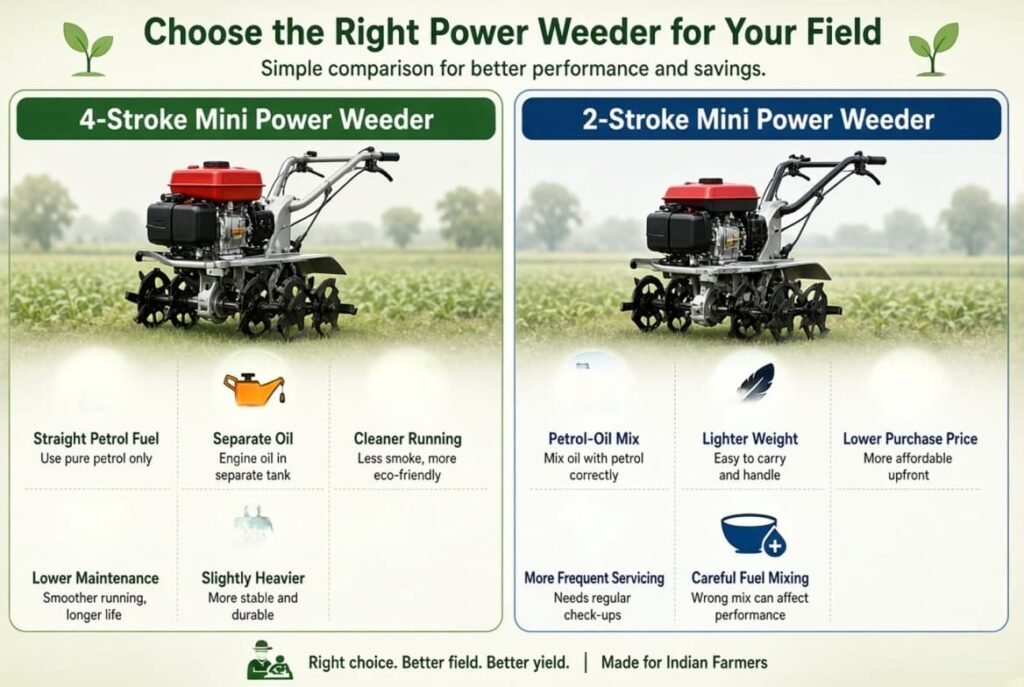
Power weeders are useful for controlling weeds and preparing soil in various farming applications. They can be particularly helpful for farmers who want to reduce manual labour during cultivation and inter-cultivation activities.
When choosing a power weeder, factors such as engine performance, working width, operating comfort, fuel efficiency, and ease of maintenance should be considered.
2. Agricultural Sprayers
Sprayers are commonly used for applying pesticides, fertilizers, herbicides, and other agricultural inputs. A suitable sprayer can help farmers achieve more consistent application while reducing unnecessary wastage.
Farmers should consider tank capacity, spraying pressure, coverage, portability, operating mechanism, and availability of replacement components when selecting spraying equipment.
3. Agricultural Engines
Engines are an important component of several agricultural and irrigation applications. Reliable engines can provide the power required for different farm operations and equipment.
When comparing engines, farmers should evaluate factors such as power output, fuel consumption, durability, starting performance, maintenance requirements, and suitability for the intended application.
4. Reapers and Harvesting Equipment
Harvesting is a time-sensitive stage of farming. Delays can increase the risk of crop losses, particularly when weather conditions change unexpectedly. Reapers and other harvesting machinery can help farmers complete harvesting operations more efficiently and reduce dependence on manual labour.
The appropriate harvesting equipment depends on crop type, field conditions, farm size, and the required harvesting method.
How to Choose Agricultural Equipment Manufacturers in India
With many companies operating in the agricultural machinery market, choosing the right manufacturer requires more than simply comparing prices. Farmers and dealers should consider several important factors.
Product Quality and Durability
Agricultural machinery is often used in demanding field conditions. Equipment needs to withstand regular operation, dust, moisture, varying soil conditions, and seasonal workloads.
A manufacturer that focuses on reliable construction and consistent product quality can provide better long-term value to customers.
Performance and Ease of Operation
Agricultural equipment should be practical and easy to operate. Complicated machinery may increase the learning curve and affect productivity.
Before purchasing, farmers should understand the machine’s operating process, capacity, fuel requirements, and suitability for their particular agricultural application.
Maintenance and Spare Parts
Regular maintenance is essential for keeping agricultural machinery in working condition. Buyers should therefore check whether spare parts and service support are readily available.
Choosing an equipment manufacturer with an established supply and support network can make maintenance easier and reduce unnecessary downtime.
After-Sales Support
After-sales service is another important consideration when selecting agricultural machinery. Technical guidance, maintenance assistance, warranty support, and access to replacement components can make a significant difference throughout the machine’s working life.
Farmers should look for manufacturers and suppliers that provide clear product information and dependable customer support.
Why Local Manufacturing and Support Matter
India has diverse agricultural conditions, with differences in soil, crops, climate, farm sizes, and cultivation methods across regions. Agricultural machinery designed with Indian farming requirements in mind can provide practical advantages.
Local manufacturing and distribution networks can also make it easier for customers to access equipment, replacement parts, technical assistance, and service support. For farmers, these factors can be just as important as the machine’s initial purchase price.
This is why selecting established agricultural equipment manufacturers in India can be beneficial for farmers looking for dependable machinery backed by accessible support.
Royal Kissan: Agricultural Machinery for Indian Farming Needs
Royal Kissan is an Indian agricultural machinery company focused on providing practical equipment for farmers and agricultural businesses. The company offers products including power weeders, agricultural sprayers, engines, reapers, and other farm machinery.
With a focus on quality, performance, and customer support, Royal Kissan aims to provide agricultural equipment suitable for different farming requirements. Its Pan-India supply and support network helps customers access machinery and assistance across different regions.
For farmers and dealers evaluating agricultural machinery, working with a manufacturer that provides product variety along with ongoing support can make the purchasing process more convenient.
Benefits of Investing in the Right Farm Equipment
The right agricultural machinery can provide several potential benefits to farmers. It can reduce dependence on manual labour, improve operational efficiency, help complete farm activities within appropriate timeframes, and make physically demanding tasks easier.
Modern equipment can also help farmers manage repetitive operations more consistently. However, the benefits depend on selecting machinery that matches the farm’s requirements, crop type, operating conditions, and available resources.
Farmers should therefore evaluate their specific needs before investing in any agricultural machine rather than choosing equipment solely on price.
The Future of Agricultural Equipment in India
The agricultural machinery sector is expected to remain important as Indian farming continues to adopt greater levels of mechanisation. Farmers are increasingly looking for equipment that combines performance, convenience, durability, and economical operation.
Manufacturers are also focusing on developing machinery that can address the needs of different farm sizes and applications. Improved access to equipment, better service networks, and increasing awareness of mechanised farming can further support the adoption of agricultural machinery.
For manufacturers, maintaining product quality and providing dependable customer support will remain essential as competition within the agricultural equipment market grows.
Conclusion
Agricultural mechanisation is playing an increasingly important role in improving the efficiency of farming operations across India. From power weeders and sprayers to engines and reapers, modern farm equipment can help farmers manage various agricultural activities more effectively.
When comparing agricultural equipment manufacturers in India, buyers should consider product quality, performance, durability, maintenance, spare-parts availability, and after-sales support rather than focusing only on the initial price.
Companies such as Royal Kissan are contributing to this growing agricultural machinery ecosystem by offering a range of farming equipment with Pan-India supply and support. By choosing machinery that matches their specific requirements and working with dependable manufacturers, farmers can make more informed decisions and support more efficient farming practices.