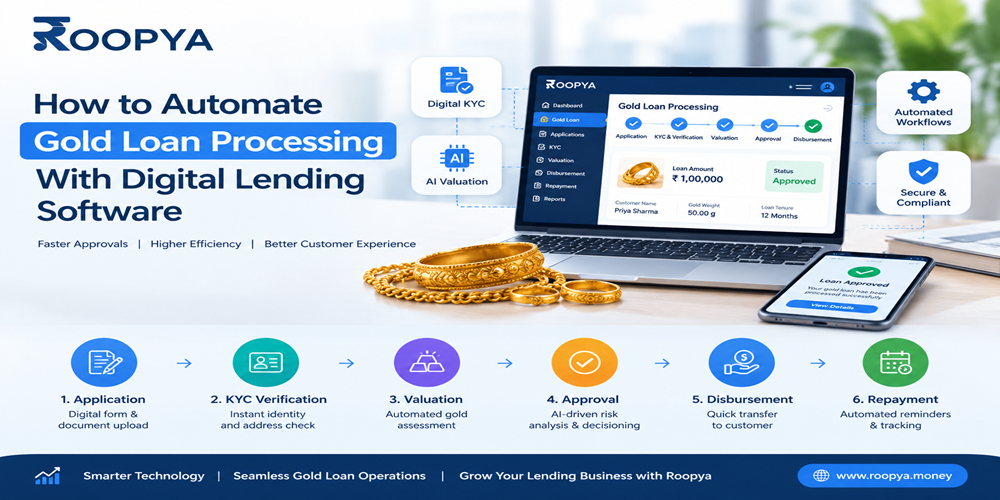
Learn how digital lending software automates gold loan appraisal, KYC, underwriting and disbursal for banks and NBFCs. See the full workflow.
Gold loans are one of the fastest-growing secured credit products in India, but for many banks and NBFCs the back-end process hasn’t kept pace with the demand. Branch staff still spend hours on manual appraisal paperwork, loan officers re-key the same borrower data into three different systems, and valuation sheets get passed around on paper or in spreadsheets. The result is slower disbursals, inconsistent collateral valuation, and a loan book that’s harder to audit when regulators come asking.
Digital lending software changes that equation. By automating origination, valuation, KYC, approval, disbursal, and renewal workflows on one platform, lenders can cut gold loan turnaround time from hours to minutes, standardize how every branch values collateral, and keep a clean audit trail for every loan in the book.
This guide walks through exactly how gold loan automation works, what a modern digital lending platform needs to include, and how to plan an implementation that fits your existing core banking and branch operations — whether you’re a scheduled bank, a cooperative bank, or an NBFC gold loan specialist.
Why Manual Gold Loan Processing Is Becoming a Liability
Gold loans look simple on the surface: a customer brings in jewellery, a branch official appraises it, and a loan is sanctioned against a percentage of its value. In practice, manual processing creates several problems that compound as loan volumes grow.
Inconsistent valuation across branches. When appraisal depends on an individual employee’s judgment, purity estimates, and a weighing scale with no system-level checks, two branches can value the same piece of jewellery differently. That inconsistency becomes a real compliance exposure once regulators start asking lenders to standardize how collateral is valued.
Slow, paper-heavy originations. A typical manual gold loan file involves a physical application form, a hand-written appraisal slip, photocopies of KYC documents, and a loan agreement that’s manually filled in. Each handoff between the appraiser, the branch manager, and the back office adds delay and room for transcription errors.
Weak audit trails. When appraisal notes, photographs of the pledged jewellery, and approval sign-offs live in different physical files or disconnected spreadsheets, reconstructing what happened on a specific loan — for an internal audit, a customer dispute, or a regulatory inspection — can take days.
Limited visibility into the live loan book. Without a central system, management can’t see real-time exposure by branch, by gold price movement, or by loan-to-value (LTV) band. That makes it harder to react quickly when gold prices fall and LTV ratios on outstanding loans drift upward.
Operational cost per loan stays high. Manual re-keying, physical document storage, and branch-level reconciliation all add cost to a loan product that is, by design, meant to be fast and low-friction for the borrower.
None of this is a reason to avoid offering gold loans — demand for the product remains strong. It’s a reason to automate the parts of the process that don’t need a human judgment call on every single step.
What “Digital Lending Software” Means for Gold Loans
Digital lending software — sometimes called a loan management system (LMS) or loan origination system (LOS) — is a platform that runs the full lifecycle of a loan: origination, underwriting, disbursal, servicing, collections, and closure. For gold loans specifically, this needs a few capabilities that a generic personal-loan or mortgage platform usually doesn’t have out of the box.
A gold-loan-ready digital lending platform typically includes:
- A digital appraisal module that captures gross weight, net weight, purity (caratage), and deductions for stones or other non-gold material, and calculates eligible loan value against a configurable LTV slab.
- Configurable gold rate feeds that update the reference gold price used for valuation, so every branch is pricing collateral off the same number on the same day.
- Photo and video capture of the pledged jewellery at the time of pledge, tagged to the loan file, for dispute resolution and audit purposes.
- Digital KYC and e-KYC integrations (Aadhaar-based e-KYC, PAN verification, video KYC) to verify borrower identity without manual document handling.
- Rule-based credit decisioning that applies LTV caps, per-borrower exposure limits, and (for larger loans) income or repayment-capacity checks automatically.
- E-signature and digital loan agreements so sanction letters, pledge forms, and loan agreements are generated and signed electronically.
- Vault and locker management that tracks which packet of pledged jewellery is stored where, cross-referenced to the loan ID.
- Automated interest accrual, renewal, and auction-notice workflows that calculate dues, send renewal reminders, and flag overdue accounts for the pre-auction notice process without manual tracking.
- Dashboards and MIS reporting for branch managers, risk teams, and regulators — exposure by branch, by LTV band, by gold price sensitivity, and by overdue bucket.
- Core banking and payment integrations so disbursal, repayment, and ledger entries flow automatically into the bank’s or NBFC’s core system instead of being manually posted.
A platform like roopya.money is built around this exact workflow: origination, appraisal, underwriting, disbursal, and collections for secured lending products including gold loans, on a single configurable system that banks and NBFCs can adapt to their own policies.
Step-by-Step: How Gold Loan Automation Works End to End
Here’s what an automated gold loan journey typically looks like once a digital lending platform is in place, from the customer walking in to the loan being booked.
1. Digital application and e-KYC
Instead of filling out a paper form, the customer’s details are captured directly into the system — either by a branch officer on a tablet or through a self-service kiosk/app. Aadhaar-based e-KYC or video KYC verifies identity in minutes instead of requiring photocopies that get manually checked later. The system also runs a quick de-duplication check against existing borrower records so the lender immediately knows if this customer already has an active loan or any flag on file.
2. Digital appraisal and valuation
The appraiser weighs the jewellery and records gross weight, deducts the weight of stones or other embedded material, and records purity — either via a certified testing method or a calibrated in-branch device, depending on the lender’s policy. This data is entered directly into the appraisal module rather than a paper slip. The system pulls the day’s reference gold rate automatically and calculates eligible loan value using the LTV slab configured in the credit policy, so there’s no manual multiplication and no room for a branch to apply an off-policy rate.
Photos (and in many implementations, a short video) of the jewellery are captured at this stage and attached permanently to the loan file — this becomes critical evidence if there’s ever a dispute about the condition or description of the pledged items.
3. Automated credit decisioning
For gold loans, underwriting is largely rules-based: LTV limit, per-customer exposure cap, and — for larger ticket sizes — a basic repayment-capacity or income check. The system applies these rules automatically and either approves the loan within policy limits or routes it for manual review when it falls outside auto-approval thresholds (for example, unusually high ticket size, a flagged customer, or jewellery that fails a purity threshold).
4. Digital sanction and loan agreement
Once approved, the system generates the sanction letter, the pledge form, and the loan agreement pre-filled with the borrower’s details, the appraised value, the loan amount, interest rate, and tenure. The customer reviews and e-signs these documents on the spot rather than a staff member manually typing out an agreement.
5. Disbursal
Approved loans are disbursed directly — to a bank account, UPI ID, or cash counter — with the transaction automatically posted to the core banking ledger through system integration. There’s no separate manual entry step that could introduce a mismatch between the loan system and the books.
6. Vault allocation and custody tracking
The physical jewellery packet is sealed, tagged with the loan ID, and logged into a vault or locker management module that records exactly where each pledge is stored. This matters operationally — it’s one of the most common sources of error and dispute in gold loan operations when done manually — and it matters for audits, since examiners frequently check that the physical gold on hand reconciles with the system’s loan book.
7. Servicing: interest accrual, reminders, and renewals
Interest accrues automatically based on the loan’s terms. The system sends automated reminders ahead of the due date, flags overdue accounts, and manages the renewal or part-payment workflow without a branch officer having to track each loan manually in a register.
8. Pre-auction and auction workflow (for defaults)
If a loan goes into default, the system can automatically generate the required pre-auction notices in line with the lender’s policy and regulatory timelines, track acknowledgment, and manage the auction process — keeping a complete, time-stamped record of every notice sent. This is one of the areas where automation reduces real legal and compliance risk, since missed or undocumented notices are a common source of disputes.
9. Closure and release
On full repayment, the system triggers the release workflow: it flags the loan as closed, generates a release memo, and updates the vault tracking so staff know to retrieve and hand back the correct jewellery packet, matched against the loan ID rather than relying on memory or a paper register.
Key Benefits of Automating Gold Loan Processing
Faster turnaround for customers. Gold loan customers typically want cash quickly — automation can take a process that used to take 45–60 minutes down to a fraction of that, which is a meaningful competitive advantage in a product category where speed is a primary reason customers choose one lender over another.
Standardized, defensible valuation. When every branch uses the same gold rate feed, the same purity-assessment process, and the same LTV calculation logic, lenders get consistent collateral valuation across the network — which is both an operational benefit and, increasingly, a regulatory expectation.
Stronger audit trail. Every appraisal, approval, disbursal, and notice is time-stamped and stored against the loan ID, including photos of the pledged jewellery. That makes internal audits, customer dispute resolution, and regulatory inspections considerably faster to handle.
Lower operational cost per loan. Removing manual re-keying, paper handling, and physical reconciliation reduces the staff time needed per loan, which matters at scale — particularly for lenders processing hundreds of gold loans per branch per month.
Real-time portfolio visibility. Management gets a live view of exposure by branch, by LTV band, and by gold price sensitivity, instead of waiting for a monthly MIS roll-up. That’s especially valuable when gold prices move quickly, since it lets risk teams see which loans are approaching unfavorable LTV territory and act before it becomes a write-off risk.
Better compliance posture. Automated, standardized valuation and documented notice workflows make it considerably easier to demonstrate compliance with evolving regulatory requirements around gold-backed lending.
Fewer disputes over pledged items. Photo and video evidence captured at the time of pledge, combined with systematic vault tracking, significantly reduces disputes about what was actually pledged and ensures the right items are returned to the right customer.
What to Look For in a Gold Loan Automation Platform
Not every loan management system is built with gold loans in mind. When evaluating a digital lending platform for this product, it’s worth checking for a few specific things.
- Configurable LTV and policy engine — your credit policy should be something you can configure and adjust in the system, not something hard-coded by the vendor.
- Multi-branch, multi-entity support — especially important for NBFCs and banks operating across states, where gold rates, local regulations, or policy variations may need to differ by branch or region.
- Offline or low-connectivity resilience — many gold loan branches are in semi-urban or rural locations with inconsistent internet; the system should handle temporary connectivity loss without losing appraisal data.
- Integration-readiness — look for documented APIs to connect with your core banking system, payment gateways, credit bureaus, e-KYC providers, and SMS/WhatsApp notification services.
- Strong document and media storage — appraisal photos and videos need to be stored securely, retrievable quickly, and retained for the periods your compliance policy requires.
- Role-based access control — appraisers, branch managers, risk teams, and auditors typically need different levels of access to loan data and documents.
- Reporting built for regulators, not just management — the ability to quickly generate branch-wise, LTV-band-wise, and overdue-bucket reports in the format examiners expect.
Staying Ahead of Regulatory Change
Gold loan regulation in India has been tightening. The Reserve Bank of India issued unified directions on lending against gold and silver collateral in June 2025, with compliance required by April 1, 2026, covering banks, cooperative banks, and NBFCs. Among other things, the directions require lenders to value collateral based on its actual purity, to standardize weighing and assay procedures across branches, to assess repayment capacity for larger aggregate loans, and to prohibit lending against primary gold, silver, or gold/silver-backed financial instruments such as ETFs.
This kind of regulatory shift is exactly where manual, branch-by-branch processes become a liability — if your appraisal method, documentation, and LTV calculation vary from branch to branch, demonstrating uniform compliance across the network becomes genuinely difficult. A digital lending platform that enforces a single, configurable valuation and documentation standard across every branch makes it far easier to adapt when rules change, because the policy update happens once, centrally, rather than through a retraining exercise at every branch.
Lenders evaluating or upgrading their gold loan technology should treat regulatory alignment as a core requirement of the platform, not an afterthought — ask any vendor directly how their system handles purity-based valuation, exposure assessment above regulatory thresholds, and standardized documentation across branches.
Planning Your Automation Rollout
Moving from manual or semi-digital gold loan processing to a fully automated workflow is a project, not a flip of a switch. A phased approach tends to work best.
- Map your current process end to end. Before automating anything, document exactly how a gold loan moves through your organization today — every handoff, every form, every approval step. This is also the point at which to identify which steps genuinely need human judgment (final sign-off on a high-value loan, say) versus which are purely mechanical (interest calculation, reminder scheduling).
- Define your configuration, not just your software. Decide your LTV slabs, exposure limits, auto-approval thresholds, and documentation requirements before implementation starts. A platform can only enforce policy consistently if the policy itself is clearly defined.
- Pilot in a small set of branches. Roll out to a handful of branches first, ideally a mix of urban and semi-urban locations, to surface connectivity issues, training gaps, and workflow friction before a full rollout.
- Integrate with core systems early. Core banking, payment, and credit bureau integrations are usually the longest lead-time items in a rollout — start these early rather than leaving them for the end of the project.
- Train appraisers and branch staff on the new workflow, not just the software. The biggest change for frontline staff isn’t learning a new screen — it’s trusting a system-calculated valuation over their own manual judgment. Plan for this change management explicitly.
- Monitor and iterate. Once live, track turnaround time, exception rates (loans needing manual review), and audit findings, and use that data to refine policy configuration over the following months.
Common Mistakes to Avoid When Automating Gold Loans
Lenders that struggle with gold loan automation projects tend to run into a handful of recurring problems. Knowing these in advance makes the rollout smoother.
Automating a broken process instead of fixing it first. If your current appraisal or approval workflow has inconsistencies or unclear ownership, digitizing it as-is just makes the inconsistency faster and harder to unwind later. Clean up the policy and process first, then automate it.
Treating it as a pure IT project. The people who actually run gold loan branches — appraisers, branch managers, collections staff — need to be involved in defining requirements, not just trained after the system is built. Their day-to-day workflow knowledge is what prevents a platform from looking good on paper but failing in practice.
Underestimating connectivity and hardware needs. Gold loan branches are often in locations where internet connectivity is inconsistent. A platform that assumes constant high-speed connectivity will create friction exactly where gold loans are most in demand. Test offline resilience and device requirements (tablets, weighing scales, cameras) before committing to a vendor.
Skipping data migration planning. Existing loan records, appraisal history, and customer data need a clear migration path into the new system. Rushing this step risks losing audit history on older loans or creating duplicate borrower records.
Not building in a manual-override path. Even a well-designed automated workflow needs a clear, documented path for a branch manager to escalate or override a system decision within policy limits — for edge cases the rules engine wasn’t designed to handle. A platform with no override path just pushes exceptions outside the system entirely, which defeats the purpose of having an audit trail.
Measuring ROI After You Automate
Once a gold loan automation platform is live, it’s worth tracking a small set of metrics consistently so you can quantify the return on the investment and keep improving the process.
- Average turnaround time, from application to disbursal, tracked by branch, to spot outliers that may need additional training or hardware support.
- Exception rate — the percentage of loans that get routed to manual review instead of auto-approval — which tells you how well your policy configuration matches real-world loan patterns.
- Cost per loan processed, comparing staff hours and paper/document costs before and after automation.
- Audit finding rate, comparing the number and severity of findings in internal or regulatory audits before and after the system went live.
- Customer satisfaction or Net Promoter Score specifically for the gold loan product, since turnaround time is often the single biggest driver of satisfaction in this category.
- Portfolio-level LTV drift, tracked in real time as gold prices move, so risk teams can see — and act on — rising exposure without waiting for a monthly report.
These metrics also give you a concrete basis for justifying further investment in automation, whether that’s extending the platform to additional branches, adding new integrations, or expanding into adjacent secured lending products like loans against property or vehicle loans on the same underlying system.
Final Thoughts
Gold loans remain one of the most reliable, fast-growing lending products for banks and NBFCs in India, but the manual processes many lenders still rely on are increasingly out of step with customer expectations and regulatory direction. Automating origination, appraisal, underwriting, disbursal, and servicing on a single digital lending platform doesn’t just speed up the process for customers — it gives lenders a standardized, auditable, and defensible way to manage one of their most collateral-sensitive products.
If you’re evaluating digital lending software for gold loans, prioritize platforms that let you configure your own credit policy, integrate cleanly with your core systems, and give you full visibility into appraisal, valuation, and portfolio data in real time. That combination is what turns gold loan automation from a back-office IT project into a genuine competitive advantage.
Frequently Asked Questions
- What is digital lending software for gold loans?
Digital lending software for gold loans is a platform — often called a loan management system (LMS) or loan origination system (LOS) — that automates the full gold loan lifecycle: application, digital appraisal and valuation, KYC verification, credit decisioning, disbursal, interest accrual, renewals, and closure, replacing manual paperwork and spreadsheets with a single auditable system.
- How does digital appraisal of gold jewellery work?
An appraiser records the gross weight, net weight (after deducting stones or other embedded material), and purity of the jewellery directly into the system. The software applies the lender’s configured LTV slab against the current gold rate to calculate the eligible loan amount automatically, removing manual calculation and ensuring every branch values collateral the same way.
- Can digital lending software integrate with our existing core banking system?
Yes — most modern digital lending platforms, including roopya.money, are built with API-based integrations for core banking, payment gateways, credit bureaus, and e-KYC providers, so disbursals, repayments, and ledger entries can flow automatically instead of being manually posted.
- Is gold loan automation suitable for NBFCs as well as banks?
Yes. Both banks and NBFCs process high volumes of gold loans and face the same operational challenges — valuation consistency, documentation, turnaround time, and regulatory compliance. Digital lending platforms are typically configurable enough to support the policy differences between a bank and an NBFC on the same underlying system.
- How does automation help with RBI compliance for gold loans?
RBI’s June 2025 directions on lending against gold and silver collateral require standardized, purity-based valuation, consistent documentation across branches, and repayment-capacity assessment for larger loans, with compliance required by April 1, 2026. A digital lending platform enforces these rules centrally and consistently across every branch, rather than depending on manual compliance at each location, and makes it far easier to demonstrate compliance during audits.
- How long does it take to implement a gold loan automation system?
Timelines vary by lender size and the number of integrations required, but a phased rollout — starting with a pilot across a small set of branches before a full network rollout — typically allows lenders to go live with core workflows within a few months, with core banking and bureau integrations often the longest lead-time component.
- What happens to physical gold tracking once the process is digital?
The physical jewellery is still stored securely in the branch vault, but digital lending software adds a vault and locker management layer that logs exactly which pledge packet is stored where, cross-referenced to the loan ID, along with photos or video captured at the time of pledge — reducing disputes and making vault reconciliation during audits much faster.
- Does automating gold loans reduce the role of branch appraisers?
No — appraisers remain essential for physically assessing the jewellery. Automation removes the manual, repetitive parts of the process (calculations, paperwork, tracking, reminders) so appraisers and branch staff can focus on accurate assessment and customer service rather than administrative work.