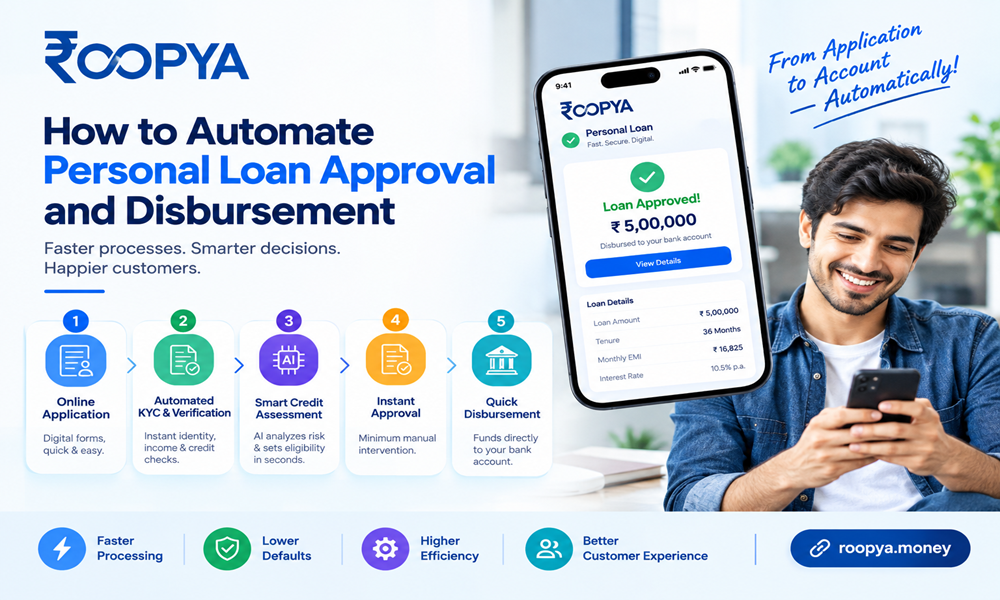
Learn how to automate personal loan approval and disbursement: KYC, credit decisioning, e-mandate and payouts. A step-by-step guide for lenders.
Every minute a personal loan applicant waits is a minute spent comparing your offer with someone else’s. Borrowers who apply on a phone expect to enter a few details, receive a clear decision and see money in their bank account the same day, sometimes within minutes. Lenders that still rely on manual document checks, email-based approvals and batch payouts lose applicants at every hand-off.
Automating personal loan approval and disbursement fixes this, but it is not a single feature. It is a chain of connected steps: data capture, identity verification, fraud screening, income assessment, credit decisioning, offer generation, agreement signing, mandate registration and payout. Each step has to produce a clean output that the next step can use without human rework, and each has to leave an audit trail.
This guide walks through that chain one step at a time. It covers what to automate, what to keep under human control, which controls regulators expect, which metrics prove the system works, and how a no-code lending platform such as Roopya helps NBFCs, banks, microfinance institutions and fintech lenders put it into practice.
Key takeaways
- Automation works best when the whole journey is connected, from application to payout, rather than when individual steps are digitized in isolation.
- A business rule engine that risk teams can configure without code is the center of automated decisioning.
- Straight-through processing should cover clear approvals and rejections, while borderline cases go to people with the full context attached.
- Compliance, auditability and disbursement controls must be designed in from the start, not added after launch.
Why Automate Personal Loan Approval and Disbursement?
Manual processing looks manageable at 200 applications a month and unmanageable at 20,000. The same problems show up in most lending businesses as volumes grow:
- Long turnaround time. Documents wait in queues, files move between teams and decisions take hours or days.
- Applicant drop-off. Personal loan applicants usually have several options. A slow response often means a lost customer.
- Inconsistent decisions. Two underwriters can treat similar profiles differently, which weakens portfolio quality and makes audits harder.
- Higher cost per loan. Manual review, rekeying and reconciliation add cost that small ticket sizes cannot absorb.
- Error and fraud exposure. Tired reviewers miss tampered documents, mismatched names and duplicate applications.
- Limited scalability. Growth requires hiring in proportion, which compresses margins.
Automation addresses all six. It also changes the role of credit teams. Instead of checking documents line by line, they design policy, review exceptions and study portfolio performance, which is the work that actually improves results.
The Automated Personal Loan Journey at a Glance
A fully automated journey has ten connected stages. The sections that follow explain each one.
- Digital application and data capture
- Automated KYC and identity verification
- Fraud and eligibility screening
- Income and cash-flow assessment
- Credit bureau pull and scoring
- Rule-based decisioning
- Pricing and offer generation
- e-Sign and e-mandate registration
- Automated disbursement
- Handoff to servicing and collections
Step 1: Digital Application and Data Capture
Automation starts with the quality of the data you collect. A clean application captures identity, contact, employment, income, loan amount and tenure, plus the consents needed to fetch bureau and bank data. Fields should be validated as the applicant types: PAN format, mobile number verification by OTP, pincode serviceability and date of birth against minimum age.
Good design reduces both effort and errors. Pre-fill what you can from verified sources, ask only for information the decision actually needs, and show progress clearly. Every extra field lowers completion rates, so each one should earn its place by changing a rule, a score or a regulatory record.
The application should also work through more than one channel. Your own app and website, partner apps, sales agents and API-based embedded journeys should all feed the same workflow, so policy and reporting stay consistent no matter where the borrower begins.
Step 2: Automated KYC and Identity Verification
KYC is the first step where manual work is easy to remove. Digital verification methods let you confirm identity in seconds instead of days:
- Aadhaar-based e-KYC or offline XML for identity and address, subject to consent and the rules that apply to your entity.
- PAN verification to confirm the number is valid and the name matches.
- Video KYC where regulations or your risk policy require a live interaction.
- Face match and liveness checks to compare a selfie with the ID photo and reduce impersonation.
- Mobile and email verification to confirm the applicant controls the contact details provided.
The output should be a structured result with a pass, fail or refer status for each check, not just a document image. That structure is what allows the rule engine to act on KYC results without a person reading them.
Step 3: Fraud and Eligibility Screening
Screening should happen early, before you spend money on bureau pulls or analyst time. Eligibility checks apply your hard policy limits: age range, income floor, geography, employment type and existing exposure with your company.
Fraud checks look for patterns that suggest risk:
- Duplicate applications using the same PAN, mobile number, device or bank account under different names.
- Mismatches between name, date of birth and address across documents and data sources.
- Device, IP address and location signals that look inconsistent or associated with previous fraud.
- Tampered or synthetic documents detected by image and metadata analysis.
- Matches against internal blacklists, negative lists and sanctions or watchlist screening where applicable.
Applicants that fail a hard rule can be declined immediately with a reason code. Those with soft flags can continue but carry a risk marker into the decision stage.
Step 4: Income and Cash-Flow Assessment
Income verification used to mean salary slips and manually reviewed bank statements. Automation offers faster and more reliable alternatives:
- Account Aggregator data. With explicit consent, the borrower shares bank data directly through India’s Account Aggregator framework. The data arrives in a structured form, so there is nothing to upload or read manually.
- Bank statement analysis. For statements uploaded as PDFs, OCR and parsing tools extract transactions, categorize inflows and outflows, and calculate average balance, salary credits, EMI obligations and bounce counts.
- Document analysis. AI-based extraction reads salary slips, Form 16 and employer letters, cross-checks the figures and flags anomalies.
- Employment and income APIs. Where available, direct employer or payroll verification confirms employment status and salary.
The goal is to turn raw data into a few decision-ready variables such as verified monthly income, fixed obligations to income ratio, average monthly balance and cash-flow stability. Those variables then feed the scorecard and the rule engine.
Step 5: Credit Bureau Pull and Scoring
With consent captured, the platform pulls the credit report from one or more bureaus and parses it into usable variables: score, number of active loans, delinquency history, utilization, recent enquiries and total obligations. Parsing matters because a report that a human has to read is a report that blocks automation.
Many lenders combine the bureau score with their own application scorecard, which blends bureau, income, demographic and behavioral variables into a probability of default estimate tuned for their own portfolio. For thin-file or new-to-credit applicants, alternative data such as cash-flow patterns can help assess risk where a bureau score is missing or weak.
Scoring models should be monitored and revalidated regularly. A model that was accurate last year can drift as the borrower mix, interest rates or economic conditions change.
Step 6: Rule-Based Decisioning
This is the heart of automation. A business rule engine (BRE) combines verification results, fraud flags, income variables and scores with your credit policy to produce one of four outcomes:
| Outcome | Typical trigger | Action |
| Auto-approve | All verifications clear, score above cut-off, obligations within limits | Generate the offer immediately |
| Auto-reject | Hard policy failure, serious delinquency or confirmed fraud flag | Send a decline with a reason code and log the decision |
| Refer to review | Borderline score, data mismatch or unclear document | Route to an underwriter with a case summary |
| Request more information | Missing or low-quality data | Ask the applicant for the specific item needed |
The rule engine should be configurable by business users, not only by developers. Credit policy changes frequently: cut-offs tighten after a spike in early delinquency, and limits expand for a proven customer segment. If every change needs a software release, decisioning will lag the business. A no-code BRE with testing and version history lets risk teams adjust policy quickly and safely.
Also decide how many decisions you want fully automated. Many lenders begin by automating clear rejects, then clear approvals for low-risk segments, and widen the band as confidence builds.
Step 7: Pricing and Offer Generation
Once an application is approved, the system determines how much to lend and at what price. Offer logic usually considers the risk band, income and obligations, product limits, tenure options and any campaign or partner terms. Risk-based pricing assigns different rates and processing fees to different bands, so safer borrowers get better terms and riskier ones pay for the extra risk.
The offer screen must be transparent. Show the loan amount, tenure, interest rate, annual percentage rate, processing fees, EMI and total repayable amount in plain language. In India, digital lenders are expected to provide a Key Fact Statement before the agreement, so the platform should generate it automatically from the same data that drives the contract.
Step 8: e-Sign and e-Mandate Registration
After the borrower accepts the offer, the loan agreement is generated from templates populated with verified data and presented for e-signature. Digital signing removes printing, couriering and manual scanning, and it timestamps consent for the audit trail.
Repayment setup is just as important as signing. Registering an e-mandate through e-NACH or UPI AutoPay before disbursement increases the chance that EMIs are collected on time. Lenders can make mandate registration a condition of disbursement, or allow a short grace window depending on risk and product design. Whatever you choose, encode it as a rule so it applies consistently.
Step 9: Automated Disbursement
Disbursement should be triggered automatically when all pre-conditions are satisfied. A well-designed disbursement workflow includes several controls:
- Bank account verification. A penny-drop or equivalent check confirms the account exists and that the name matches the borrower before any money moves.
- Pre-disbursement checks. The system confirms that the agreement is signed, the mandate is registered, limits are available and no duplicate payout exists.
- Direct payout to the borrower. Regulatory guidance in India expects disbursal to go directly into the borrower’s bank account, without pass-through accounts of third parties. Confirm the current rules that apply to your entity.
- Payment rails. Connect to payout channels such as IMPS, NEFT, RTGS or UPI through your bank or payment gateway, with automatic retry and fallback logic.
- Status tracking and reconciliation. Capture UTR numbers, match payouts to bank statements and flag failures or pending transactions.
- Approval limits for high-value payouts. Apply maker-checker approval or additional verification above set thresholds.
Failures should never disappear silently. If a payout fails because of an invalid account or a bank outage, the system should alert operations, notify the borrower and retry or reroute according to policy.
Step 10: Handoff to Servicing and Collections
Approval and disbursement are not the end of automation. The moment funds are released, the loan should be created in the loan management system with its repayment schedule, interest accrual rules, fees and mandate details. The borrower should receive a welcome message with the schedule, a link to a self-service portal and clear instructions for repayment.
From there, automated reminders, collections workflows and an early warning system take over. Because all stages share data, a missed first EMI can be linked back to the origination variables that predicted it, and your credit team can use that insight to refine the rules at Step 6.
Designing for Different Borrower Segments
One workflow rarely fits every applicant. Salaried borrowers can often be verified through payroll data, employer checks and salary credits in their bank statements, which makes high straight-through rates achievable. Self-employed borrowers and small business owners usually need richer evidence, such as GST returns, income tax filings and cash-flow analysis over a longer period.
New-to-credit applicants present a third pattern. Without a bureau history, lenders may rely more on bank data, lower starting limits and graduated increases after on-time repayments. A configurable rule engine lets you maintain separate paths and cut-offs for each segment within the same journey, rather than forcing every borrower through identical logic.
Communicating Clearly Throughout the Journey
Automation can feel opaque to borrowers if it is not communicated well. Tell applicants what is happening and what they need to do next at every stage. Useful touchpoints include:
- Confirmation of the application and a clear expectation of how long the decision will take.
- Prompts that explain exactly which document or consent is missing, instead of a generic error.
- Approval or decline messages with plain-language reasons and, for declines, guidance on when the applicant can reapply.
- Alerts on agreement signing, mandate registration and disbursement, including the amount, date and reference number.
- A welcome message with the repayment schedule, due dates and payment options.
Use channels that borrowers actually read, such as SMS, WhatsApp, email and in-app notifications, and keep records of what was sent. Good communication reduces abandoned applications, cuts support calls and improves repayment behavior later.
Real-Time vs. Batch Disbursement
Lenders also need to decide how to release funds. Real-time disbursement sends money as soon as the pre-conditions are met, which suits instant personal loans and gives borrowers the strongest experience. Batch disbursement groups payouts into scheduled runs, which can suit larger-ticket loans, products that need extra checks, or institutions with banking cut-offs and approval workflows.
Many lenders combine the two. Low-value loans from low-risk segments go out in real time, while higher-value or flagged cases wait for an additional approval. Either way, the platform should show clear status for every payout, from initiated to successful, pending or failed, so operations teams never need to chase information across bank portals.
Keeping People in the Loop
Automation does not mean removing human judgment. It means reserving human attention for cases where it adds value. Design manual review deliberately:
- Show reviewers a concise case summary, with verification results, score drivers, flags and the rule that triggered the referral, instead of raw files.
- Set service levels for referred cases so they do not become a new bottleneck.
- Record every override with a reason, and review override patterns monthly. Frequent overrides in one direction usually signal that a rule needs adjusting.
- Use maker-checker controls for policy changes, high-value approvals and exceptions.
This human-in-the-loop design also supports responsible AI use. Models recommend, rules and people decide within limits, and every decision can be explained.
Compliance and Controls to Build In
Lending is regulated, and automation must produce evidence as well as speed. Plan for these controls from day one:
- Consent management. Capture and store explicit, purpose-specific consent for KYC, bureau pulls and data sharing, with timestamps.
- Audit trails. Log every data fetch, rule version, decision and override so any outcome can be reconstructed later.
- Present the Key Fact Statement, fees, grievance redressal contact and other required information before the borrower commits.
- Data security and privacy. Use role-based access, encryption and data retention policies consistent with applicable law.
- Digital lending rules. Follow the Reserve Bank of India’s digital lending directions on disbursal, fee disclosure, cooling-off or look-up periods and the handling of loan service providers.
- Fair and explainable decisions. Keep reason codes for declines and be able to explain how automated models are used.
Regulations change, so ask legal and compliance teams to review your workflow configuration before launch and whenever rules are updated. A platform that is maintained for regulatory changes reduces, but does not remove, your own responsibility.
Common Pitfalls to Avoid
- Automating a broken process. If your manual policy is unclear or inconsistent, automation will only make errors faster. Document and simplify policy first.
- Too many hard-coded rules. Rules buried in code are expensive to change. Keep policy in a configurable rule engine.
- Ignoring edge cases. Name mismatches, joint accounts, failed payouts and applicants who abandon midway all need defined paths.
- Treating integrations as one-time work. Bureaus, KYC providers and payment partners change their APIs and uptime. Monitor them and keep fallbacks ready.
- Launching without measurement. If you cannot see approval rate, turnaround time and early delinquency by channel and score band, you cannot tell whether automation is helping.
- Skipping a pilot. Go live with a limited cohort first, compare results with your manual baseline and then expand.
Metrics That Show Automation Is Working
Track a focused set of indicators and review them on a regular schedule:
- Straight-through processing rate. The share of applications that complete without manual touch.
- Application-to-disbursal turnaround time. Measure the median and the 90th percentile, split by auto and manual cases.
- Funnel conversion. Drop-off at each step, from application start to disbursement.
- Cost per loan. Origination, verification, disbursement and servicing costs divided by loans booked.
- Approval rate and score distribution. Check that automation is not drifting toward riskier or more conservative decisions than intended.
- First-payment default and early delinquency. The clearest indicator of underwriting quality, tracked by channel, product and risk band.
- Disbursement success rate. The share of payouts that complete on the first attempt.
- Override rate. How often people reverse automated outcomes, and in which direction.
Build vs. Buy: How Lenders Typically Implement Automation
Lenders usually choose one of three routes. Each fits a different stage of growth and technical capacity.
| Approach | Strengths | Trade-offs |
| Build in-house | Full control over design and roadmap | High cost, long timelines, ongoing maintenance and regulatory rework |
| Assemble point solutions | Best-of-breed tools for each step | Integration effort, fragmented data and several vendors to manage |
| Unified no-code platform | Faster launch, one data model, configurable rules and pre-built integrations | Depends on the vendor roadmap and fit with your products |
For most personal loan lenders, a unified platform with open APIs offers the best balance. It covers the standard journey out of the box and still lets you add proprietary models or custom customer experiences on top.
How Roopya Helps Automate Personal Loan Approval and Disbursement
Roopya provides autonomous lending systems delivered on a no-code, unified lending infrastructure that spans origination, loan management, collections and early warning. Its personal loan software and automated customer loan journey are designed to take an applicant from first click to funded loan with minimal manual work. Relevant capabilities include:
- No-code business rule engine. Risk and product teams configure eligibility, approval and routing rules through a visual interface.
- 300+ pre-integrated APIs. Credit bureaus, verification services, payment gateways and other providers are connected, so you switch services on rather than build them.
- Digital application and decisioning. Digital forms, automated credit scoring, document verification and real-time decisioning are part of the loan origination platform.
- AI-powered document analysis and fraud modules. Documents are extracted and verified automatically, and pre-built fraud checks screen applications.
- 20+ pre-configured loan products. Ready-to-use products and customer journeys shorten the path to launch.
- Connected servicing. Disbursed loans flow into the loan management system, with payment processing, schedules, a customer portal, collections and early warning on the same data.
- Fast go-live and flexible pricing. Roopya advertises a one-day setup, with pay-as-per-use pricing and zero upfront cost.
Because the platform is open and API-based, it can connect to your CRM, ERP and banking partners. Lending analytics and credit risk analytics then help you tune scorecards and policy after launch. See the pricing page for plan details.
A Practical Implementation Roadmap
- Map the current process. Document each step, owner, turnaround time and drop-off point, and note where decisions depend on judgment rather than policy.
- Write the policy as rules. Convert eligibility, scoring cut-offs, pricing bands and referral conditions into explicit logic.
- Choose data and service providers. Select KYC, bureau, bank data, e-sign, e-mandate and payout partners, with fallbacks for critical ones.
- Configure the journey. Set up the application, rules, offers, agreement templates and disbursement workflow on your platform.
- Test thoroughly. Run test cases for approvals, rejections, referrals, failed payouts and edge cases, and involve compliance in the review.
- Pilot with a controlled cohort. Limit volume, compare outcomes with your manual baseline and fix issues quickly.
- Scale and optimize. Widen the automated band, add channels and products, and use early delinquency data to refine rules.
Start with one product and one channel, prove the economics, and then expand. Automation rewards iteration, and a platform that lets you change rules and journeys without a development cycle makes each iteration cheaper and less risky.
Conclusion
Automating personal loan approval and disbursement is about connecting verified data, clear policy and reliable payment rails into one flow that is fast for borrowers and controlled for lenders. The institutions that do it well decide the clear cases in seconds, give people the right context for difficult ones, and learn from every loan they book.
If you are planning to modernize your personal loan journey, request a demo to see how Roopya can be configured for your products, policies and partners.
3. Frequently Asked Questions
Place this block at the bottom of the landing page. The answers match the FAQPage schema in section 4 word for word.
Frequently Asked Questions
What does it mean to automate personal loan approval and disbursement?
It means using software to run the steps between application and payout, including data capture, KYC, fraud checks, income assessment, credit decisioning, offer generation, e-signing, mandate registration and fund transfer, with little or no manual intervention for standard cases.
How long does automated personal loan approval take?
Clear cases can be decided in seconds to a few minutes once verification and bureau data are returned. Cases that need manual review take longer, so your actual turnaround depends on your policy, data partners and the share of applications that go straight through.
Can a lender fully automate personal loan decisions?
Many lenders automate clear approvals and rejections and send borderline cases to underwriters. The right level depends on your risk appetite, the maturity of your scorecards and applicable regulations. Most start with a limited automated segment and expand as results prove stable.
What technologies are needed to automate loan approval and disbursement?
You need a loan origination system, a business rule engine, integrations for KYC, credit bureaus, bank data and payment gateways, e-sign and e-mandate tools, and a loan management system. Document analysis, fraud detection and scoring models add speed and accuracy.
How does automated disbursement work?
After approval, the borrower signs the agreement and registers a repayment mandate. The system verifies the bank account, runs pre-disbursement checks and sends funds through a payout channel such as IMPS, NEFT or UPI, then records the transaction reference and reconciles it with bank statements.
Is automated lending compliant with RBI rules?
It can be, if the workflow is configured to meet current requirements, such as consent capture, disclosures, direct disbursal to the borrower’s bank account and audit trails. Regulations change, so lenders should review their configuration with legal and compliance teams.
How does a no-code platform help?
A no-code platform lets business, risk and operations users configure products, rules and workflows through a visual interface, so changes do not wait for development releases. This shortens launch time and makes policy adjustments faster and easier to audit.
How quickly can I go live with Roopya?
Roopya advertises go-live in as little as one day on its plug-and-play infrastructure. Actual timelines depend on your products, integrations and internal approvals.
What are the risks of automating loan approvals?
The main risks are poorly designed policy, model drift, weak fraud controls and gaps in compliance. They can be reduced through testing, a limited pilot, regular model validation, override monitoring and clear audit trails.
Which metrics should I track after automation?
Track straight-through processing rate, turnaround time, funnel conversion, cost per loan, approval rate, first-payment default, disbursement success rate and override rate, segmented by channel and risk band.