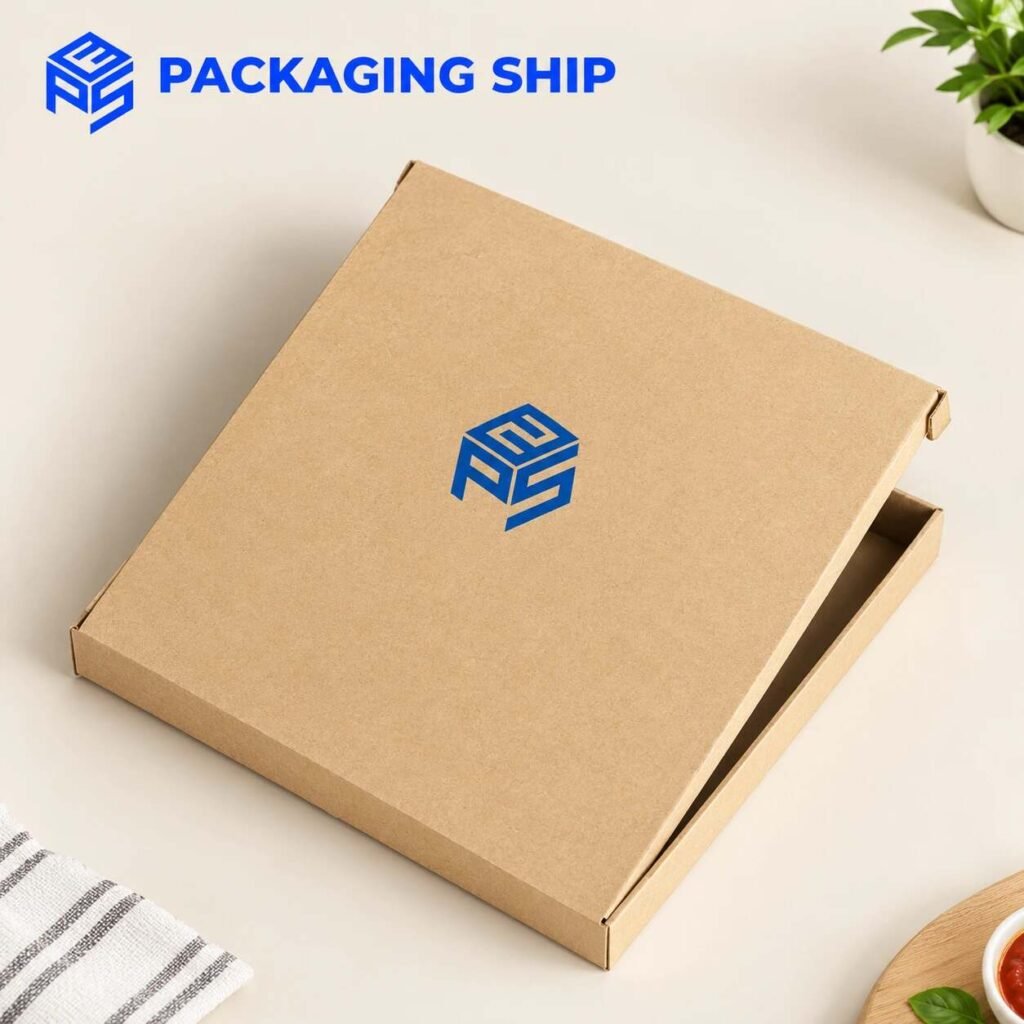
Showcase your brand with custom kraft packaging boxes featuring the Packaging Ship logo.
A custom food box with your logo keeps the meal protected and puts your brand in the customer’s hands at the moment they eat. The right box handles grease and steam, fits the portion, and uses materials suitable for food contact. This guide covers box styles, sizing, food safety, labeling, and pricing for restaurants, caterers, snack makers, and meal prep brands. If you want printed food packaging, Packaging Ship makes custom boxes and ships across the US.
Why Does Branded Food Packaging Matter?
Food packaging is the part of your business customers carry home, photograph, and set on their table. A plain box does the job, but a branded one makes the meal feel like it came from a real brand, and it gets your name in front of people who didn’t order.
Branded food boxes help in practical ways:
- Customers recognize your delivery bag or box before they open it
- A clean box signals care, which supports your pricing
- Printed boxes cut down on separate stickers and labels
- Photos on social media spread your logo for free
- Consistent packaging makes a small shop look established
For delivery-heavy businesses, the box also travels through third-party apps, so it often becomes the only branded item the customer touches.
Is Custom Packaging Only for Large Brands?
No. Many suppliers now offer wholesale-style pricing without very high minimums, so a single-location restaurant or a home-based food business can print a logo. Starting with one box size and a one-color logo keeps the first order affordable.
Which Food Box Style Fits Your Menu?
Match the box to the food, since a burger, a salad, and a pastry each need different structure. A good fit keeps food from sliding, steaming itself soggy, or leaking into the bag.
| Box Style | Best For | Notes |
|---|---|---|
| Takeout box (folding, with a tuck or lock closure) | Rice dishes, noodles, entrees | Easy to fold, familiar to customers |
| Clamshell box | Burgers, sandwiches, wraps, fried food | Hinged lid, easy to open |
| Pizza box (corrugated) | Pizza, flatbreads | Strong, flat, vents steam |
| Window box | Pastries, cookies, candy | Shows the product, adds a small cost |
| Tray with sleeve | Meal prep, bento, multi-compartment meals | Neat presentation, stackable |
| Sandwich or wrap box | Handheld lunches | Narrow, keeps fillings in place |
| Gift or catering box | Boxed lunches, party platters | Sturdy, often larger |
| Pouch (mylar bag) | Snacks, granola, coffee, dry mixes | Barrier protection, lightweight |
Ask your supplier which styles they can build in your sizes, since availability varies by factory.
Which Style Works Best for Delivery?
Boxes with a secure closure and a firm base work best, since delivery involves bumps, stacking, and heat. A closure that locks, or a lid that can be sealed with a sticker, helps prevent spills. For hot, saucy food, ask about leak-resistant options.
What Is the Best Material for Food Boxes?
Food-grade paperboard and corrugated board are the most common choices. Kraft gives a natural look, white board shows color well, and corrugated adds strength for heavier or larger meals.
| Material | Look and Feel | Best For | Typical Cost |
|---|---|---|---|
| White paperboard | Clean, bright, colors look vivid | Full-color logos, modern brands | Lower to moderate |
| Kraft paperboard | Natural, rustic, earthy | Artisan and farm-to-table brands | Lower |
| Corrugated board | Strong, rigid, holds heat | Pizza, large entrees, catering | Moderate |
| Rigid board | Thick, premium | Gift boxes, premium assortments | Higher |
| Mylar (metallized film) | Light, barrier protection | Dry snacks, coffee, supplements | Lower to moderate |
Greasy and saucy foods can soak through plain board. Ask your supplier about grease-resistant options or a food-safe liner, and test a sample with your hottest, oiliest dish before a large order.
What Does Grease-Resistant Mean?
It means the board or coating slows oil from passing through, so the outside stays clean and the box keeps its shape. It doesn’t make a box leakproof for soups or very liquid sauces. For those, use a sealed container inside the box.
What Food Safety Rules Apply?
Any packaging that touches food should be made from materials suitable for food contact. The FDA sets requirements for food-contact materials, so ask your supplier to confirm that the board, coating, liner, and any window film meet them.
A few practical habits:
- Get written confirmation of food-safe materials before you order
- Use parchment, liners, or inserts when food touches printed surfaces
- Let hot food vent briefly before closing the lid, since trapped steam softens board
- Check your state or local health department rules for packaging and labeling
- Store boxes in a clean, dry place, away from cleaning supplies
Rules differ by state and by how you sell, so check with your local health department if you’re unsure.
What Size Box Do You Need?
Size the box to the portion with a little room for the lid and steam. Measure the food in its container or on its liner, in inches, then add about half an inch on each side and enough height for the lid not to touch the food.
| Food | Typical Portion | Suggested Box Size |
|---|---|---|
| Burger or sandwich | About 4 to 5 inches wide | About 6 by 6 by 3 inches |
| Single entree (rice, noodles) | About 16 to 24 ounces | About 6 by 5 by 3 inches |
| Large salad or bowl | About 24 to 32 ounces | About 8 by 8 by 3 inches |
| 12 inch pizza | 12 inches across | About 12.5 by 12.5 by 1.75 inches |
| Meal prep tray (three compartments) | About 8 by 6 inches | About 9 by 7 by 2 inches |
| Boxed lunch | Sandwich, side, snack, dessert | About 9 by 7 by 4 inches |
These are rough guides. Portions vary by menu, so measure your own and ask for a sample before ordering a full run.
How Should You Place Your Logo?
Put the logo on the top of the lid, where customers see it first, and keep the design simple. A clean one-color logo on kraft often looks better than a busy full-color design, and it costs less.
Common placements:
- Top of the lid: the main branding spot
- Front or side panel: helpful when boxes are stacked in a bag
- Inside the lid: a short message or pattern as a surprise
- Sleeve or sticker: a flexible way to add branding to a plain box
Most printers want a vector logo file, such as AI, EPS, or a PDF with outlined text. If you don’t have one, ask whether the supplier offers design help.
Can You Add Menu Information to the Box?
Yes, and it’s useful. You can print your website, a QR code to your menu, reheating instructions, or a short thank-you. For retail food products, a label panel with required information is also common.
What Labeling Does Packaged Food Need?
If you sell packaged food to the public, the label has rules. The FDA requires information such as the product name, net quantity, ingredient list, allergen declarations, and the name and address of the manufacturer or distributor, and many products also need a Nutrition Facts panel. Some small businesses qualify for exemptions, and rules differ for restaurant food versus packaged retail food.
Because requirements depend on what you sell and where, check current FDA guidance, your state rules, or a food-labeling professional before you print. It’s much cheaper to get the label right before production than to reprint a whole order.
Should You List Allergens on the Box?
Yes, if you sell to the public. The major allergens include milk, eggs, fish, shellfish, tree nuts, peanuts, wheat, soy, and sesame. Clear allergen information protects customers and protects your business.
How Do You Keep Food Fresh and Secure in Transit?
Pack hot food hot, cold food cold, and keep the two apart. A box can’t fix a long delay, but a good one slows heat loss and holds the food in place.
A simple routine:
- Vent hot food for a minute before closing the box.
- Add a liner or paper to absorb grease.
- Keep sauces and dressings in small sealed cups.
- Close the box securely, and use a tamper-evident sticker for delivery.
- Keep boxes level and upright in the bag.
For shipped food, such as cookies or dry snacks, use sturdy items, add padding, and ship early in the week. USPS, UPS, and FedEx are busy in November and December, so allow extra time and add tracking.
What Should You Look for in a Food Packaging Supplier?
Look for a supplier who confirms food-safe materials, shows you a proof, and gives clear pricing at your order size. A box that fails with your actual menu item is hard to fix after production, so test a sample.
Questions worth asking:
- What’s the minimum order quantity, and how does price change at higher volumes?
- Are the board, coating, liner, and window film food-safe?
- Can they size the box to your portions?
- Will you see a proof or sample before production?
- Is shipping included in the quote?
- How long does production take during the holidays?
- Is design help available if you don’t have finished artwork?
Packaging Ship is a US-based custom packaging company in Valley Stream, New York. It produces food packaging, mailer boxes, rigid boxes, tuck boxes, cosmetic boxes, and mylar bags to order, with free design support, free shipping, and wholesale pricing without needlessly high minimums. If you run a restaurant, bakery, or snack brand, send your portion sizes and logo to the team and ask which box style fits your menu.
How Much Do Custom Food Boxes With a Logo Cost?
Custom food boxes usually cost between $0.20 and $3.00 each, depending on size, material, printing, and quantity. Small one-color boxes ordered in volume sit at the low end, and larger boxes with full-color printing or windows sit higher.
| Cost Factor | Effect on Price |
|---|---|
| Order quantity | More boxes means a lower price per box |
| Box size | Larger boxes use more material |
| Material | Kraft and white paperboard cost less than rigid board |
| Number of print colors | One color costs less than full color |
| Grease-resistant coating | May add cost, depending on the option |
| Window panel or insert | Small added cost per box |
| Shipping | Free shipping lowers your total |
Ask for the full delivered price, since setup fees and freight can change what you actually pay. A sample run lets you test a new design before a large order.
When Should You Order Before the Holidays?
Order by early November for holiday menus, catering, and gift boxes. Thanksgiving falls on November 26 and Christmas on Friday, December 25 this year, and custom production and shipping usually take two to four weeks, sometimes longer when many food businesses order at once. With today being October 26, you have time to confirm sizes, test a sample, check a proof, and have boxes ready before the busiest weeks.
Frequently Asked Questions
Where can I order custom food boxes with my logo?
US-based suppliers such as Packaging Ship make custom food packaging with free design support and free shipping. Ask for a sample or proof before you place a large order.
How much do custom food boxes cost?
Most cost between $0.20 and $3.00 each. Larger orders, smaller boxes, kraft board, and one-color printing lower the price.
What is the minimum order quantity for custom food boxes?
It varies by supplier, and many start somewhere between 100 and 250 boxes for food packaging. Confirm the number before you finalize your design.
How long does it take to get custom food boxes?
Production and shipping usually take two to four weeks, and the holiday season can add time. Rush options are sometimes available for an extra fee.
Are custom food boxes food-safe?
They can be, if the board, coating, and any liner or window film are suitable for food contact under FDA requirements. Ask your supplier to confirm in writing.
What size food box should I order?
Measure your portion in inches and add about half an inch on each side, plus lid clearance. A single entree often fits a box around 6 by 5 by 3 inches, but test with a sample.
Do I need allergen or nutrition labels on my food boxes?
If you sell packaged food, FDA labeling rules can apply, including allergen declarations and, for many products, a Nutrition Facts panel. Check current FDA guidance or consult a food-labeling professional before you print.