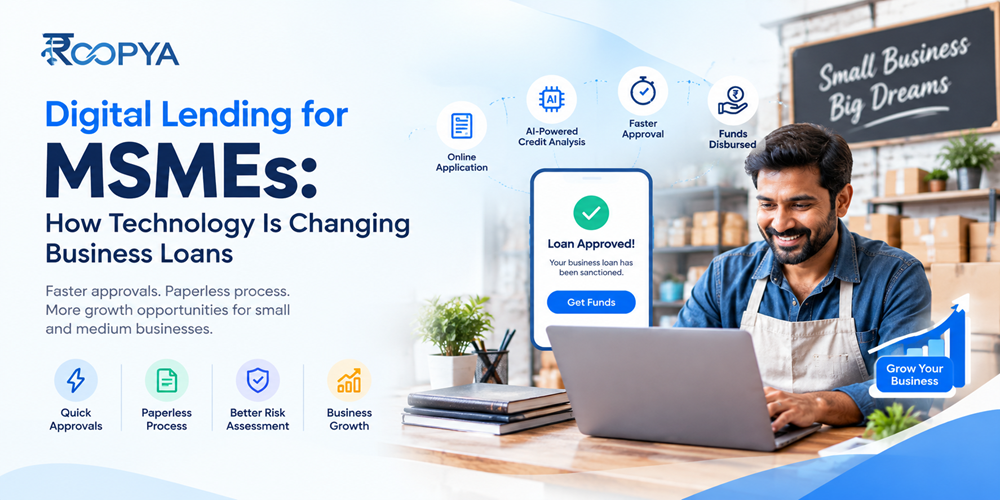
Learn how digital lending is transforming MSME business loans in India: faster approvals, data-driven credit, compliance and what lenders should do next.
Micro, small and medium enterprises are the backbone of India’s economy. They employ hundreds of millions of people, supply large corporate value chains, and contribute a significant share of national output and exports. Yet for decades, the simple act of getting a business loan has been one of the hardest parts of running one. Paperwork piles up, branch visits eat into working hours, and approvals can take weeks, by which time the opportunity the loan was meant to fund has often passed.
Digital lending is changing that equation. By combining verified data, automation and open APIs, banks and NBFCs can now assess, approve and disburse MSME loans in a fraction of the time and cost that traditional processes demand. This guide explains what digital lending for MSMEs actually means, the technologies driving it, the benefits for borrowers and lenders, the risks and regulatory expectations to plan for, and a practical roadmap for building a modern MSME lending operation.
Why MSME Lending Has Been So Hard for So Long
Before technology can fix a problem, it helps to understand why the problem exists. MSME lending has struggled for structural reasons rather than a lack of demand.
- Thin or missing credit history. Many small businesses are new to credit, run largely on cash, or are owned by first-time entrepreneurs. Traditional bureau scores say very little about them.
- Informal records. Financial statements may be incomplete, unaudited or maintained by hand, which makes conventional underwriting slow and subjective.
- High cost to serve. Underwriting a small loan by hand can cost almost as much as underwriting a very large one. For lenders, small tickets often looked unprofitable.
- Collateral dependence. Many MSMEs cannot offer property or fixed assets, so secured-only lending excluded them.
- Slow turnaround. Physical documentation, field verification and multi-layer approvals stretch timelines, while MSMEs typically need working capital within days, not months.
The result is a persistent credit gap. Widely cited industry estimates put unmet MSME credit demand in India in the range of tens of lakh crores of rupees, although figures vary by source and year. Whatever the exact number, the direction is clear: a large share of viable, income-generating businesses remains underserved by formal credit.
What Is Digital Lending for MSMEs?
Digital lending for MSMEs is the use of technology to run the entire loan lifecycle, including application, KYC, underwriting, approval, disbursal, servicing and collections, largely online and with minimal manual intervention. Instead of relying only on collateral and historic balance sheets, digital lenders use near real-time data from GST returns, bank statements, payment platforms, accounting software and other sources to understand how a business is performing today.
Three characteristics separate true digital lending from simply placing a paper form on a website:
- Data-first underwriting. Decisions are driven by verified, consented data pulled directly from source systems.
- Straight-through processing. Clean applications move from submission to decision, and often to disbursal, without manual handoffs.
- Continuous monitoring. Risk is tracked throughout the life of the loan, not only at origination.
Digital lending is delivered through several models: direct lending by banks and NBFCs on their own platforms, partnerships with fintechs acting as lending service providers, marketplace models that match borrowers with multiple lenders, and embedded lending inside accounting, commerce or supply-chain platforms.
The Technologies Changing Business Loans
1. Open APIs and Consent-Based Data Sharing
The biggest shift is access to verified data. India’s public digital infrastructure, including Aadhaar-based eKYC, the GST network, UPI and the Account Aggregator framework, lets lenders fetch financial information directly from the source with the borrower’s consent. A lender can review bank statements or GST filings in minutes instead of waiting for photocopies. Because the data comes straight from the source, it is harder to manipulate and cheaper to verify.
2. AI and Machine Learning in Credit Scoring
Bureau scores are only one input. Machine-learning models can analyse cash-flow patterns, GST filing consistency, banking behaviour, transaction velocity and seasonality to estimate risk for businesses with limited formal history. Properly built and validated, these models help lenders approve good borrowers that a rule-of-thumb scorecard would reject, and decline risky ones faster.
Lenders must still govern these models carefully. Validation, explainability, drift monitoring and bias checks are essential, particularly in regulated environments. A well-structured application scorecard combined with broader credit risk analytics gives credit teams both predictive power and accountability.
3. Document AI and Digital KYC
Optical character recognition and natural language processing extract data from bank statements, invoices, tax returns and identity documents, cross-check it against source data and flag anomalies. Video KYC, eSign and eNACH replace physical meetings, stamp-paper errands and cheque collection. What used to take days of back-and-forth can now be completed in a single online session.
4. Business Rule Engines and Automated Decisioning
A business rule engine (BRE) encodes credit policy, including eligibility criteria, exposure limits, pricing tiers and referral triggers, into rules that run the moment an application is submitted. Clean cases can be approved straight through, borderline ones routed to credit officers with the reasoning attached, and clear declines closed instantly.
No-code rule engines let credit and product teams change policy themselves without waiting for a development cycle. That matters when portfolios, market conditions and regulations keep evolving.
5. Cloud-Native Loan Origination and Management Systems
Behind every smooth borrower experience sits a system that keeps the process consistent and auditable. A modern loan origination platform handles applications, workflows, verification and decisioning, while a loan management system manages disbursal, repayment schedules, interest and charges, accounting and reporting. Cloud-native, API-first platforms allow lenders to launch new products in days and scale to thousands of applications without rebuilding infrastructure.
6. Embedded Finance and Supply-Chain Lending
MSMEs increasingly borrow where they already transact. Embedded finance places credit inside accounting tools, B2B marketplaces, point-of-sale systems and supplier platforms, so a working-capital offer appears at the moment of need. Invoice financing through platforms such as TReDS lets small suppliers convert receivables from large buyers into cash quickly, often at pricing linked to the buyer’s credit strength rather than the seller’s.
7. Digital Collections and Early Warning Systems
Technology now extends well past disbursal. Automated reminders, payment links, UPI AutoPay mandates and workflow-based collections reduce delinquency, while an early warning system monitors signals such as falling bank inflows, delayed GST filings or bounced payments to flag stress before an account turns non-performing. Catching trouble early is often the difference between a restructured loan and a written-off one.
How Digital Lending Benefits MSMEs
For business owners, the advantages are practical and immediate:
- Decisions in minutes or hours and funds in days rather than weeks, which helps businesses act on orders, seasonal demand or urgent repairs.
- Less paperwork. Consent-based data sharing and digital documents remove repeated submissions and branch visits.
- Wider access. Cash-flow and transaction-based assessment reduces dependence on collateral, opening credit to businesses that were previously turned away.
- Right-sized products. Smaller tickets, flexible tenures, revolving credit lines and invoice-backed limits fit how MSMEs actually earn and spend.
- Clear digital journeys show fees, repayment schedules and application status, supported by standardised disclosures such as the Key Fact Statement.
- A path to formal credit. Timely repayment on small digital loans builds a bureau record, which unlocks better terms over time.
How Digital Lending Benefits Banks and NBFCs
Lenders gain just as much. Automation lowers the cost per loan, which makes small-ticket MSME lending commercially viable. Data-driven underwriting improves risk selection, so portfolios grow without a proportional rise in defaults. Standardised workflows create consistency and a complete audit trail, easing supervisory reviews. And because every step is captured digitally, management gets real-time visibility into approvals, turnaround times, delinquency and profitability by product, channel and segment.
Scalability is the other major advantage. A lender that once needed a branch and a credit officer in every district can serve businesses across the country through a digital channel, while reserving human judgement for complex or high-value cases.
Traditional vs Digital MSME Lending at a Glance
| Aspect | Traditional Lending | Digital Lending |
| Application | Branch visit, paper forms | Online or in-app, mobile-first |
| Documentation | Physical copies, manual checks | eKYC, eSign, API-fetched data |
| Underwriting basis | Collateral, balance sheets, bureau score | Cash flow, GST, banking data, alternative data plus bureau |
| Turnaround | Days to weeks | Minutes to a few days |
| Cost to serve | High per loan | Low per loan at scale |
| Monitoring | Periodic reviews | Continuous signals and early warnings |
| Scalability | Limited by branches and staff | Scales through digital channels |
Risks, Compliance and Responsible Lending
Speed without discipline creates risk. Lenders operating digitally should plan for the following:
- Regulatory compliance. The Reserve Bank of India’s digital lending directions set expectations on disclosures such as the Key Fact Statement, flow of funds directly between the borrower and the regulated entity, grievance redressal, data storage and reporting of digital lending apps. Because the rules have been updated over time, lenders and their lending service providers should always check the current directions.
- Data privacy. India’s Digital Personal Data Protection Act, 2023 emphasises consent, purpose limitation and security safeguards. Data collected for underwriting should be used only for that purpose and protected accordingly.
- Synthetic identities, forged documents and circular transactions are real threats. Layered checks, including document forensics, device signals and cross-verification against source data, are essential.
- Model risk. Scoring models can drift as the economy changes. Regular validation, back-testing and stress testing keep them reliable.
- Over-indebtedness and pricing fairness. Faster credit should not mean careless credit. Affordability checks and transparent pricing protect both borrowers and the lender’s portfolio.
- Cybersecurity and vendor risk. Every API and third-party integration widens the attack surface. Strong access controls, encryption and vendor due diligence are non-negotiable.
Choosing a platform that is continuously updated for regulatory changes and maintains a complete audit trail significantly reduces the compliance burden.
A Practical Roadmap for Building a Digital MSME Lending Stack
Whether you are a bank, an NBFC or a fintech lender, the following sequence keeps projects focused and de-risked:
- Define the segment and product. Decide which MSMEs you will serve, such as traders, manufacturers or service businesses, and which products fit them: term loans, working-capital lines, invoice financing or small-ticket loans.
- Map your data sources. Identify the credit bureau, GST, bank statement, KYC and fraud data you need, and how each will be accessed with consent.
- Codify credit policy. Translate eligibility, exposure and pricing rules into a business rule engine, and decide which cases are auto-approved, referred or declined.
- Automate the customer journey. Design a mobile-friendly flow with digital KYC, eSign, e-mandates and clear disclosures, so a borrower can finish without visiting a branch.
- Integrate the core systems. Connect the origination platform, loan management system, payment gateway, accounting and collections tools through APIs.
- Pilot, measure and iterate. Launch with a controlled segment and track approval rates, turnaround time, early delinquency and cost per loan before scaling.
- Monitor and improve continuously. Use analytics and early warning signals to refine rules, models and collection strategies as the portfolio matures.
Build or Buy?
Building every component in-house is slow and expensive. Many lenders now adopt a configurable platform instead. Roopya, for example, offers a no-code lending infrastructure covering origination, loan management, collections, early warning and analytics, with pre-integrated APIs, ready loan products and pay-as-you-use pricing. Lenders focused on this segment can explore its business and SME loan software or its small-ticket loan software to see how quickly a product can go live.
Trends Shaping the Future of MSME Lending
- Cash-flow-based lending becomes the norm. As more business activity leaves a digital trail, lenders will rely less on collateral and more on real-time income and expense patterns.
- Wider use of the Account Aggregator ecosystem. Consent-based data sharing is expected to keep expanding across financial data types, making underwriting faster and richer.
- Open networks and interoperable credit. Initiatives aimed at connecting lenders, borrowers and data providers over common protocols may reduce integration effort and widen choice for MSMEs.
- Generative AI in operations. Underwriting assistants, document summarization and conversational support can shorten review times and improve borrower communication, as long as human oversight remains in place.
- Co-lending and partnerships. Banks with low-cost funds and NBFCs with distribution and technology strengths will keep pairing up to reach more MSMEs.
- Real-time portfolio risk monitoring. Always-on analytics will move risk management from periodic review to continuous action.
Digital lending is not just a faster way to process the same old loan. It reshapes how MSME credit is assessed, priced, delivered and monitored. For small businesses, it means quicker access to capital with less friction. For lenders, it means lower costs, sharper risk decisions and the ability to serve a segment that was once considered too small or too opaque.
The winners will be institutions that pair technology with responsibility: verified data, transparent pricing, strong governance and a platform flexible enough to adapt as rules and markets change. Start with a focused segment, automate what can be automated, keep humans where judgement matters, and measure everything. That approach turns the MSME credit gap from a chronic problem into a growth opportunity.
Frequently Asked Questions (FAQ)
What is digital lending for MSMEs?
Digital lending for MSMEs is the use of online platforms, data and automation to run business loans from application to repayment. Lenders verify identity and financials through digital sources such as GST data, bank statements and eKYC, then decide, disburse and service the loan with minimal manual work.
How does technology make MSME loans faster?
Technology removes manual steps. Consent-based data sharing replaces document collection, automated rule engines and scoring models replace multi-level manual reviews, and digital signatures and e-mandates replace physical paperwork. Many straightforward applications can be decided in minutes.
Can an MSME get a loan without collateral through digital lending?
Often yes. Digital lenders assess cash flow, GST filings, banking behaviour and repayment history instead of relying only on collateral. Eligibility, limits and pricing still depend on the lender’s credit policy and the business’s financial health.
What data do digital lenders use to assess MSMEs?
Common inputs include KYC details, credit bureau reports, bank statements, GST returns, income tax data, transaction and payment history, and in some cases accounting or e-commerce data. Access should always be consent-based and used only for the stated purpose.
Is digital lending safe and regulated in India?
Regulated banks and NBFCs offering digital loans must follow the Reserve Bank of India’s directions on disclosures, fund flow, data handling and grievance redressal. Borrowers should deal only with regulated lenders and read the Key Fact Statement before accepting any loan.
What are the main risks of digital lending?
Key risks include fraud, weak data privacy, model errors, over-lending and cybersecurity threats. Lenders manage them with layered fraud checks, model validation, affordability assessments, strong security controls and continuous monitoring.
What should a bank or NBFC look for in an MSME lending platform?
Look for a configurable origination and loan management system, a no-code rule engine, pre-integrated APIs for bureaus, KYC and payments, built-in fraud checks, collections and early warning modules, regulatory updates, and transparent pricing.
How can a lender start digital MSME lending quickly?
Begin with a defined segment and product, map your data sources, codify credit policy in a rule engine, and launch a pilot on a configurable platform. Measure approval rate, turnaround time and early delinquency before scaling.