Global Electric Vehicle Charging Stations Industry Overview
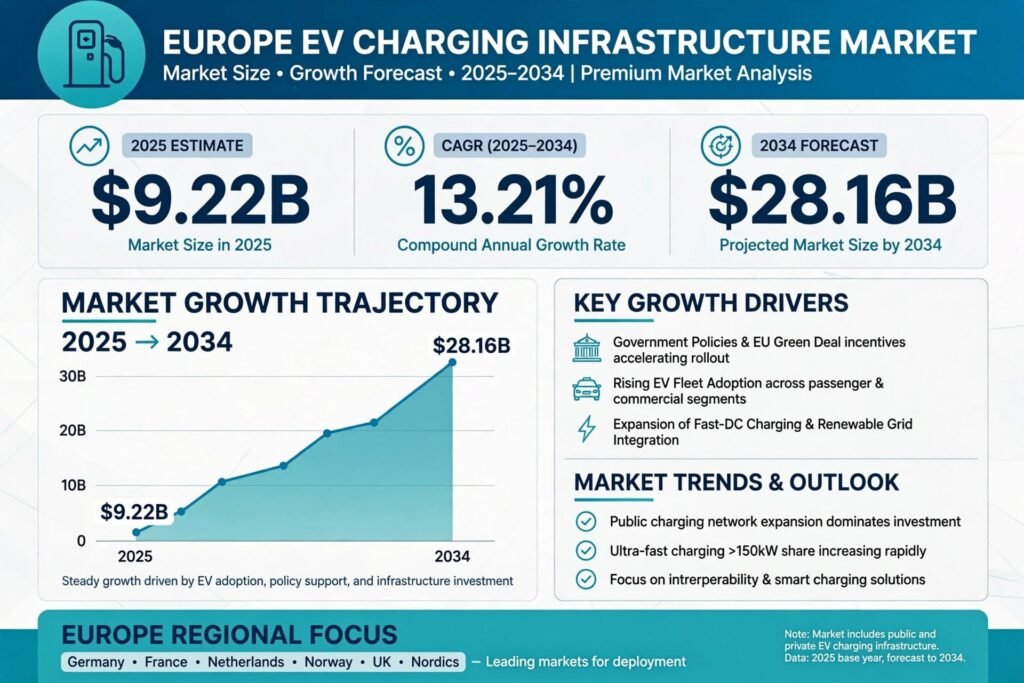
The global EV charging infrastructure market is experiencing unprecedented expansion, driven by the rapid global transition toward sustainable transportation. According to Renub Research, the market is projected to grow from US$ 9.22 Billion in 2025 to US$ 28.16 Billion by 2034, registering a compound annual growth rate (CAGR) of 13.21% during the 2026–2034 forecast period. This remarkable trajectory is propelled by soaring electric vehicle sales, supportive government incentive programs, expanding public and private charging networks, and continuous technological breakthroughs in fast-charging systems. Furthermore, increasing demand for low-emission mobility, smart charging solutions, vehicle-to-grid (V2G) integration, and renewable energy-powered charging stations are accelerating the deployment of robust infrastructure worldwide.
EV Charging Infrastructure Uses and Worldwide Popularity
Electric vehicle charging infrastructure forms the foundational network of equipment, electrical systems, software, and stations supplying power to plug-in vehicles. This comprehensive ecosystem spans residential units, workplace chargers, public hubs, and highway fast-charging corridors. Categorized primarily into Level 1 (AC slow charging), Level 2 (AC fast charging), and DC fast or ultra-fast charging, modern systems increasingly integrate smart energy management, digital payment gateways, and remote monitoring.
Worldwide, public charging points have surpassed 5 million units, supported by annual global EV sales exceeding 17 million units. Key regions including Asia-Pacific, Europe, and North America continue making heavy investments in destination charging, fleet electrification solutions, and ultra-fast charging corridors to alleviate range anxiety and support mainstream adoption.
Global Stock of Public EV Charging Points (2018–2024)
-
2018: Approximately 0.6 million public charging points globally, with China leading the market followed by Europe and the United States.
-
2019: Global stock climbed to approximately 0.9 million, bolstered by strong European expansion and continued Chinese dominance.
-
2020: Infrastructure reached roughly 1.3 million points as government incentive programs accelerated installations.
-
2021: Accelerated investments across Europe and China pushed total global points to approximately 1.8 million.
-
2022: Worldwide charging stations surpassed 2.8 million, heavily driven by newly installed Chinese and European urban networks.
-
2023: Total global infrastructure exceeded 4.1 million public charging points, with the United States expanding its fast-charging networks.
-
2024: Worldwide public charging points reached approximately 5.4 million, led by China (3.6 million), Europe (1.0 million), the United States (0.2 million), and the Rest of the World (0.6 million).
Primary Growth Drivers
-
Rapid Growth in Global EV Adoption: With global sales surpassing 17 million units annually, stringent government emission standards and fuel economy regulations are compelling consumers to shift from internal combustion engines to battery electric vehicles (BEVs) and plug-in hybrids (PHEVs).
-
Government Policies and Large-Scale Investments: Billions of dollars in public funding, tax credits, grants, and utility incentives are encouraging nationwide fast-charging corridors and EV-ready building regulations.
-
Expansion of Fast-Charging and Smart Technologies: Modern DC fast chargers and ultra-fast stations exceeding 350 kW can replenish vehicle batteries up to 80% in 20 to 30 minutes, while smart charging and V2G technologies optimize grid stability.
Key Industry Challenges
-
High Installation Costs and Grid Limitations: Installing high-capacity grid connections, transformers, civil construction, and DC fast-charging equipment requires massive capital investment, often straining aging electricity distribution networks.
-
Uneven Network Availability and Standardization: Discrepancies in charging connector standards, payment platforms, and regional density create accessibility gaps, fueling range anxiety in rural and emerging markets.
Global EV Charging Station Launches and Developments
Major industry leaders continue upgrading their networks to meet escalating demands. Tesla expanded its Supercharger V4 network across North America and Europe to support both Tesla and non-Tesla vehicles via NACS. IONITY opened multiple ultra-fast 350 kW hubs across Germany, France, Italy, and Spain. bp pulse and Shell Recharge launched high-power charging corridors in the UK, US, Europe, and Asia. Electrify America commissioned new 350 kW fast-chargers along major U.S. interstates, while ChargePoint, ABB E-mobility, EVgo, Blink Charging, and Alpitronic introduced advanced DC fast chargers, fleet management capabilities, and megawatt-class charging technology.
Download Free Sample Report: https://www.renub.com/request-sample-page.php?gturl=europe-electric-vehicle-charging-infrastructure-market-p.php
Market Segmentations Overview
-
Charger Type: Slow Charger, Fast Charger
-
Charging Type: AC Charging, DC Charging
-
Installation Type: Fixed, Portable
-
Connector Standards: CHAdeMO, CCS, Others
-
Level of Charging: Level 1, Level 2, Level 3
-
Connectivity: Non-connected, Connected Charging Stations
-
Deployment: Private, Public
-
Application: Commercial, Residential
-
Key Regional Markets: France, Germany, Italy, Spain, United Kingdom, Belgium, Netherlands, Russia, Poland, Greece, Norway, Romania, Portugal, Rest of Europe, North America, Asia-Pacific.
-
Leading Market Players: ABB Ltd., ChargePoint, Inc., Blink Charging Co., Eaton Corporation, Tesla Inc., Webasto Group, Schneider Electric, Inc., Siemens, and Delta Electronics, Inc.
Frequently Asked Questions
-
What is the projected market size of the global EV charging infrastructure market? The global EV charging infrastructure market is projected to reach US$ 28.16 Billion by 2034, growing at a CAGR of 13.21% from 2026.
-
What are the primary factors driving the growth of EV charging stations? Key growth drivers include rising global EV adoption exceeding 17 million units annually, supportive government policies and incentives, and advancements in fast-charging and smart energy technologies.
-
Which charging type dominates the daily EV infrastructure market? AC charging stations dominate daily infrastructure requirements, accounting for over 80% of charging sessions occurring at residential and workplace locations due to their affordability and ease of installation.
-
How many public EV charging points exist worldwide? Global public charging points have surpassed 5.4 million units, with China maintaining the largest regional share followed by Europe and the United States.
-
What role does V2G technology play in modern charging infrastructure? Vehicle-to-grid (V2G) technology allows electric vehicles to supply stored electricity back to the power grid during peak demand hours, thereby enhancing overall energy efficiency and grid stability.
-
What are the main challenges facing the EV charging industry? Significant challenges include high capital installation costs, grid infrastructure limitations, uneven regional network availability, and a lack of universal connector standardization.
-
Which countries are leading the expansion of charging networks? China leads globally in total charging points, while the United States, the United Kingdom, India, and various European nations are experiencing rapid infrastructure growth driven by aggressive electrification mandates.