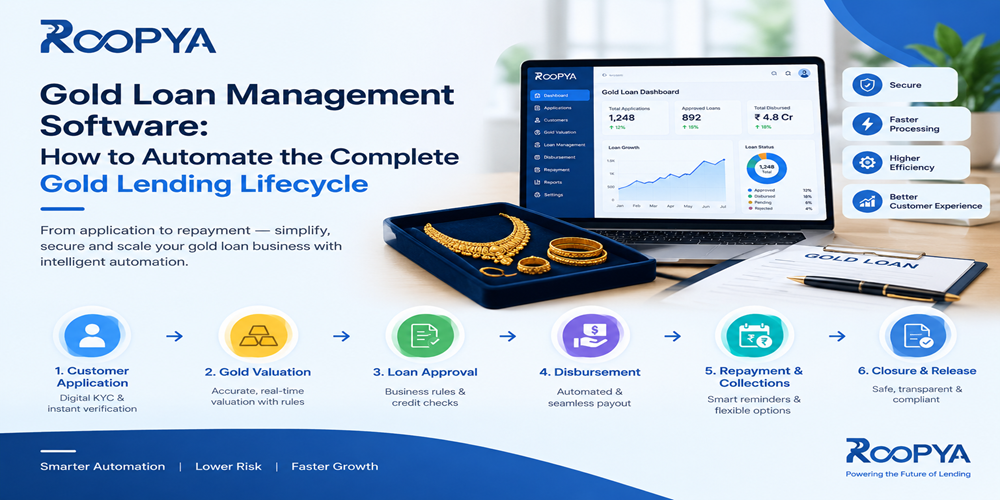
Automate the full gold lending lifecycle — appraisal, vault tracking, collections & auctions — with gold loan management software built for banks & NBFCs.
Gold loans remain one of the fastest-growing secured lending products in India, driven by quick disbursal, minimal documentation, and the cultural prevalence of household gold. For banks and NBFCs, however, the operational reality behind a “5-minute gold loan” advertisement is anything but simple. Appraising purity and weight accurately, storing pledged ornaments securely, tracking interest accruals across thousands of live accounts, managing renewals, and handling auctions for defaulted loans all demand tight coordination between branch staff, vault custodians, credit teams, and compliance officers.
When these processes run on registers, spreadsheets, or disconnected point solutions, lenders face valuation errors, delayed disbursals, interest leakage, compliance gaps, and poor visibility into portfolio risk. Gold loan management software solves this by digitizing and connecting every stage of the lending lifecycle — from the moment a customer walks in with ornaments to the moment the loan is closed or the collateral is auctioned. This guide walks through what gold loan management software actually does, why automation matters at each lifecycle stage, the features that separate a basic system from an enterprise-grade one, and how to evaluate a platform before you commit to it.
What Is Gold Loan Management Software?
Gold loan management software is a specialized module within a broader loan management system (LMS) that is purpose-built for the unique mechanics of gold-backed lending. Unlike a generic LMS that treats collateral as a line item, gold loan software is designed around the physical and procedural realities of the product: item-wise ornament appraisal, purity testing records, net weight versus gross weight calculations, per-gram rate tables that move with market prices, vault and packet tracking, and renewal or top-up workflows that are specific to gold loans.
A well-built platform connects the front-end customer journey (application, KYC, appraisal) with the back-end operational workload (vault management, interest accrual, collections, auction) and the top-level governance layer (regulatory reporting, risk dashboards, audit trails) in a single system of record. That connectivity is what allows a lender to scale gold loan volumes without proportionally scaling headcount or risk.
The Complete Gold Lending Lifecycle
Before looking at automation, it helps to map out the stages a gold loan actually passes through. Each stage has its own operational burden, and each is a candidate for automation.
1. Lead Capture and Customer Onboarding
The lifecycle begins when a prospective borrower is identified — whether through branch walk-ins, a digital lead form, DSA referrals, or cross-sell from an existing banking relationship. Onboarding involves identity verification, address proof, and increasingly, digital KYC through Aadhaar-based e-KYC or video KYC.
2. Gold Appraisal and Valuation
A certified appraiser examines each ornament for purity (typically via touchstone, karat meter, or XRF testing), weighs it net of stones and other non-gold materials, and calculates the eligible loan amount based on the prevailing per-gram rate and the lender’s loan-to-value (LTV) policy, which in India is capped by RBI guidelines (currently up to 75% LTV for most gold loans). This stage is the single biggest source of operational risk: under-valuation annoys customers and loses business, while over-valuation exposes the lender to loss on default.
3. Loan Structuring and Approval
Based on the appraised value, the system proposes eligible loan schemes — bullet repayment, EMI-based, overdraft-style gold loans, or monthly-interest schemes — each with its own interest rate, tenure, and processing fee structure. Approval may be automated for amounts within pre-set thresholds or routed for manual sign-off above certain limits.
4. Documentation and Disbursal
Loan agreements, pledge forms, and insurance documentation are generated and signed, often digitally. Once documentation is complete, funds are disbursed — via cash, NEFT/RTGS, or directly to a linked account — and the pledged ornaments are packeted, sealed, tagged, and moved into secure vault custody.
5. Vault and Packet Management
Every pledged packet needs a documented chain of custody: who sealed it, which vault it sits in, and when it was last physically verified. Dual-custodian controls, CCTV logs, and periodic physical stock reconciliation against system records are standard requirements for both operational safety and regulatory audits.
6. Interest Accrual and Collections
Interest accrues daily or monthly depending on the scheme, and the system must track partial payments, interest-only payments, and principal reductions accurately across potentially tens of thousands of live accounts simultaneously. Automated reminders — SMS, WhatsApp, IVR, or app notifications — are sent ahead of due dates to reduce delinquency.
7. Renewal, Top-Up, and Part-Release
Many borrowers renew loans at maturity rather than closing them, or request a top-up against the same collateral if gold prices have risen. Others make partial payments and request part-release of some ornaments while keeping the rest pledged. Each of these transactions needs to be reflected accurately in both the loan ledger and the vault inventory.
8. Delinquency Management and Auction
When a loan crosses the default threshold defined in the lender’s policy and regulatory guidelines, the account moves into a structured notice-and-recovery workflow. This typically involves multiple reminder notices, a legally mandated notice period, public auction announcements, and finally, a transparent auction process — all of which must be documented for compliance and potential legal scrutiny.
9. Loan Closure and Release
On full repayment, the system calculates the final settlement amount, generates a closure certificate, and triggers release of the pledged ornaments from the vault, with the customer’s identity and signature verified before release.
10. Reporting, Compliance, and Portfolio Analytics
Throughout the lifecycle, the lender needs real-time visibility into portfolio composition, LTV distribution, overdue accounts, vault utilization, branch-wise performance, and regulatory reports for the central bank and internal audit committees.
How Automation Transforms Each Stage
Faster, More Accurate Onboarding
Digital KYC integrations (Aadhaar e-KYC, PAN verification, video KYC) cut onboarding time from a paper-based process of 20–30 minutes to a few minutes, while reducing data-entry errors that cause downstream mismatches.
Consistent, Auditable Appraisal
Automation does not replace the human appraiser, but it standardizes the appraisal workflow: digital weighing scale integration, purity-testing device integration, auto-calculation of eligible loan amount against live gold rates, and photo capture of each ornament attached to the digital file. This creates an auditable record for every valuation decision and reduces disputes.
Policy-Driven Loan Structuring
Instead of staff manually checking LTV caps and scheme eligibility, the system applies lending policy rules automatically, ensuring every loan structured across every branch complies with the same LTV ceiling, interest rate card, and approval hierarchy — a critical control for lenders operating across hundreds of branches.
Straight-Through Disbursal
Where risk thresholds are met, loans can disburse without manual intervention, with system-generated agreements, e-signatures, and instant fund transfer, compressing the time between appraisal and disbursal to minutes.
Digital Vault Ledger
Barcode or QR-tagged packets linked to a digital vault ledger eliminate manual packet registers. Every movement — sealing, storage, retrieval, part-release — is logged with a timestamp and user ID, and periodic reconciliation between the physical count and system count can be scheduled and tracked automatically.
Automated Interest Computation and Collections
Interest accrual runs automatically against each account’s scheme rules, eliminating manual calculation errors. Automated reminder cadences and digital payment links (UPI, payment gateway integration) increase on-time collection rates and reduce the operational load on collections staff.
Rules-Based Renewal and Top-Up Processing
Renewal eligibility, top-up limits based on updated gold rates, and part-release calculations can be automatically validated against policy before being routed for approval, removing a common source of manual error.
Structured, Compliant Auction Workflows
Automated workflows ensure notice periods, reminder counts, and auction announcement timelines strictly follow the lender’s policy and regulatory requirements, with every step timestamped and documented — reducing legal and reputational risk if an auction is later challenged.
Real-Time Dashboards for Leadership and Regulators
Portfolio-level dashboards give risk and compliance teams live visibility into LTV distribution, overdue buckets, branch-wise gold holding, and vault reconciliation status, replacing the manual, delayed MIS reports that many lenders still depend on.
Key Features to Look for in Gold Loan Management Software
When evaluating a platform, lenders should look beyond generic LMS capabilities and assess gold-loan-specific functionality:
- Live gold rate integration that auto-updates per-gram valuation rates across all branches simultaneously, with an audit trail of rate changes.
- Configurable LTV and scheme engine that lets risk teams set and adjust LTV caps, interest rate cards, and tenure options by scheme, branch, or customer segment without code changes.
- Digital appraisal workflow with device integration for weighing scales and purity testers, plus mandatory photo capture per ornament.
- Vault and packet tracking module with barcode/QR tagging, dual-custodian approval for vault access, and scheduled reconciliation.
- Multi-channel collections supporting SMS, WhatsApp, IVR, and app-based reminders, with integrated digital repayment options.
- Renewal, top-up, and part-release workflows built as first-class transaction types, not manual workarounds.
- Auction management with configurable notice periods, templated legal notices, and a documented audit trail of every step.
- Branch and centralized vault reconciliation reporting, ideally with exception flagging for mismatches.
- Regulatory and MIS reporting aligned to RBI and internal audit requirements, generated on demand rather than compiled manually.
- Role-based access control and audit logs covering appraisal overrides, rate changes, approval escalations, and vault access.
- API-based integration with core banking systems, payment gateways, credit bureaus, and e-KYC providers, so the gold loan module does not operate in a silo.
- Mobile and tablet support for appraisers and relationship managers working at the counter or in the field.
Business Benefits of Automating the Gold Lending Lifecycle
Operational Efficiency
Automating appraisal, documentation, and disbursal can cut loan processing time from tens of minutes to a handful, letting branches handle significantly higher ticket volumes with the same staffing.
Risk and Compliance Control
Policy-driven LTV enforcement, auditable appraisal records, and documented auction workflows reduce exposure to regulatory penalties, customer disputes, and reputational damage from mishandled defaults.
Reduced Revenue Leakage
Accurate, automated interest computation and systematic renewal tracking prevent the silent revenue loss that occurs when interest is miscalculated or renewal opportunities are missed due to manual tracking gaps.
Better Customer Experience
Faster disbursal, transparent valuation with photo evidence, and proactive renewal reminders build trust — a meaningful differentiator in a product category where customers are pledging family gold and are highly sensitive to how it’s handled.
Scalability Across Branches
A centralized system with branch-level configurability allows a lender to expand into new geographies or increase gold loan volumes without re-building operational processes from scratch at each location.
Stronger Audit Readiness
Every appraisal, rate change, approval, vault movement, and auction step is timestamped and attributable to a user, which materially shortens the time and effort needed for internal and regulatory audits.
Choosing the Right Gold Loan Management Software
Not every loan management system is built for the specific demands of gold lending. When shortlisting a platform, banks and NBFCs should evaluate:
- Depth of gold-specific functionality — is appraisal, vault management, and auction handling a native part of the product, or bolted on as a generic collateral module?
- Configurability without custom development — can your risk and credit teams adjust LTV, schemes, and rates themselves, or does every change require a vendor ticket?
- Integration ecosystem — does it connect cleanly to core banking, payment gateways, e-KYC, and credit bureau systems you already use?
- Deployment model and data security — cloud, on-premise, or hybrid, and how does the vendor handle data residency and security certifications?
- Vendor experience with regulated lenders — has the platform been built and tested specifically for the compliance environment that Indian banks and NBFCs operate in?
roopya.money is built as a loan management system for banks and NBFCs with this kind of lifecycle automation in mind — covering origination, appraisal workflows, vault and collateral tracking, collections, and portfolio reporting within a single connected platform, rather than a patchwork of spreadsheets and standalone tools.
Common Pitfalls When Automating Gold Lending
Even well-intentioned automation projects run into predictable problems. Being aware of them upfront helps lenders avoid costly rework.
Treating gold loans as a generic collateral type. Some lenders try to force gold loans into a loan management system designed primarily for unsecured or property-backed lending. The result is usually a series of manual workarounds for appraisal, vault tracking, and auctions — the exact inefficiencies automation was meant to remove.
Under-investing in device integration. A system that requires appraisers to manually re-enter weight and purity readings from a separate device defeats the purpose of digitizing appraisal. The accuracy and audit-trail benefits only materialize when the weighing scale and purity tester feed data directly into the loan file.
Leaving vault reconciliation as a manual, periodic exercise. Many lenders digitize origination and collections but still reconcile vault stock against system records through manual physical counts on an ad-hoc basis. This gap is precisely where operational losses and fraud tend to surface, and it should be one of the first processes automated, not the last.
Rigid, hard-coded LTV and scheme rules. Gold prices move daily, and lending policy may need to adjust LTV caps or scheme terms in response to market conditions or regulatory updates. A system that requires a vendor engagement for every rate card change will slow a lender down exactly when speed matters most.
Ignoring mobile and field use cases. Appraisers and relationship managers often work at a counter with limited desk space, or in the field for doorstep gold loan products. Software that only works well on a full desktop interface creates friction at the exact point of customer interaction.
Implementation Roadmap for Lenders
Moving from manual or semi-digital processes to a fully automated gold lending lifecycle is best approached in stages rather than as a single big-bang rollout.
Stage 1 — Process mapping and policy codification. Before any software is configured, document the current appraisal, LTV, scheme, and auction policies precisely enough that they can be translated into system rules. This step surfaces inconsistencies between branches that are worth resolving before automation locks them in.
Stage 2 — Core origination and appraisal digitization. Start with the highest-friction, highest-risk stage: appraisal and disbursal. Digitizing this first delivers the fastest visible improvement in processing time and valuation consistency, building internal confidence in the broader rollout.
Stage 3 — Vault and collateral tracking. Extend automation to packet tagging and vault ledger management, including reconciliation workflows, so collateral integrity is tracked with the same rigor as the loan ledger.
Stage 4 — Collections, renewals, and top-ups. Automate interest computation, reminder cadences, and renewal/top-up validation to reduce delinquency and capture renewal revenue that manual tracking tends to miss.
Stage 5 — Delinquency, auction, and compliance reporting. Bring the most legally sensitive stage online last, once the team is comfortable with the platform, ensuring notice periods, auction timelines, and regulatory reports are fully automated and auditable.
Stage 6 — Integration and scale-out. Connect the gold loan module to core banking, payment gateways, and credit bureau systems, then roll out branch by branch or region by region, using early branches as reference implementations for the rest of the network.
A phased approach limits operational disruption at any single branch while giving the lender real performance data — processing time, delinquency rates, reconciliation accuracy — to validate the system before committing to a full-scale rollout.
The gold lending lifecycle involves far more operational complexity than its “quick and simple” customer-facing reputation suggests. From appraisal accuracy and vault custody to interest accrual, renewals, and compliant auctions, every stage carries risk if handled manually at scale. Gold loan management software replaces fragmented, manual processes with a connected, auditable, policy-driven system — reducing processing time, tightening compliance, cutting revenue leakage, and improving the experience for customers pledging some of their most valued possessions. For banks and NBFCs looking to grow gold loan volumes profitably and safely, investing in purpose-built automation is no longer optional — it’s the foundation the rest of the business is built on.
Frequently Asked Questions
- What is gold loan management software?
It is a specialized module within a loan management system that digitizes and automates the full gold lending lifecycle — from appraisal and disbursal to vault tracking, collections, renewals, and auctions — for banks and NBFCs.
- How does gold loan software improve appraisal accuracy?
It standardizes the appraisal process through device integration (weighing scales, purity testers), live gold rate feeds, and mandatory photo documentation of each ornament, creating an auditable record for every valuation decision.
- Can gold loan management software handle vault and packet tracking?
Yes. A proper platform includes a digital vault ledger with barcode or QR tagging, dual-custodian access controls, and scheduled reconciliation between physical stock and system records.
- Does the software support loan renewals and top-ups?
Yes, renewals, top-ups based on revised gold valuations, and part-release of pledged ornaments are handled as native transaction types, validated automatically against lending policy.
- How does automation help with gold loan auctions?
It enforces configurable notice periods, generates legally required notices, and timestamps every step of the auction process, creating a documented, compliant audit trail if an auction is ever challenged.
- Is gold loan software compliant with RBI guidelines?
A platform built for Indian lenders should support configurable LTV caps, documentation standards, and reporting formats aligned with RBI regulations for gold loans, though lenders should confirm specific compliance features with the vendor.
- Can gold loan management software integrate with core banking systems?
Yes, most enterprise-grade platforms offer API-based integration with core banking systems, payment gateways, credit bureaus, and e-KYC providers so the gold loan module isn’t operating in isolation.
- Who should use gold loan management software?
Banks, NBFCs, and other regulated gold lending institutions looking to scale loan volumes, reduce manual processing risk, and strengthen audit and compliance readiness should adopt gold loan management software.