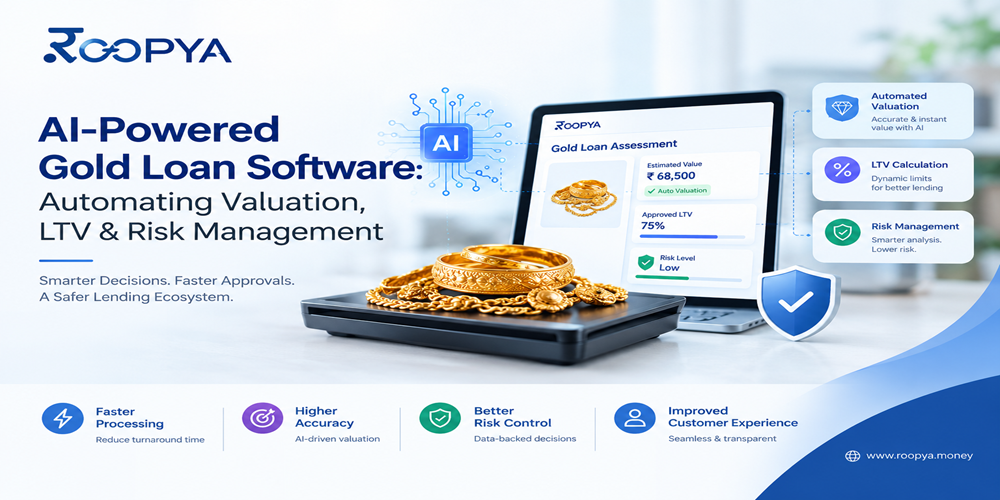
Automate gold valuation, LTV monitoring & risk management with AI-powered gold loan software from Roopya. Built for RBI-compliant lending by banks & NBFCs.
Gold loans have quietly become one of the fastest-growing credit products in India. Banks and NBFCs disbursed lakhs of crores of rupees against household gold last year alone, driven by rising gold prices, a large underbanked population, and a cultural comfort with pledging jewellery rather than taking on unsecured debt. For lenders, that growth is a double-edged sword. Every new gold loan branch adds more manual valuation work, more paperwork, more auditors checking vault registers, and more exposure to fraud, price volatility, and regulatory scrutiny.
For decades, the gold loan process barely changed: a customer walks in with jewellery, an in-house appraiser scratches and weighs it, a manager approves a loan-to-value (LTV) ratio based on a rough read of the day’s gold rate, and a clerk enters the details into a register or a legacy core banking module. It worked when branches were small and volumes were low. It does not work at the scale banks and NBFCs are operating at today, especially with the Reserve Bank of India’s new Lending Against Gold and Silver Collateral Directions, 2025 tightening how valuation, LTV monitoring, and disclosure must be done from April 1, 2026 onward.
This is the gap that AI-powered gold loan software is built to close. Rather than replacing appraisers and credit officers, it gives them a digital backbone: automated valuation support, continuous LTV tracking, fraud and risk scoring, and audit-ready compliance records, all running quietly behind every loan a branch originates. This article explains what AI-powered gold loan software actually does, why valuation and LTV management are the hardest parts of gold lending to get right, and how banks and NBFCs can use automation to lend faster while managing risk more tightly.
Why Gold Loans Are Harder to Manage Than They Look
Gold lending looks simple from the outside: pledge an asset, borrow against a percentage of its value, repay, get the asset back. In practice, every stage of that cycle carries operational risk that compounds across thousands of loans.
Valuation is subjective by default. Two appraisers looking at the same set of bangles can arrive at different purity estimates, different net weight calculations after deducting stones and dust, and therefore different loan amounts. When valuation varies branch to branch, a lender’s overall portfolio risk becomes difficult to model, and inconsistent appraisals are one of the most common sources of internal audit findings and customer disputes.
Gold prices move daily, but many core systems do not. A loan sanctioned at a particular LTV can drift outside that band within weeks purely because gold prices corrected. Under the RBI’s new directions, LTV must be maintained throughout the tenure of the loan, not just checked at disbursement. That means a lender needs a live view of every active loan’s current LTV against today’s gold price, not a report generated once a quarter.
Fraud takes many forms. Under-carating (representing 18-carat gold as 22-carat), gold-plated or hollow ornaments, and pledging the same jewellery at two branches of the same lender or across lenders are all recurring problems. Manual cross-checks between branches are slow and easy to miss, particularly for lenders operating hundreds of branches.
Compliance has become a moving target. The RBI’s 2025 directions consolidated more than three decades of circulars into one unified framework covering valuation methodology, permissible collateral, tenure limits for bullet loans, ownership declarations, and auction procedures. Lenders now need systems that can enforce these rules automatically rather than relying on branch staff to remember every clause.
Recovery and auction management are operationally heavy. When a loan turns delinquent, lenders must follow a defined notice period, valuation refresh, and public auction process. Doing this manually, loan by loan, across a large book is slow and increases both compliance risk and credit loss.
None of these problems are new. What has changed is that lenders can no longer absorb them with more headcount and more paperwork. This is where AI-powered gold loan software earns its place.
What Is AI-Powered Gold Loan Software?
AI-powered gold loan software is a purpose-built loan management system (LMS) for gold-backed lending that layers machine learning, computer vision, and rules-based automation on top of the traditional gold loan workflow. Instead of treating valuation, LTV monitoring, fraud checks, and compliance as separate manual steps performed by different people at different times, it unifies them into one system that runs continuously across the entire loan book.
At a functional level, this kind of platform typically includes:
- A digital valuation workbench that assists appraisers with purity and weight estimation
- A live LTV engine that recalculates every active loan’s LTV as gold prices change
- Risk scoring models that flag high-risk loans, branches, or customer patterns
- Fraud detection tools, including duplicate-pledge checks and image-based anomaly detection
- Automated compliance rules aligned to RBI directions
- Dashboards for portfolio-level risk, concentration, and early-warning signals
- Digital documentation, e-KYC integration, and audit trails for every loan event
The goal is not to remove human judgment from gold lending. Appraisers, credit managers, and branch staff remain central to the process. The software’s job is to give them consistent data, catch what a busy branch might miss, and produce a defensible, auditable record of every decision.
Automating Gold Valuation With AI
Valuation is where AI adds the most visible value in gold lending, because it is the step most exposed to human inconsistency.
Image-Based Purity and Weight Assistance
Modern gold loan platforms increasingly use computer vision models trained on large sets of jewellery images to assist appraisers in estimating purity, identifying stone or alloy content, and flagging ornaments that look inconsistent with their declared carat value. This does not replace physical testing methods such as touchstone or XRF (X-ray fluorescence) testing, which remain the gold standard for purity verification. Instead, it acts as a second check: if the AI model’s estimate diverges significantly from the appraiser’s manual entry, the system can flag the loan for a second review before disbursement.
Standardised Net Weight Calculation
A large share of valuation disputes come down to how deductions are calculated for stones, enamel work, threads, and other non-gold material embedded in an ornament. AI-powered systems apply the same deduction logic every time, based on configurable rules that match a lender’s policy and RBI’s standardised valuation requirements, removing the variance that comes from different appraisers using different personal judgment calls.
Real-Time Gold Price Integration
Under the current RBI framework, the gold price used for valuation must be the lower of the last 30-day average or the previous day’s closing price from a recognised exchange such as the India Bullion and Jewellers Association (IBJA). Doing this calculation manually, loan by loan, is error-prone. AI-powered gold loan software pulls live and historical gold price feeds automatically, applies the correct valuation formula per the lender’s policy, and timestamps the rate used for every loan, creating a clean audit trail.
Consistency Across Branches
Because the valuation logic lives in the software rather than in each branch manager’s head, a lender with a hundred branches gets the same purity assumptions, the same deduction rules, and the same price source applied everywhere. This consistency is what allows a lender to model portfolio risk accurately, because the inputs feeding that model are standardised.
Automating LTV Computation and Monitoring
Loan-to-value management is arguably the single most important control in gold lending, and it is also the one most vulnerable to being treated as a one-time check rather than an ongoing obligation.
LTV at Origination
At the point of disbursement, AI-powered software calculates the maximum permissible loan amount automatically based on the ticket-size tier the loan falls into. RBI’s tiered structure (loans have historically been capped in bands, generally more generous for smaller ticket sizes and more conservative above ₹5 lakh) means the applicable cap changes depending on loan amount, and a system that automatically applies the correct tier removes a common source of manual error.
Continuous LTV Monitoring
This is the more important shift introduced by the 2025 RBI directions: LTV must be maintained for the life of the loan, not only checked at sanction. As gold prices fluctuate, the value of the pledged collateral changes, and a loan that was well within its LTV band at disbursement can drift toward or past the regulatory ceiling. AI-powered gold loan software recalculates every active loan’s LTV daily (or in near real time) against the current gold price, and automatically flags loans that are approaching or have breached the permitted threshold.
Automated Margin Call and Top-Up Workflows
Once a loan is flagged for LTV breach, the system can automatically trigger a defined workflow: a notification to the customer requesting a partial repayment or additional collateral, an alert to the branch or collections team, and a countdown to the next required action based on the lender’s policy and regulatory timelines. This removes the dependency on a branch employee remembering to check gold price movements against an active loan book that may run into thousands of accounts.
Portfolio-Level LTV Analytics
Beyond individual loans, risk and compliance teams need to see the shape of the entire book: what percentage of loans are within a safe LTV band, what percentage are approaching the ceiling, and how concentrated that risk is by branch, product, or gold price scenario. AI-powered dashboards can model this in real time and simulate the impact of a gold price correction of, say, 10% or 15%, giving management a forward-looking view of collateral risk rather than a backward-looking report.
AI-Driven Risk Management in Gold Lending
Valuation and LTV are the foundation, but risk management in a modern gold loan book goes further, covering borrower behaviour, fraud, and portfolio-level early warning.
Borrower and Loan-Level Risk Scoring
Machine learning models can combine a borrower’s repayment history, loan tenure, ticket size, branch-level default patterns, and even seasonal gold price trends to generate a risk score for each loan. This allows credit teams to prioritise monitoring and collections effort where it matters most, rather than treating every account in the book identically.
Fraud and Anomaly Detection
Beyond image-based purity checks, AI systems can flag patterns that are difficult for a human reviewer to catch across a large branch network: the same customer pledging gold at multiple branches within a short window, ornaments that repeatedly appear in loan applications with only cosmetic differences, or valuation entries that are statistical outliers compared to similar loans processed on the same day. Centralising this detection across the whole lender, rather than leaving it to individual branches, is one of the clearest benefits of a unified AI-powered system.
Early Warning for Delinquency and NPAs
Non-performing gold loan assets rose sharply across the industry in the last reporting cycle, and regulators have cited this as one of the reasons for tightening norms. Predictive models that look at early repayment behaviour, partial payment patterns, and customer contact responsiveness can identify accounts likely to slip into delinquency weeks before they formally do, giving collections teams a window to intervene with restructuring or reminder outreach rather than moving straight to recovery and auction.
Auction and Recovery Automation
When a loan does move to recovery, the software can automate the procedural steps mandated by RBI: notice generation with the correct timelines, revaluation of the pledged gold at current market price before auction, documentation of the auction process, and settlement of any surplus back to the borrower. Automating this workflow reduces both compliance risk and the operational burden of recovery, which historically consumes disproportionate branch staff time relative to the number of accounts involved.
Regulatory Compliance Automation
The RBI’s Lending Against Gold and Silver Collateral Directions, 2025 replaced more than thirty separate circulars issued since 1964 with a single harmonised framework, covering permissible collateral, valuation methodology, tenure limits, ownership verification, and restrictions on misleading advertisements and third-party fund transfers. Keeping a large branch network aligned to a single evolving rulebook by training and manual checklists alone is difficult. AI-powered gold loan software encodes these rules directly into the workflow, so a branch cannot disburse a loan that violates the current LTV cap, cannot skip the required ownership declaration, and cannot process an auction outside the mandated notice period.
Business Benefits for Banks and NBFCs
The case for automating gold lending is not purely about compliance. It shows up directly in operating metrics.
Faster turnaround times. Automated valuation assistance and pre-filled compliance checks reduce the time a customer spends at the branch, which matters in a product category where speed of disbursement is a key competitive differentiator.
Lower cost per loan. Reducing manual data entry, duplicate verification steps, and paper-based registers lowers the operating cost of originating and servicing each loan, which matters more as ticket sizes for small gold loans shrink under regulatory pressure to serve smaller borrowers.
Reduced credit and collateral risk. Continuous LTV monitoring and early fraud detection catch problems while they are still manageable, rather than after a gold price correction or a fraud pattern has already caused losses across the book.
Stronger audit readiness. Every valuation, LTV calculation, and compliance check performed by the system leaves a timestamped digital record, which materially simplifies both internal audit and RBI inspection.
Better customer experience. Faster processing, transparent LTV disclosure, and fewer disputes over valuation build the kind of trust that keeps gold loan customers coming back to the same lender for repeat borrowing.
Scalability without proportional headcount growth. A lender expanding into new geographies or launching a digital gold loan product does not need to hire and train an appraiser and compliance specialist in every new branch to the same degree, because the system carries a large share of the consistency and rule-enforcement burden.
What to Look For in a Gold Loan Management Platform
Not every loan management system marketed to gold lenders offers genuine AI capability. When evaluating a platform, banks and NBFCs should look closely at a few specifics:
- Does the valuation module support live integration with recognised gold price sources, and does it apply the lender’s configured valuation formula automatically?
- Is LTV recalculated continuously across the active book, or only at origination and periodic manual review?
- Does the platform maintain a clear, exportable audit trail for every valuation, LTV check, and compliance rule applied to a loan?
- Are fraud and duplicate-pledge checks centralised across the entire branch network, not just within a single branch’s records?
- Can the system be configured quickly as RBI guidelines evolve, without requiring a lengthy custom development cycle each time a circular changes?
- Does the platform integrate with existing core banking systems, e-KYC providers, and payment rails already in use, or does it require a disruptive rip-and-replace implementation?
- Is reporting granular enough to support both branch-level operational decisions and board-level portfolio risk review?
These questions matter more than any single feature, because gold lending risk shows up at the intersection of valuation accuracy, LTV discipline, and regulatory compliance, not in any one of those areas alone.
The Road Ahead for AI in Gold Lending
Gold lending in India is entering a period where the regulatory bar and customer expectations are both rising at the same time. RBI’s harmonised 2025 directions mean every regulated lender, regardless of size, must now operate to the same valuation, disclosure, and LTV-monitoring standard. At the same time, digital-first competitors are pushing disbursement times down and customer expectations up.
Lenders that treat this as purely a compliance cost will spend the next several years reacting to circulars and audit findings one at a time. Lenders that treat it as an opportunity to modernise their gold lending infrastructure, with AI-assisted valuation, continuous LTV monitoring, and automated risk management built in from the start, will be positioned to grow their gold loan book faster, with tighter risk control and lower operating cost per loan, than competitors still running the process on registers and spreadsheets.
Gold as an asset class is not going anywhere in Indian household finance. The way lenders manage the risk of lending against it is what is changing, and AI-powered gold loan software is the infrastructure making that shift possible.
Frequently Asked Questions
What is AI-powered gold loan software?
It is a loan management system built specifically for gold-backed lending that uses computer vision, machine learning, and automated rules to assist with gold valuation, continuously monitor loan-to-value ratios, detect fraud, and enforce regulatory compliance across a lender’s entire branch network.
Does AI replace human gold appraisers?
No. AI tools assist appraisers by providing a consistency check on purity and weight estimates and by applying standardised valuation formulas, but physical testing methods such as touchstone or XRF testing performed by a trained appraiser remain central to the valuation process.
How does AI help with loan-to-value (LTV) compliance?
AI-powered systems recalculate the LTV of every active loan as gold prices move, rather than checking it only at disbursement. This allows lenders to meet the RBI requirement that LTV be maintained throughout the loan tenure, and to flag or act on loans approaching the permitted ceiling before they breach it.
What are the RBI’s current gold loan LTV rules?
Under the RBI’s Lending Against Gold and Silver Collateral Directions, 2025, which regulated entities must comply with no later than April 1, 2026, LTV caps are tiered by loan ticket size, with different maximum ratios applying to smaller and larger loans, and the ratio must be maintained for the life of the loan rather than checked only once. Because tiered thresholds have been refined through the RBI’s rule-making process, lenders should confirm the exact current percentages against the latest official RBI notification before configuring system rules.
Can AI-powered gold loan software detect fraud?
Yes. It can flag under-carating, ornaments that appear inconsistent with declared purity, and duplicate pledges of the same collateral across branches or across lenders, by centralising valuation data and comparing patterns that would be difficult for individual branch staff to detect manually.
Is this type of software only for large banks?
No. NBFCs and co-operative banks of varying sizes fall under the same RBI directions as commercial banks, and a cloud-based gold loan management platform can be scaled to a single branch or a large multi-state network without requiring the lender to build valuation and compliance automation in-house.
How long does it take to implement a gold loan management system?
Implementation timelines vary based on how much integration is needed with a lender’s existing core banking system, KYC provider, and payment rails, but a purpose-built platform is generally faster to deploy than custom in-house development, since the valuation, LTV, and compliance logic already exist and mainly need configuration to the lender’s specific policies.
Will RBI’s gold loan rules change again?
Regulatory frameworks for a fast-growing credit segment like gold loans tend to be revisited as market conditions and NPA trends evolve. This is one of the strongest arguments for automated, configurable compliance rules over hard-coded processes, since a lender’s system can be updated centrally rather than requiring every branch to be retrained each time a rule changes.