A production coordinator I know ran a three day commercial shoot on private land east of Dayton last spring. Sixty people on set, trucks everywhere, a catering tent, and a client who’d made it clear that “the bathrooms better not be gross.” So she did the smart thing and booked a nice trailer. Air conditioning, mirrors, flushing toilets. Everybody was happy for about a day and a half. Then the onboard tank hit its limit, a production assistant spent most of the morning on the phone, and the whole crew stood around waiting. If you’re researching restroom trailer rental, that’s the story I’d want you to hear first. The trailer is the pretty part. What feeds it and what catches the waste is where schedules fall apart. And on sites with no sewer line, waste holding tank rental is often the missing piece. So here’s the plain version. What these services are, sizing, costs, hookups, placement, rules, and what to ask before you pay anybody. Shoots, weddings, builds, festivals, mostly the same headaches.
What a Trailer Actually Is
Let’s get a picture in your head, because people use these words loosely. A restroom trailer is a bathroom on a towable chassis. Real door, flushing toilets, sinks with running water, decent lighting, and climate control, so it’s cool in August and warm in January. Buck Waste, a family owned company based in Crosby, TX and serving Houston since 2024, calls its version a luxury restroom trailer, the upscale choice for weddings and VIP events. The one pictured on its site is a two stall trailer with entry steps, which shows you the smaller end of the range.
Compare that to a standard portable toilet. Those are self contained plastic units with a lockable door, ventilation and hand sanitizer inside. Cheap, easy to move, and perfect for most job sites. But they’re a different experience, and you can feel it the second you step in. A trailer feels like a bathroom. A plastic unit feels like a plastic unit.
Trailers come in different sizes. Small ones have a couple of stalls, good for a small crew or a backyard party. Bigger ones are set up with separate men’s and women’s sides and more stalls, built for larger crowds. Ask the provider exactly what it has, how many guests each model covers comfortably, and whether any stalls are accessible. A big trailer isn’t automatically accessible, and plenty have entry steps.
When It’s Worth the Money
Honest answer, not always. A framing crew on a residential build does fine with standard units and a hand wash station. Save your money. But some situations earn the upgrade.
Weddings are the obvious one. Guests in nice clothes, heels, a ninety-five degree afternoon, and a plastic box baking in the sun is a rough way to treat people. Same goes for galas, corporate events, concerts, VIP areas and production shoots, anywhere comfort and appearances matter. Nobody thanks you for a nice bathroom. They just don’t complain, which is the goal.
Trailers also make sense on long or high profile jobs. Supervisors, inspectors, clients and visitors often expect something better than a standard unit, and giving them one keeps people on site instead of driving off to find a gas station. Buck Waste says roughly eighty percent of its work is construction and industrial, so plenty of its customers fit that picture. On plant turnarounds, with twenty or more units serviced daily, a trailer for management and guests helps keep things moving.
And Houston heat is its own argument. In August, air conditioning isn’t a luxury. It’s survival, and a cool trailer is a break people actually remember.
Counting Stalls Without Guessing Low
Almost everybody guesses low. Let’s use real numbers.
A common rule of thumb is one portable toilet per hundred people for a four hour event, and a standard unit holds roughly two hundred uses before it needs servicing. Buck Waste has an online calculator built on its own event sizing chart, covering crowds from fifty to ten thousand and event lengths from one to ten hours. For a hundred and fifty guests it suggests three standard restrooms, one hand wash station and one ADA unit. It also raises capacity by about twenty percent when food or alcohol is served, since restroom use goes up.
For construction, OSHA’s sanitation standard, 29 CFR 1926.51, calls for one toilet for up to twenty workers, then one toilet and one urinal for every forty workers above that, plus hand washing facilities. That’s a floor, not a target. Production crews don’t always fall under that rule, so check what applies to you, but it’s a decent yardstick.
Trailers change the math, since one trailer holds several stalls. Ask the provider how many guests a particular model handles comfortably. And think about lines, not totals. A sixty person crew on a lunch break all heads for the same stalls at the same moment. Even with enough stalls on paper, one long line makes everybody grumpy. Treat every number as a planning guide, since layout, gender ratio and local code change the final count.
What It Costs and Where the Extras Hide
Money. Restroom trailer rental costs noticeably more than standard units, and the price depends on size, number of stalls, season, rental length and delivery distance. I won’t quote a number I can’t back up, so get a real quote for your dates. For context, standard portable toilets around Houston often run roughly a hundred to three hundred dollars per unit for a weekly service period.
The base rate isn’t the whole bill. Trailers get towed, so delivery and pickup are usually charged separately, and distance matters, which is a big deal on a remote location. Setup and leveling can cost extra. Generator rental, fuel, water hauling and an attendant to keep things clean can all show up as line items. I saw a quote once that looked reasonable until a fuel charge, an attendant and a weekend fee got stacked on, and it nearly doubled. Ask for everything itemized, in writing. If a company gets slippery about that, you’ve learned something about the invoice.
Waste tanks have their own pricing, and I won’t quote a number I can’t back up. It depends on capacity, rental length, pumping frequency and distance. Ask for a real quote.
Ask about price matching. Buck Waste offers a price match against a comparable local quote and gives real pricing over the phone the first time you call, which isn’t something every company does. And ask about bundling. When one company handles the trailer, the tank, the pumping and a few standard units, you get one phone number and one invoice. Book weeks ahead, since trailers are scarce and spring and fall wedding seasons, festival months and the weeks after a storm are busy.
Power, Water and the Waste Question
Plan the hookups before you sign anything. A trailer isn’t magic. It needs electricity for lights, fans and air conditioning, and water for the sinks and flushing toilets. Some trailers plug into your site’s power and a regular garden hose. Others arrive with a generator and an onboard fresh water tank. Both work. You just need to know which one you’re getting.
Power first. Air conditioning pulls a lot, and a regular outlet may not handle it, so ask what the trailer needs and whether your site can supply it. If not, you need a generator, and generators are loud, which matters a lot if you’re recording sound. Think about where it sits compared to the set, and keep it away from tents and crowds. Never run one in an enclosed space. Somebody also has to watch the fuel.
Water works the same way. A spigot nearby makes life easy. Without one, the onboard tank might cover a few hundred uses, but a big crowd drains it faster than you’d think. Ask how many people a full tank covers and who refills it.
Now the part that got my coordinator. Whatever goes into a trailer has to land somewhere. If your site has no sewer, the trailer relies on its own tank, and tanks fill up. That’s where waste holding tank rental comes in. A waste holding tank is temporary wastewater storage for job sites and events without sewer access. It comes in multiple capacities and gets pumped and serviced on your schedule. The one on Buck Waste’s site is a low profile gray tank built to sit on the ground and connect to whatever is producing the wastewater. For a multi day shoot, festival or long build, it gives you room to breathe.
Placement, Ground and Gulf Coast Weather
Placement sounds boring until it goes wrong, and then it’s all anyone talks about.
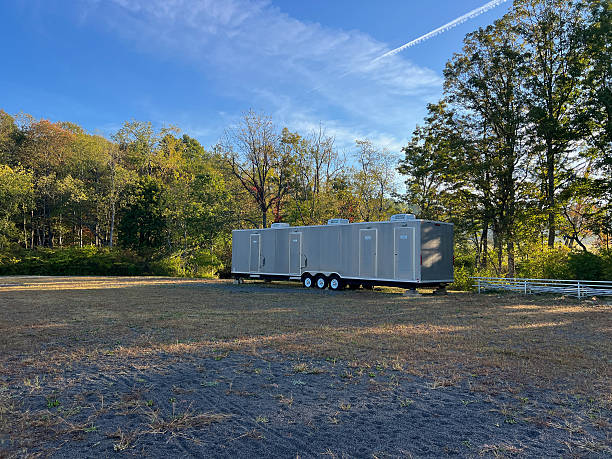
Trailers need flat, firm ground and more room than people expect. Some run twenty feet or longer, plus space for steps or a ramp, plus clearance for the tow vehicle to back in and unhook. Soft soil after rain is a real problem, since a heavy trailer can sink or get stuck. Gravel, pavement or compacted dirt works best. Walk the route the truck will take. Low branches, overhead wires, tight gates and narrow lanes are the usual troublemakers, so send photos to the company ahead of time.
Holding tanks need the same care, plus the weight. A full tank can settle or tip on soft ground, so use a gravel pad or compacted dirt, and keep it close enough to the trailer that you aren’t running long hoses across walkways, which are trip hazards. The vacuum truck needs a clear path to reach it. Keep tanks away from food areas and guest paths.
Keep the trailer close enough that people will use it, but not right beside the food or the camera. If the day runs past dark, add lighting. On job sites, put it where crews can reach it without hiking across the whole property. Weather matters here. Heavy rain, wind and flooding are real. Pick higher ground when you can, and ask what the company does when a storm is coming. Do they pull the trailer or leave it? A cold snap can also freeze lines and fittings. Houston doesn’t freeze often, but when it does, nobody’s ready.
Rules, Paperwork and Questions to Ask
Skipping this part costs more than reading it. Cities and counties often have sanitation requirements for public events, and toilet counts can be tied to expected attendance. You may need a special event permit, with your sanitation plan as part of approval. Private land shoots have their own landowner and insurance requirements. Many public events also need accessible facilities, so ask directly whether a trailer has a ramp, wider doors and handrails. Your rental company probably knows the local routine, but call the city or county yourself.
Wastewater rules are strict. Never dump it on the ground, in a storm drain or into a regular septic tank. It’s illegal, it’s nasty, and the fines are real. Only licensed haulers should pump and transport it. In Texas, that means a company registered with the Texas Commission on Environmental Quality. Buck Waste lists its TCEQ registration number, 26592, on its website and carries one million dollars in general liability and pollution insurance, with certificates available. Ask any provider for theirs. If they can’t give you a number, walk.
Then ask blunt questions. What’s included in the price and what isn’t? Does the trailer bring a generator or need site power? How big are the water and waste tanks, and how many people does that cover? Who services it, and how often? Buck Waste says its own trained technicians handle servicing, never subcontractors. What happens if something breaks mid event? Same day delivery is often possible for some orders placed by noon, and weekend delivery usually needs notice by Thursday. Office hours run Monday through Friday, eight to four thirty, with emergency only service after hours. Read reviews, especially the three and four star ones, and trust your gut. A vague quote usually means a vague company.
Conclusion
Planning ahead is most of it. Know your crowd, decide whether a trailer is really worth it for them, sort out power and water, and figure out where the waste goes before the first truck rolls in. Do that and restroom trailer rental becomes one of the nicer parts of your shoot, wedding or job instead of a gamble. And if your site has no sewer, or the crew is big and the schedule is long, line up waste holding tank rental at the same time, so nobody’s standing around waiting on a pump truck. Don’t overthink it. Don’t wing it either. A little effort now saves a lot of grief later.
Reach Us Out
Need a restroom trailer, a waste holding tank or portable restrooms for your event, shoot or job site? Talk to the Buck Waste team. We’ll help you size the right setup, give you real pricing over the phone, and get service out to you fast.
Buck Waste
2529 Kennings Rd, Crosby, Texas 77532
Call: (832) 761-2825
FAQs
How much does restroom trailer rental cost?
It depends on trailer size, number of stalls, rental length, season and delivery distance, and it costs more than standard units. Ask for an itemized quote that includes delivery, setup, power and water.
Do restroom trailers need power and water hookups?
Yes. They need electricity for lights and air conditioning, and water for sinks and flushing toilets. Some bring a generator and onboard tank, while others connect to your site.
When do I need waste holding tank rental?
When your site has no sewer connection, or the event or job is long or busy enough to fill the trailer’s onboard tank. A holding tank gives you temporary wastewater storage, pumped on a schedule.
How often does a waste holding tank need to be pumped?
It depends on tank size, headcount and usage. Busy sites may need daily pumping, while quieter jobs may go weekly. Ask your provider for a schedule that fits.
Can restroom trailers be ADA accessible?
Some models have ramps, wider doors and handrails, but not all do, and some have entry steps. Ask directly before booking, and add a dedicated accessible unit if you’re unsure.
How far ahead should I book a restroom trailer?
Several weeks is safest, longer for peak wedding and festival seasons. Trailers are limited, so last minute bookings are difficult.
Can I dump wastewater on the ground or in a storm drain?
No. Only licensed haulers should handle wastewater. Dumping it on the ground, in a storm drain or into a regular septic tank is illegal and can bring fines.