Ask any cabinet shop owner about their worst day, and there’s a good chance it involves a stack of parts cut a quarter inch short. Somebody misread the tape, a stop got bumped, and good lumber ends up in the scrap bin. An automatic chop saw is built to stop that from happening. Instead of measuring and marking every board by hand, the machine moves the material to an exact length pulled from a cutlist, and the operator just makes the cut. RazorGage has been building systems around this idea in Ames, Iowa since 2001. This post covers how these machines work, what to look for, and where they make the most sense.
What Does This Kind of Saw Actually Do?
A regular chop saw depends entirely on the person running it. You hold a tape, find the line, and hope your eye and your hand agree. An automatic chop saw swaps that guesswork for a programmable stop or pusher that slides the board to a set position and holds it there. You load the cutlist, the fence moves, and the blade comes down. It’s the same saw you already know, just with far less room for mistakes. RazorGage says its positioners work with chop saws, upcut saws, downcut saws, drill presses, and even haunching, notching and punching machines, so you don’t always need a whole new saw to get started.
Where the Accuracy Comes From
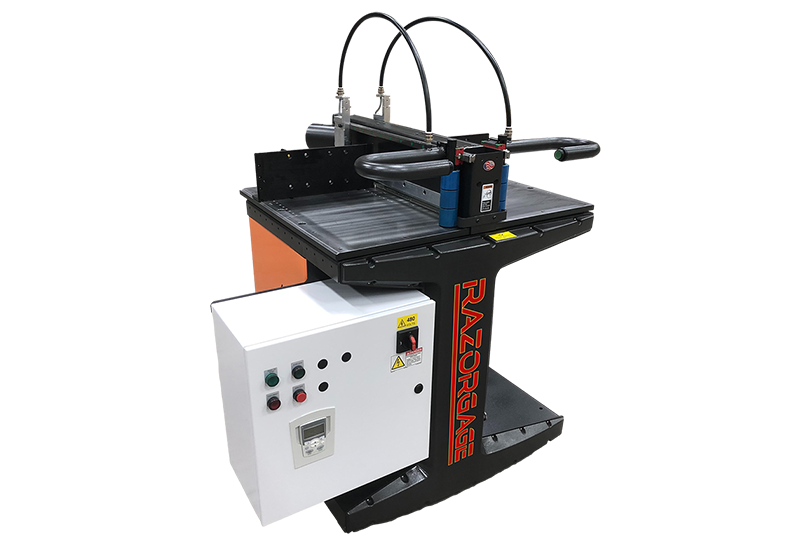
Accuracy is the whole point, so it’s worth knowing what’s under the hood. The RazorGage ST positioner uses a hardened and ground linear bearing rail, the same type of rail you’d find on CNC machining centers. That keeps the carriage moving smoothly with very little play. The motion controller reacts fast when it hits a jam, which means no stretched belts to replace later. On the spec sheet, the ST is rated at plus or minus .004 inch over twelve feet, as long as you calibrate it with a capable measuring device. That last part matters. Any machine is only as good as the setup behind it, so take the calibration step seriously.
Software, Cutlists, and Less Waste
The hardware gets the attention, but the software does a lot of the daily work. The Windows-based RazorGage software runs on a touchscreen, stores thousands of cutlists, and sorts them into groups by several criteria. Because it runs on Windows, sharing files across your office and shop network feels like any other computer. Every RazorGage controller also has built-in Wi-Fi, so you can send cut data straight to the machine. That means nobody is standing at the saw with a pencil, copying numbers off a printout. If you want to save more material, the optional optimizing software arranges parts to cut down on waste. Smaller shops can start with the XT-PC, which comes with a rugged Android tablet and simpler software, then move up to the Windows version later.
How Does the RazorOptimal Go Further?
At the top of the line sits the RazorOptimal, an optimizing cut-off saw system. RazorGage pairs its ST positioner with the Cyclone 600 upcut saw. The operator marks defects on the board with a crayon, the system scans the material, and the software fits your remaining parts into the clean areas between the marks. It then advances the stock, makes the cuts, and can print part information right onto the material with an inkjet printer. Knots and splits get cut around instead of cut into good parts.
The Pocket Hole Version
There’s also a version built for face frames. Swap the upcut saw for an 18-inch down-cut precision saw, and the machine drills pocket holes and scribes layout marks in the same pass. RazorGage calls it the only crayon-defecting optimizing saw that does both, and the parts come off ready for assembly. One reseller listing mentions enough output for about 40 face frames per hour, though your real numbers will depend on your material and your cutlists.
Who Gets the Most Out of It?
RazorGage’s customers are mostly custom cabinet makers and high-volume door manufacturers across the U.S. The company, which marked its 25th anniversary this year, says its goal from the start was to make accurate, automated cutting available to shops of every size. That fits the product range. A small shop cutting a few hundred parts a week can get real value from a basic positioner, while a busy production floor may want the full optimizing setup. Either way, the savings tend to show up in three places: fewer mistakes, less lumber in the trash, and less time spent measuring.
What to Check Before You Buy
Before signing anything, look at your power supply. The Cyclone saw needs three-phase power, either 230 volts at 30 amps or 460 volts at 20 amps, and the pocket hole saw asks for a bit more. Think about the materials you cut most, the size of your parts, and whether you really need defect scanning or just a reliable stop. Ask about training and support too. After more than two decades in business, RazorGage has built its name on customer support, and that counts for a lot when a machine runs all day.
Final Thoughts
A shop doesn’t need to be huge to benefit from automation. It just needs to be tired of re-cutting parts. Start with the problem you want to fix, whether that’s accuracy, waste, or speed, and pick the system that matches it. If your work involves lots of lineal stock, defects, and face frames, the RazorOptimal is worth a close look.
Frequently Asked Questions
What is an automatic chop saw?
It’s a chop saw paired with a programmable stop or pusher that positions each board for you. You load a cutlist, and the system moves the material to the right length before every cut.
How accurate is the RazorGage ST?
The listed accuracy is plus or minus .004 inch over twelve feet, provided the system is calibrated with a capable measuring device.
Can I add a positioner to a saw I already own?
Often, yes. RazorGage says its positioners work with chop saws, upcut and downcut saws, drill presses, and several other machines. Check your saw’s setup with the team before ordering.
How does defect scanning work?
The operator marks knots or splits with a crayon. The system scans those marks and arranges your parts so they land in the clean sections of the board.
Is there an option for smaller budgets?
The XT-PC is the entry-level positioner. It uses an Android tablet with simpler software, and you can upgrade to the Windows version when your needs grow.
Contact Us
Address: 57006 241st Street Ames, IA 50010
Phone: 515.232.3188
Email: sales@RazorGage.com