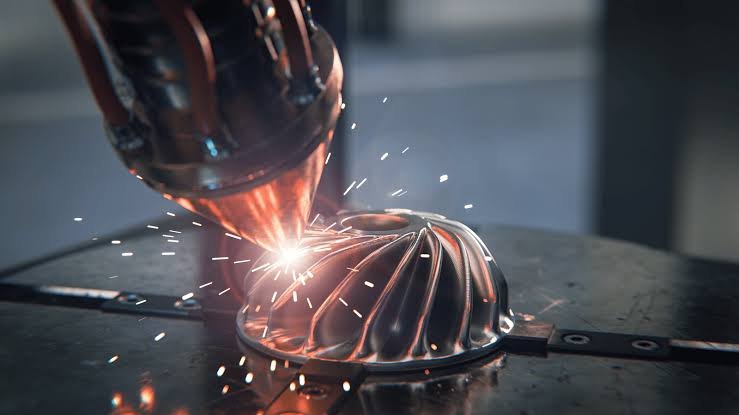
Ordering 20 or 30 metal parts puts a buyer in an awkward spot. A casting foundry wants to build a mold that can cost more than the parts themselves. A machine shop may need custom fixtures before cutting the first chip. Metal additive manufacturing skips most of that setup, which is why the question keeps coming up, yet it isn’t automatically the cheaper path. Whether it’s worth it depends on the part, the quantity, and what the buyer values most: price, speed, or performance.
Where Metal Additive Manufacturing Makes Financial Sense at Small Quantities
The main financial argument is simple. Printing needs no mold, die, or dedicated fixture, so the first part costs roughly what the twentieth costs. Tooled processes work the opposite way. Their up-front expense gets spread across the run, which looks fine at 5,000 pieces and painful at 15. Somewhere between those extremes sits a crossover point, and for small batches the printer often reaches it first. Lead time moves in the same direction, since nobody waits for tooling to be made.
Part Characteristics That Tip the Decision Toward Printing
Some parts suit printing far better than others. The strongest candidates usually share a few traits:
- Internal passages, cooling channels, or lattice structures that machining can’t reach
- An assembly of several pieces that could be consolidated into one build
- Weight reduction that matters, as in flight hardware
- A design that is still changing, where tooling would be thrown out after each revision
- Hard-to-machine alloys such as Inconel 718
A part that ticks two or three of those boxes deserves a serious look.
Situations Where Traditional Machining Still Wins on Cost
Printing isn’t the best choice for every part. Take a plain bracket in a common alloy: cutting it from bar stock costs less, even if you only need a handful. A part bigger than the printer’s build space has to be split into pieces or made another way. And if a surface needs to be very smooth, it still goes to a machine after printing. Some buyers skip this check and pay for the part twice.
How Additive Manufacturing & Engineering Supports Low-Volume Metal Parts
Additive Manufacturing & Engineering, known as AME, is a Huntsville, Alabama provider built around this kind of work. The shop runs an EOS M400 that handles parts up to 400 mm on each side, and prints in Inconel 718 and GRCop-42, with other metals available on request when volume supports it. AME accepts STL, STP, and OBJ files and works with customers through iterative design checks, although it does not design parts from scratch. Its client list includes NASA and Blue Origin, and the company holds AS9100D and ISO 9001 certifications along with ITAR registration.
Hidden Costs That Can Change the Math on a Small Batch
The sticker price of a print rarely tells the full story. Costs that often get overlooked in small-batch jobs include:
- Support removal and heat treatment after the build
- Machining of sealing faces, threads, or tight-tolerance features
- Inspection reports and material certifications
- Extra design rounds if the first version isn’t printable
Adding these up early keeps comparisons fair.
A Practical Method for Comparing Printing Against Other Processes
A practical test is to ask for quotes on two quantities, perhaps 10 and 50, from both a printing provider and a machine shop. Request line items, include tooling, and note lead times. The comparison usually makes the answer obvious. For small runs of complex parts, metal additive manufacturing frequently comes out ahead. For simple shapes, it often doesn’t, and a good provider will say so.
FAQs
What counts as low-volume production in metal 3D printing?
No official cutoff exists. Most shops think of it as anything from a single prototype up to a few dozen parts, sometimes a couple of hundred if the part is small. Past that point, tooled processes like casting often start winning on cost. Where the line falls depends on size and complexity.
At what quantity does CNC machining become cheaper than printing?
There is no single number, because the answer depends on the part. A simple bracket in a common metal is often cheaper to machine even at ten pieces. A part with internal channels can stay cheaper to print well into the dozens. The practical step is to request quotes at 10 and at 50 pieces and compare the two.
Are printed metal parts strong enough for end-use applications?
For most jobs, yes. We print stainless steel and titanium parts that go straight into service, and customers use them in machines every day. The one thing we always say is to test a part if a failure could hurt someone or stop a production line. We can share what we check before shipping.
Can a design made for machining be printed without changes?
Sometimes, but we almost always adjust something. A part drawn for a mill might have a wide flat ledge, and a printer can’t build a ledge in thin air without support under it. Cleaning that up later costs time. Before printing, we go through the file with the customer and point out where a small change saves money.
Does low-volume printing work for parts that need certification paperwork?
Yes, if the shop knows about it early. Some jobs need papers that prove the material and the inspection results. Others need a shop with a quality certificate, such as AS9100D. Defense parts can also have special rules. All of this takes extra time and money, so mention it in your first quote request.