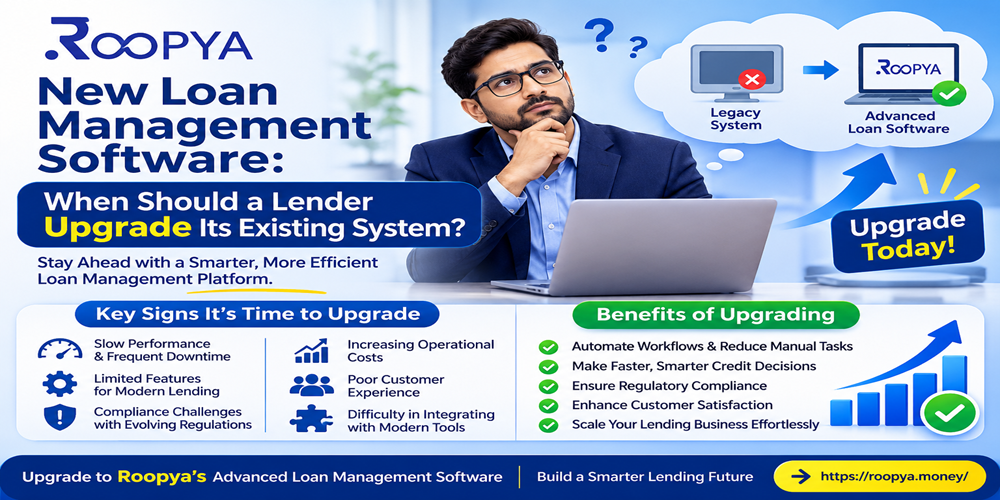
Slow approvals, manual reports, compliance workarounds? Learn the 10 signs your loan management software needs an upgrade and how to choose the right one.
Every lender reaches a point where the system that once held the business together starts to hold it back. The loan management software (LMS) that comfortably handled a few hundred accounts now struggles with thousands. Reports take days instead of minutes. Every new product needs a developer. Regulators ask for data that nobody can pull without a spreadsheet marathon.
Yet replacing a core lending system is a serious decision. It touches customers, collections, accounting, and compliance all at once, and a poorly planned migration can cost more than the problems it was meant to solve.
So when is the right time to upgrade? This guide gives a practical answer for banks, NBFCs, fintech lenders, and lending service providers (LSPs). It explains what a loan management system is responsible for, ten warning signs that your current platform is reaching its limit, the signs that suggest you can safely wait, how to weigh the real costs, and how to run an upgrade without disrupting your portfolio. The goal is to help you decide with evidence rather than vendor pressure or gut feeling.
What Does Loan Management Software Actually Do?
Loan management software is the operating system of a lending business. It records and controls a loan from the moment an application arrives to the moment the final instalment is repaid, and often beyond, into recovery or closure.
In most lenders, a complete system covers these areas:
- Loan origination: capturing applications, KYC, documents, and borrower data through digital journeys.
- Underwriting and credit decisioning: applying credit policy, bureau data, and business rules to approve, reject, or refer a case.
- Disbursal: generating agreements, collecting e-signatures and e-mandates, and releasing funds.
- Servicing: schedules, interest calculation, repayments, part-payments, foreclosure, and customer communication.
- Collections and recovery: tracking delinquency, assigning cases, and managing follow-up.
- Accounting and reporting: ledgers, reconciliation, regulatory returns, and management dashboards.
When these pieces work together, the business runs predictably. When one is weak, the weakness spreads. A slow origination module inflates acquisition costs, a rigid rule engine delays product launches, and poor reporting hides the early signs of portfolio stress.
Why the Timing of an Upgrade Matters
Upgrading too early wastes money and management attention. Upgrading too late is usually more expensive, because the cost of an outdated system rarely appears as a single line item. It shows up as lost applicants who abandoned a slow journey, staff hours spent on manual work, compliance exceptions, delayed launches, and decisions made on stale data.
The best time to upgrade is when evidence shows that the system is limiting growth, control, or compliance, and before the pain becomes a crisis. A planned migration over several months is safer than an emergency replacement after an audit finding, a major outage, or a vendor ending support.
10 Signs Your Lending Business Needs New Loan Management Software
No single sign below means you must replace your system today. Treat them as a checklist. If you recognise four or more, a formal evaluation is justified.
1. Approvals and disbursals take too long
Borrowers today compare lenders in minutes. If your process depends on manual document checks, re-keying data between screens, or sending files between teams, turnaround time suffers and drop-offs rise. Measure the time from application to disbursal and the percentage of applicants who abandon midway. If both numbers are worsening while volumes grow, the workflow is likely the bottleneck.
2. Every new product or policy change needs custom development
A modern system lets business teams configure loan products, interest structures, fees, tenures, and eligibility rules without writing code. If launching a new product takes months, or a small policy tweak requires a vendor change request, you are paying for rigidity. A flexible business rule engine (BRE) is one of the clearest dividing lines between legacy and current platforms.
3. Integrations are fragile, costly, or missing
Lending today depends on connections to credit bureaus, KYC and identity services, account aggregators, e-sign and e-mandate providers, payment gateways, and co-lending or channel partners. If each integration is a custom project that breaks when a provider updates its API, your team spends its time on plumbing instead of lending.
4. Reporting is manual, slow, or untrusted
Ask a simple question: how long does it take to produce an accurate portfolio-at-risk report by product, region, and channel? If the answer is days, or if different teams show different numbers, your data is not reliable enough to steer the business. Leaders need current dashboards on disbursals, delinquency, collection efficiency, and partner performance, not month-old exports.
5. Compliance depends on workarounds
Regulation in digital lending keeps evolving, covering areas such as borrower disclosures, consent, data storage, grievance handling, fund flow, and the roles of lending service providers. India’s Digital Personal Data Protection Act adds further obligations around personal data. If your team maintains compliance through side spreadsheets, manual checks, or after-the-fact audit trails, you carry operational and regulatory risk. Your system should enforce compliance by design, with complete, timestamped records of who did what and when.
6. Servicing and collections are reactive
Late-stage collections are expensive. Better systems support early-warning triggers, automated reminders across channels, repayment-link generation, and clear workflows for assigning and tracking field or telecalling teams. If you only discover delinquency after it has aged significantly, or cannot see which collection actions actually work, upgrading can pay for itself through improved recovery alone.
7. Growth causes slowdowns or outages
Systems that performed well at one volume sometimes degrade sharply at ten times that volume. Warning signs include slow screens at month-end, failed batch jobs, long interest-accrual runs, and downtime during campaigns or festive peaks. If you must limit marketing because the platform cannot cope, the software is capping your revenue.
8. Data lives in silos
When origination, servicing, collections, and accounting run on separate tools that barely talk to each other, no one has a single view of the customer. The result is duplicate data entry, reconciliation errors, and missed opportunities such as pre-approved top-up offers for good repayers. A unified platform, or a well-architected set of connected modules, removes that friction.
9. Security and vendor support are slipping
Check whether your vendor still releases security patches, supports your database and operating system versions, and responds quickly to incidents. A product approaching end-of-life, or one maintained by a single developer who knows its quirks, is a business continuity risk. Lenders hold sensitive financial and identity data, so weak access controls, limited audit logs, or no role-based permissions are serious concerns.
10. Total cost of ownership keeps climbing
Add up licence fees, hosting, customisation, support contracts, manual labour, and workaround tools. Many lenders find that their ageing system is not cheap at all; the costs are simply scattered across departments. If maintenance spend rises every year while capability stays flat, a modern platform may cost less over three to five years.
Metrics That Tell You Whether It Is Time
Opinions about a system tend to differ by department, so anchor the decision in numbers. Track these indicators for at least a quarter and compare them with your targets:
- Turnaround time: average hours or days from application to disbursal, split by product and channel.
- Application drop-off rate: the share of applicants who start a journey but do not finish it.
- Cost per loan: total origination and servicing cost divided by loans processed, including staff time.
- Straight-through processing rate: the percentage of cases decided automatically without manual touch.
- Time to launch: how many weeks a new product or rule change takes from approval to going live.
- Collection efficiency and early delinquency: how quickly overdue accounts are flagged and resolved.
- Reporting lag and error rate: how long reports take and how often figures need correction.
If several of these metrics worsen as volumes rise, or if they cannot be measured at all because the system does not capture the data, that is strong evidence the platform is no longer fit for purpose.
Signs You Can Wait: Optimise Before You Replace
An upgrade is not always the answer. Sometimes the existing system is sound and the problem lies in configuration, training, or process design. Consider holding off if:
- Your current vendor has a clear roadmap, regular releases, and responsive support.
- Most pain comes from a single area, such as collections or reporting, that a connected add-on module could solve.
- Your portfolio is small and stable, and compliance and security needs are fully met.
- Staff are using only a fraction of existing features because of limited training.
A useful test: ask whether the issue would disappear with better configuration or a targeted integration. If yes, fix it first. If the same constraints return every time, the architecture itself is the limit.
The Real Cost of Staying on an Outdated System
Delay has a price, even if no invoice arrives for it. Consider four hidden costs:
- Lost revenue: slow journeys lose applicants to faster competitors, and capped volumes leave growth unrealised.
- Higher operating cost: manual reconciliation, document checks, and report building consume skilled hours that could go to risk and customer work.
- Elevated risk: weak audit trails, delayed fraud detection, and inconsistent data increase regulatory and credit losses.
- Talent friction: good analysts and operations staff leave when they must fight their tools every day.
Put rough figures against each category for your own business. Even conservative estimates often show that the cost of waiting exceeds the cost of a well-run migration.
What to Look for in New Loan Management Software
If the checklist points toward an upgrade, evaluate vendors against requirements drawn from your own operations. These criteria matter most:
Configurable workflows and rules
Business teams should be able to build and change journeys, products, pricing, and credit rules through a visual interface, with proper versioning and approval controls.
API-first architecture
Open, well-documented APIs make it far easier to connect bureaus, KYC providers, payment rails, co-lenders, and future partners. Ask for the list of integrations that are already live, not only those that are promised.
Built-in compliance and auditability
Look for consent capture, disclosure templates, role-based access, immutable audit logs, and data-handling features aligned with current regulation. Ask how the vendor updates the product when rules change and who pays for those updates.
Scalability and reliability
Request evidence of performance at your expected volume, including uptime history, disaster recovery arrangements, and how batch processes behave at peak load. Cloud-native platforms usually scale more gracefully than on-premise systems, though data-residency requirements must be checked.
Analytics and reporting
The system should provide real-time dashboards, portfolio and cohort analysis, and exportable regulatory reports without custom scripting. Strong analytics help you spot problems and opportunities earlier.
Partner and channel management
If you work with sourcing partners, DSAs, fintech channels, or co-lenders, check for partner onboarding, lead routing, commission tracking, and clear performance reporting.
Vendor credibility and implementation support
Ask for references from lenders of similar size and product type. Understand the implementation timeline, data migration approach, training plan, service levels, and exit terms. A good product with weak implementation support can still fail.
Build, Buy, or Layer: Which Route Fits?
Lenders generally choose among three approaches. Building in-house gives maximum control but demands a long-term engineering commitment, continuous regulatory updates, and strong security practice. Buying a packaged LMS or subscribing to a platform shortens time to market and shifts maintenance to the vendor, though you must accept some product constraints. A layered approach keeps a stable core ledger and adds modern origination, decisioning, or analytics services around it through APIs.
For many growing lenders, the layered or platform route offers the best balance. It allows you to modernise the parts that hurt most without a risky big-bang replacement. The right choice depends on your size, technical capacity, regulatory position, and appetite for change.
A Practical Roadmap for a Safe Upgrade
- Document today’s pain. List the specific problems, their cost, and the metrics you want to improve, such as turnaround time, cost per loan, collection efficiency, or report delivery time.
- Map requirements with every stakeholder. Involve credit, operations, collections, finance, compliance, technology, and customer service. Separate must-haves from nice-to-haves.
- Shortlist and test. Run scripted demonstrations using your real scenarios, not generic vendor slides. Check integrations, rule configuration, and reporting live.
- Plan data migration early. Clean and reconcile loan data, schedules, balances, and documents before moving. Decide whether to migrate the whole book or run new loans on the new system while old loans run off.
- Pilot with a limited segment. Launch one product or region first, monitor closely, and fix issues before expanding.
- Run in parallel where needed. Reconcile outputs between old and new systems until results match consistently.
- Train teams and communicate with borrowers. Staff confidence and clear customer messaging prevent avoidable service problems during transition.
- Measure and improve. Compare results with your baseline metrics after launch and keep refining rules, journeys, and reports.
Common Mistakes to Avoid
- Choosing on price or features alone, without testing real workflows.
- Underestimating data migration effort, which is often the hardest part of the project.
- Excluding compliance and risk teams until late in the process.
- Over-customising the new system until it becomes as rigid as the old one.
- Skipping change management, so staff continue using old workarounds.
- Ignoring exit terms, which leaves you locked into a vendor even when it underperforms.
Where a Lending-as-a-Service Platform Fits In
Not every lender needs to own and operate a full technology stack. Lending-as-a-Service (LaaS) platforms offer lending infrastructure and analytics as a managed service, which can be an attractive option for lenders and lending service providers that want to move quickly without heavy engineering investment.
Roopya, for example, positions its platform as lending infrastructure and analytics as a service. According to the company, it includes a customisable customer journey builder, API connectivity to 25+ lenders, a business rule engine for origination, underwriting, and servicing, AI-driven reporting, and a lending pipeline that runs from digital application and underwriting through credit decisioning, digital document signing, disbursal, and ongoing servicing of repayments. It also describes a focus on security, reliability, and regulatory compliance.
Whichever provider you consider, apply the same standards described above: test the live workflow, check integrations and compliance support, and confirm how data, ownership, and exit are handled.
Upgrade When Evidence, Not Habit, Says So
The right moment to upgrade your loan management software arrives when your system consistently limits speed, control, compliance, or growth, and when optimisation cannot fix the underlying constraint. Slow journeys, rigid products, fragile integrations, unreliable reports, workaround-based compliance, and rising maintenance costs are all signals worth acting on.
Start by measuring where you stand today. Score your current system against the ten signs, estimate the cost of delay, and define what success looks like. Then evaluate options carefully, plan the migration in stages, and involve every team that depends on the platform. Done well, an upgrade does more than replace old software. It gives your lending business a stronger base for faster decisions, safer growth, and a better borrower experience.
Frequently Asked Questions
When should a lender upgrade its loan management software?
A lender should upgrade when the current system repeatedly limits speed, compliance, reporting, or growth, and configuration or add-on modules cannot fix the problem. Common triggers include slow disbursals, rigid product setup, fragile integrations, manual reports, compliance workarounds, and rising maintenance costs.
What are the signs that a loan management system is outdated?
Typical signs include long approval times, dependence on developers for every product change, poor integration with bureaus and KYC providers, delayed or inconsistent reports, weak audit trails, performance issues at higher volumes, data silos, and a vendor that no longer provides regular updates or security patches.
How long does it take to implement a new loan management system?
Timelines vary with scope, data quality, integrations, and the vendor. A focused deployment can take a few months, while a full core replacement across several products usually takes longer. Planning data migration, pilot testing, and staff training early helps keep the project on schedule.
Is it better to replace the entire system or add new modules?
It depends on where the problem sits. If the core ledger is stable and the pain is in origination, decisioning, or analytics, adding API-connected modules is often faster and less risky. If the core itself is slow, insecure, or unsupported, a full replacement is more appropriate.
What features should new loan management software have?
Look for configurable workflows, a business rule engine, API-first architecture, built-in compliance and audit logs, scalability, real-time analytics, collections tools, and partner management. Also check implementation support, security practices, and clear exit terms.
How does an upgrade help with regulatory compliance?
Modern platforms can capture consent, store timestamped audit trails, apply role-based access, generate required disclosures, and produce reports faster. This reduces dependence on manual checks. Lenders should still confirm current regulatory requirements with their compliance team or legal advisers.
What is Lending-as-a-Service (LaaS)?
Lending-as-a-Service is a model in which a provider supplies lending infrastructure, such as application journeys, decisioning, lender connectivity, and analytics, as a managed service. It lets lenders and lending service providers launch or scale lending operations without building every component themselves.
How can a lender reduce risk during a system migration?
Clean and reconcile data before moving, pilot with one product or region, run old and new systems in parallel until outputs match, involve compliance early, train staff in advance, and keep clear communication with borrowers during the transition.