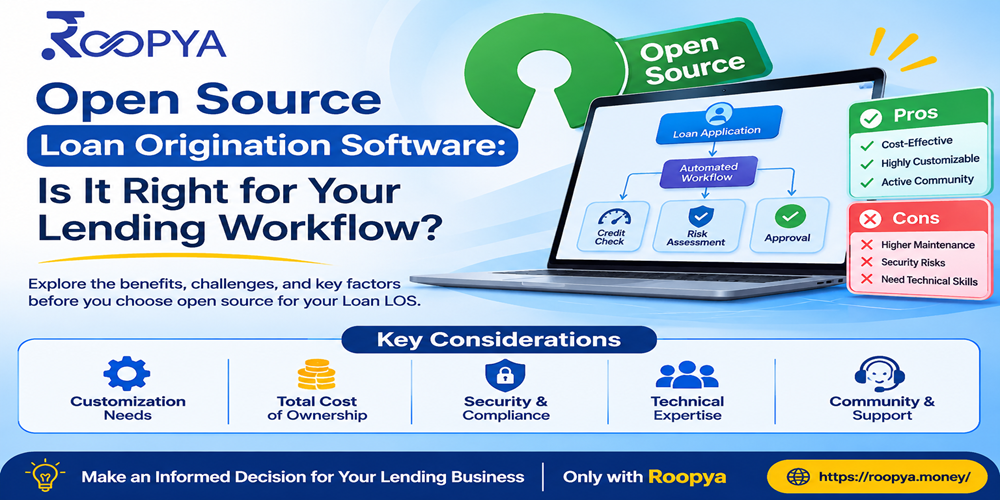
Considering open source loan origination software? Compare costs, compliance, security and support to see if it fits your lending workflow.
Every lender eventually asks the same question: should we build our loan origination system around open source software, buy a commercial product, or use a managed platform? The idea of open source is attractive. There is no licence fee, the code is visible, and your engineers can shape the product to match your credit policy. But a loan origination system sits at the centre of your business. It handles personal data, credit decisions, digital signatures and money movement. A wrong choice can slow growth, create compliance gaps and drain engineering time.
This guide explains what open source loan origination software (LOS) actually offers, where it works well, where it quietly becomes expensive, and how to decide whether it suits your lending workflow. It is written for lenders, NBFCs, fintech founders, lending service providers (LSPs) and product teams who want a practical answer rather than a sales pitch.
What Is Loan Origination Software?
Loan origination software manages the journey from the moment a borrower shows interest to the moment funds reach their account. In most lending businesses, that journey has six broad stages:
- Application capture: the borrower submits details and documents through a web or mobile journey.
- Verification: identity, income, bank statement and fraud checks are completed, usually through third-party APIs.
- Underwriting: the application is reviewed against your credit policy.
- Credit decisioning: rules, scorecards or analysts approve, reject or refer the case.
- Documentation: agreements, key fact statements and consent records are signed digitally.
- Disbursal: funds are transferred, and the loan moves into servicing and collections.
A good LOS reduces manual work in each stage, keeps an audit trail, and gives your team a single view of every application. A weak one forces staff to jump between spreadsheets, email threads and partner portals, which increases errors and turnaround time.
The software you choose also shapes borrower experience. Slow approvals, repeated document requests and unclear status updates lead to drop-offs, and every drop-off is acquisition cost wasted. That is why the decision should involve product, credit, operations and compliance teams together, not only the technology team.
What “Open Source” Really Means for Lending Software
Open source software is released under a licence that lets you view, use, modify and often redistribute the code. Well-known examples in the financial space include Apache Fineract, which is widely used for microfinance and core banking use cases, and lending modules built on open frameworks such as Frappe. Licences differ, so your legal team should read each one carefully. Permissive licences such as Apache 2.0 are generally easy to use commercially. Copyleft licences may require you to share modifications under certain conditions.
It is also important to separate three ideas that are often mixed up:
- Free to license: you do not pay a fee to use the code.
- Free to run: you do not pay for servers, engineers, security reviews or compliance work. This is almost never true.
- Purpose-built for origination: many open source projects focus on loan accounting or core banking, so you may need to build the origination layer, such as application journeys, underwriting queues and partner integrations, yourself.
Understanding these differences early prevents the most common misunderstanding in this decision: assuming that a free licence means a low-cost system.
The Real Advantages of Open Source Loan Origination Software
1. Control over workflows and code
If your credit policy is unusual, for example if you lend against non-standard collateral, run group lending, or use proprietary risk signals, a flexible codebase lets you model the process exactly. You are not limited by a vendor’s product roadmap, and you can change screens, fields and decision steps when your policy changes.
2. No vendor lock-in on the software itself
With open code, you can move hosting providers, hire different developers or fork the project if the community changes direction. This reduces dependence on a single vendor and can be valuable for lenders who are cautious about long-term contracts.
3. Transparency and independent review
Because the source is visible, your security team or an external auditor can inspect how data is handled. Active projects also benefit from many contributors who report and fix bugs, which can improve quality over time.
4. Lower licence cost at the start
For early-stage teams with strong engineers, avoiding per-user or per-loan licence fees can free budget for product development. This advantage is real, but it must be weighed against the costs described below.
5. Flexible hosting and data residency
You can deploy on your own cloud account or on-premise servers. This helps lenders who need strict control over where data is stored, which matters under data protection and sector-specific localisation expectations.
The Hidden Costs and Risks You Should Not Ignore
Engineering and maintenance burden
Someone has to install, configure, upgrade and monitor the system. Open source releases change, dependencies become outdated and security patches must be applied quickly. If you customise heavily, each upgrade becomes harder because your changes may conflict with new versions. Teams often discover that the “free” system needs a permanent engineering squad.
Missing out-of-the-box features
Many open source projects provide a strong data model but a limited user experience for lending operations. Borrower-facing journeys, document collection, e-sign, e-mandate, credit bureau pulls, fraud checks and lender APIs frequently require custom builds. Each integration also needs ongoing maintenance when the partner changes its API.
Support is not guaranteed
Community forums can be helpful, but they do not come with a service-level agreement. When a disbursal fails at month-end or a partner API breaks, you need a named person who can respond. Some projects have commercial support partners, which adds cost but also reduces risk.
Compliance is your responsibility
No open source project can guarantee that your process meets regulatory expectations. You must configure disclosures, consent capture, grievance workflows, data retention rules and reporting yourself, and you must update them whenever regulations change. In India, for example, lenders need to follow the RBI’s digital lending requirements and the Digital Personal Data Protection Act, 2023, so these controls cannot be an afterthought.
Security accountability
Visible code does not equal secure deployment. Misconfigured servers, weak access controls and unpatched libraries are common causes of breaches. You will need role-based access, encryption in transit and at rest, logging, backups, disaster recovery and periodic penetration testing.
Total cost of ownership
When you add developer salaries, DevOps, security testing, integrations, documentation, QA and support, the three-to-five-year cost of an open source LOS can match or exceed a commercial subscription. The right comparison is not licence fee versus zero. It is total cost of ownership versus time to market and risk.
Compliance, Security and Audit Readiness
For a lender, the system is not only a productivity tool. It is also your evidence. Regulators, partner banks and auditors may ask you to show who approved a loan, which data was used, what disclosures the borrower saw and when consent was recorded. Before adopting any LOS, open source or commercial, check that it can support the following:
- Complete audit trail: every action on an application is time-stamped and linked to a user or system.
- Consent and disclosure records: borrower consents, fee disclosures and agreements are stored and retrievable.
- Access control: staff see only what they need, and changes in permissions are logged.
- Data protection: encryption, masking of sensitive fields, retention and deletion policies.
- Reporting: the ability to produce regulatory and partner reports without manual reconstruction.
- Resilience: tested backups, uptime monitoring and a disaster recovery plan.
If you choose open source, assign clear owners for each of these controls. If you choose a managed platform, ask the provider to show how it handles them and what documentation you can share with your auditors.
Open Source vs Commercial LOS vs Lending-as-a-Service
The choice is not only between “open source” and “paid.” Most lenders compare three models:
| Factor | Open Source LOS | Commercial LOS | Lending-as-a-Service (LaaS) |
| Licence cost | Usually none | Subscription or per-loan fee | Platform or usage fee |
| Time to launch | Longer, depends on build | Moderate | Often fastest |
| Customisation | Very high, needs developers | Moderate, vendor-controlled | Configurable through journey builders and rules |
| Maintenance | Your team | Vendor, with some effort from you | Mostly the provider |
| Integrations | Mostly built by you | Some pre-built, some custom | Pre-built lender and partner APIs |
| Support | Community or paid partner | SLA-backed | SLA-backed |
| Best for | Engineering-led lenders with unique needs | Mid-size lenders wanting a standard product | Lenders and LSPs wanting speed with less overhead |
No model is universally better. The right answer depends on your team’s skills, product complexity, regulatory exposure and how quickly you need to reach the market.
When Open Source LOS Is a Good Fit
Open source tends to work well when most of the following statements are true:
- You have an experienced in-house engineering and DevOps team that can own the system for years.
- Your lending model is genuinely different, and off-the-shelf workflows would force costly compromises.
- You need full control over hosting, source code and data flows.
- You are comfortable building and maintaining integrations with bureaus, KYC providers, payment gateways and lenders.
- You have a compliance function that can translate regulatory changes into system updates.
- Your timeline allows for months of development and testing before launch.
When It Is Probably Not the Right Choice
Open source may slow you down if several of the following apply:
- You are a lean team that needs to start disbursing loans quickly.
- You lack dedicated engineers for security, upgrades and production support.
- Your workflow is fairly standard and can be configured rather than coded.
- You rely on many lender or channel partners and need ready-made integrations.
- Your leadership expects predictable costs and vendor accountability.
- You operate in a highly regulated setting and need documented, auditable controls from day one.
In these cases, a configurable commercial or LaaS platform can reduce risk and let your team focus on borrower experience, credit quality and growth rather than infrastructure.
How to Evaluate Any Loan Origination Software: A Practical Checklist
- Map your workflow first. Document each stage from lead to disbursal, including exceptions, approvals and handoffs. Software should follow your process, not the other way round.
- List must-have integrations. Identify the credit bureau, KYC, e-sign, e-mandate, payment and lender APIs you need, and check which are available out of the box.
- Review the licence and roadmap. For open source, confirm the licence terms, release frequency and community activity. For commercial products, confirm contract terms and exit options.
- Test the decisioning layer. Check whether a business rules engine can express your policy without code changes for every tweak.
- Assess security and audit capabilities. Ask for evidence, not assurances: architecture diagrams, penetration test summaries and sample audit logs.
- Estimate total cost of ownership. Include people, infrastructure, integrations, support and upgrades over at least three years.
- Run a pilot. Process a limited set of real applications end to end and measure turnaround time, error rates and staff effort.
- Plan for scale. Confirm the system can handle more applications, more products and more partners without a rebuild.
Common Mistakes Lenders Make When Choosing a LOS
- Comparing licence fees only. The cheapest licence can become the most expensive system once engineering, security and support are included.
- Underestimating integrations. Credit bureau, KYC, e-sign, e-mandate and lender connections often take longer than the core application screens.
- Over-customising early. Heavy changes make upgrades painful. Start with configuration and customise only where it creates real business value.
- Ignoring operations teams. Underwriters, collections staff and customer support should test the system, because they feel every usability problem first.
- Postponing compliance design. Consent records, disclosures and audit logs are much harder to add after launch than to design in from the start.
- Skipping an exit plan. Whatever you choose, know how you would export your data and move to another system if your needs change.
Three Example Scenarios
Scenario 1: A technology-led lender with a unique product. A company offers loans secured against a rare asset class and has twelve engineers. Standard workflows do not fit, so the team builds on an open source core, adds its own origination layer and accepts the maintenance load. Open source is a reasonable fit here.
Scenario 2: A lending service provider that wants to scale partnerships. A team needs to collect leads, match them with different lenders and track every application. Most of its value comes from lender connectivity and conversion, not from building software. A managed platform with ready lender APIs and a journey builder is likely to get it to market sooner.
Scenario 3: A small NBFC modernising manual processes. The firm currently uses spreadsheets and email. It has one developer and tight deadlines. A configurable commercial or LaaS product is safer, because it provides support, compliance-minded workflows and a faster path to digital operations.
Where a Lending-as-a-Service Platform Like Roopya Fits
Many lenders reach this decision point because they want flexibility without building everything from scratch. This is where a Lending-as-a-Service approach can help. Roopya provides a lending infrastructure and analytics platform that lets lending service providers and lenders start a digital lending business with a built-in customer journey builder.
Based on the capabilities described on the Roopya website, the platform includes:
- Lender connectivity: integration with 25+ lenders through APIs, so leads can be pushed to multiple lenders based on credit decisioning criteria.
- Journey builder: a customisable journey builder to map opportunities and engagement for borrowers.
- Business rules engine (BRE): rules that help automate and manage loan origination, underwriting and servicing logic.
- Customer profiling: inference-driven profiling that uses 25+ data points to match a borrower with a suitable lender.
- Analytics and reporting: AI-driven reports that help teams study performance and identify growth opportunities.
- Pipeline visibility: a clear view of each stage, from application and underwriting to credit decisioning, digital signing, funding and servicing.
This does not mean a managed platform is always better than open source. If you have unique requirements and a strong engineering bench, building on open code may still be the right route. But if your priority is to reach borrowers faster, connect with multiple lenders and reduce the maintenance burden, a platform approach deserves a serious look. You can learn more about the platform at roopya.money.
Final Verdict: Is Open Source Loan Origination Software Right for You?
Open source loan origination software can be a smart choice when you need deep control, have the engineering strength to maintain it and can invest the time to build compliant, secure workflows. It is a weaker choice when speed, predictable cost and vendor accountability matter more than customisation.
The best way to decide is to be honest about three things: your team’s capacity, your regulatory exposure and your time to market. Map your workflow, estimate the full cost over several years, and test your shortlisted options with real applications. A decision based on evidence will serve your borrowers, your partners and your business far better than one based on the licence price alone.
Frequently Asked Questions
What is open source loan origination software?
Open source loan origination software (LOS) is a loan application and processing system whose source code is publicly available under an open licence. Your team can inspect, modify and self-host it, but you are also responsible for setup, security, compliance updates and ongoing maintenance.
Is open source loan origination software free?
The licence is usually free, but the total cost is not. You still pay for engineering, hosting, security testing, integrations with credit bureaus, KYC and payment partners, documentation and support. For many lenders, these costs exceed the licence fee of a commercial product over three to five years.
Is open source LOS secure enough for regulated lenders?
It can be, but security is not automatic. Open code allows independent review, yet your team must apply patches, manage access controls, encrypt data, maintain audit trails and run regular penetration tests. Regulated lenders should document these controls before going live.
Who should use open source loan origination software?
It suits lenders with strong in-house engineering teams, unusual workflows that off-the-shelf tools cannot support, or strict hosting and data-control requirements. It is rarely the best fit for small teams that need to launch quickly and cannot dedicate developers to maintenance.
What is the difference between open source LOS and a Lending-as-a-Service platform?
With open source LOS you build and run the system yourself. With a Lending-as-a-Service (LaaS) platform, the provider hosts the infrastructure and supplies ready-made components such as journey builders, a business rules engine and lender integrations, so you can launch faster and spend less time on maintenance.
How long does it take to implement open source loan origination software?
Timelines vary with scope, but a production-ready deployment with integrations, compliance controls and testing commonly takes several months. A hosted platform with pre-built integrations can often go live sooner because less custom development is required.
What should I check before choosing any loan origination system?
Review licence terms, community or vendor support, API coverage, business rules flexibility, audit logging, data security, regulatory fit, scalability and total cost of ownership. Run a pilot with real application data before committing.