Introduction
Healthcare organizations are no longer competing only on clinical expertise. Patients also evaluate how quickly a hospital responds to an inquiry, how easy it is to book an appointment, whether communication is personalized, and how consistently the organization stays connected after a visit.
This shift has made patient relationship management an important part of hospital growth. Traditional spreadsheets, disconnected call-center systems, and manual follow-up processes make it difficult to manage hundreds or thousands of patient inquiries efficiently. A modern hospital CRM helps healthcare organizations organize these interactions and create a more structured journey from the first inquiry to appointment booking and long-term engagement.
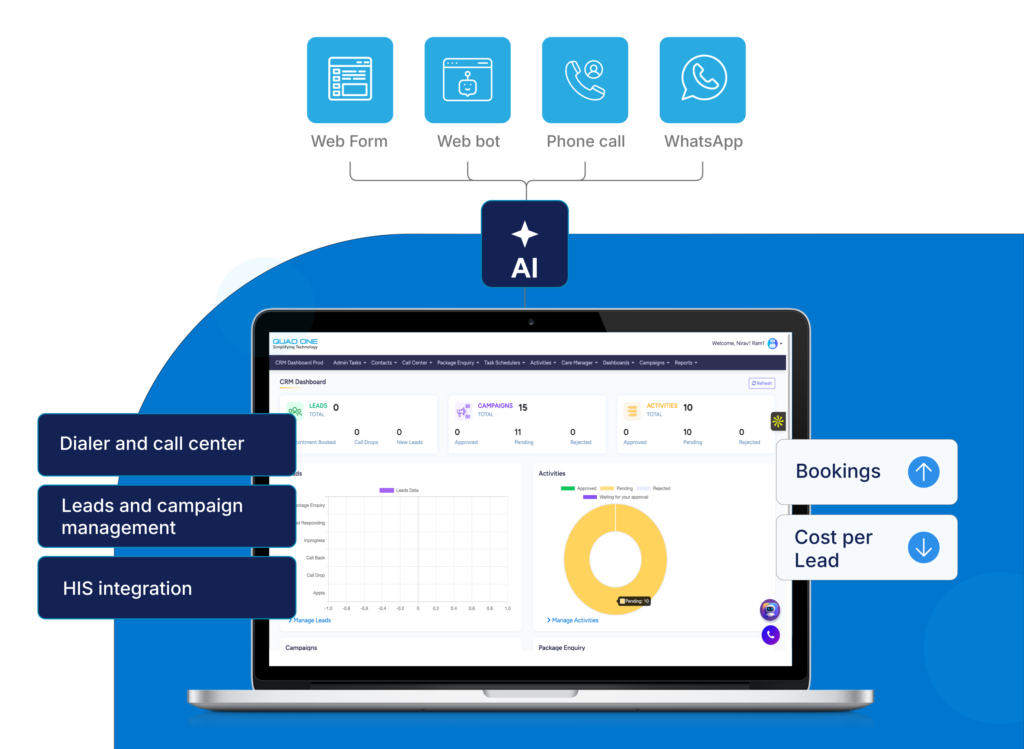
QuadOne Engage brings these workflows together, helping hospitals and diagnostic centers manage patient acquisition, communication, follow-ups, and retention through a centralized approach.
Why Patient Acquisition Has Become More Complex for Hospitals
A prospective patient may discover a hospital through Google, a social media advertisement, a physician referral, a health campaign, WhatsApp, a website form, or a phone call. Each channel can generate valuable inquiries, but managing them separately creates operational gaps.
For example, a patient may complete an online form requesting information about a cardiology consultation. If the inquiry remains unnoticed for several hours or is manually forwarded between departments, the patient may contact another provider.
The challenge therefore is not simply generating more leads. Hospitals need a reliable process for capturing, assigning, tracking, and following up with every inquiry.
A dedicated CRM for hospitals can create a centralized patient acquisition workflow where inquiries from multiple channels are recorded and routed to the appropriate department or team. Staff can see the source of each inquiry, previous interactions, follow-up status, and next action without depending on separate spreadsheets or personal notes.
This gives hospital marketing and patient-service teams greater visibility into the complete acquisition funnel.
Turning Patient Inquiries into Confirmed Appointments
Generating inquiries through healthcare marketing campaigns is only the beginning. The real value appears when those inquiries translate into appointments and completed visits.
There are several points where potential patients can drop out:
- The hospital responds too slowly.
- A patient cannot reach the right department.
- Follow-up calls are forgotten.
- Appointment information is unclear.
- Patients do not receive reminders.
- Rescheduling becomes inconvenient.
A hospital CRM can reduce these gaps by providing structured follow-up workflows.
When an inquiry enters the system, it can be assigned to the relevant team based on department, service, location, or other predefined criteria. Patient-service representatives can then record conversations, schedule next actions, and track the inquiry until an appointment is confirmed.
Automated reminders can further support patients before their scheduled visits. Rather than relying entirely on employees to make repetitive calls, hospitals can use digital communication to remind patients about upcoming appointments and provide relevant instructions.
The result is a more consistent experience for both patients and staff.
Understand Which Marketing Channels Actually Generate Patients
Healthcare organizations invest significantly in search advertising, social media, physician outreach, health camps, referral programs, and other acquisition activities.
However, measuring campaign success only through impressions, clicks, or form submissions provides an incomplete picture.
The more important questions are:
Which campaigns generate qualified patient inquiries?
Which channels produce the most appointments?
Which departments receive the highest-quality leads?
Where are prospective patients dropping out?
A CRM for hospitals helps connect inquiry sources with subsequent stages of the patient journey. Instead of evaluating campaigns only by lead volume, healthcare marketing teams can examine which sources contribute to meaningful patient actions.
This improves marketing visibility and can help organizations allocate their acquisition budgets more effectively.
Patient Acquisition Should Not End After the First Visit
Hospitals sometimes treat acquisition and retention as separate activities. In reality, they are closely connected.
Acquiring a patient requires marketing effort, staff time, communication, and operational resources. Once the patient has visited the hospital, maintaining an appropriate relationship can be just as important as attracting the patient initially.
This is where a patient retention CRM becomes valuable.
Hospitals can use CRM workflows to maintain communication after consultations, procedures, screenings, and other services. Depending on the patient’s needs and communication preferences, this may include appointment follow-ups, preventive health reminders, feedback requests, health-check notifications, or relevant service information.
Instead of contacting every patient with the same message, healthcare teams can segment audiences based on appropriate factors such as department, previous interactions, visit history, or engagement status.
The objective is not excessive messaging. Effective patient retention depends on providing useful communication at relevant stages of the healthcare journey.
How a Patient Retention CRM Supports Long-Term Engagement
Patient retention is influenced by many factors, including quality of care, convenience, communication, trust, and continuity.
Technology cannot replace clinical care or personal relationships, but it can help hospitals ensure that important engagement activities are completed consistently.
A patient retention CRM can support workflows such as:
- Post-visit communication
- Follow-up appointment reminders
- Preventive screening campaigns
- Annual health-check reminders
- Patient feedback collection
- Service recovery follow-ups
- Inactive patient re-engagement
- Personalized communication campaigns
Centralizing these interactions also gives staff better context when communicating with returning patients.
Instead of viewing every interaction as a new inquiry, the team can understand previous engagement and provide a more continuous patient experience.
Why Diagnostic Centers Need CRM Technology Too
Patient acquisition challenges are not limited to hospitals. Diagnostic laboratories and imaging centers also manage high volumes of inquiries, appointment requests, repeat tests, corporate referrals, physician referrals, and preventive healthcare packages.
This makes diagnostic center CRM software increasingly useful for organizations that want to improve both operational coordination and patient engagement.
Consider a diagnostic center offering preventive health packages, imaging services, pathology testing, and specialized screenings. Different inquiries may arrive through websites, calls, WhatsApp campaigns, corporate partners, physicians, and walk-ins.
Without a centralized system, identifying where an inquiry originated and whether it resulted in an appointment can become difficult.
With diagnostic center CRM software, teams can organize patient inquiries, manage communication, monitor follow-up activities, and evaluate acquisition sources within a structured workflow.
Diagnostic centers can also use engagement campaigns to communicate appropriate reminders for recurring health checks or preventive screening programs, helping maintain relationships beyond a single transaction.
Building a Connected Patient Journey with QuadOne Engage
The value of a healthcare CRM increases when acquisition, communication, appointments, follow-ups, and analytics are connected rather than treated as isolated activities.
QuadOne Engage is positioned to help healthcare organizations manage these interactions across the patient lifecycle.
A prospective patient journey could begin with an inquiry generated through a digital campaign. The inquiry can then move through qualification and follow-up, followed by appointment confirmation and pre-visit communication. After the visit, engagement can continue through feedback, relevant follow-ups, reminders, and retention campaigns.
For hospital management teams, this creates greater visibility into what is happening across the patient journey.
For marketing teams, it helps connect campaigns with patient responses.
For patient-service teams, it creates a clearer follow-up process.
And for patients, it can contribute to more timely and consistent communication.
What Hospitals Should Look for in a CRM
When evaluating a hospital CRM, healthcare organizations should focus on how well the platform fits real operational workflows rather than simply comparing long feature lists.
An effective solution should help teams centralize patient inquiries, assign responsibilities, manage follow-ups, maintain interaction histories, support communication workflows, segment patient audiences, and measure acquisition and engagement performance.
Organizations should also consider how the CRM will work alongside existing hospital technology and internal processes.
The best CRM for hospitals is ultimately one that employees can use consistently and that provides management with meaningful information for improving patient acquisition and engagement.
From Patient Leads to Long-Term Relationships
Healthcare growth is increasingly shaped by what happens between clinical encounters.
A missed inquiry can become a lost appointment. A forgotten follow-up can become a lost patient relationship. An untracked marketing campaign can continue consuming budget without demonstrating meaningful results.
A well-designed hospital CRM gives healthcare organizations a structured way to manage these touchpoints.
By combining patient acquisition workflows with ongoing engagement, QuadOne Engage can help hospitals move beyond fragmented lead management toward a connected patient relationship strategy.
Conclusion
This dailystorypro article must have given you a clear understanding of the topic. The same principle applies to diagnostic providers. Using specialized diagnostic center CRM software can help laboratories and imaging centers manage inquiries, appointments, campaigns, and recurring engagement more systematically.
Ultimately, patient acquisition should not be viewed as a single marketing event. It is the beginning of a relationship. With the right patient retention CRM strategy and a healthcare-focused platform such as QuadOne Engage, hospitals can build a more organized journey from the first inquiry through appointment conversion, continued engagement, and long-term patient relationships.