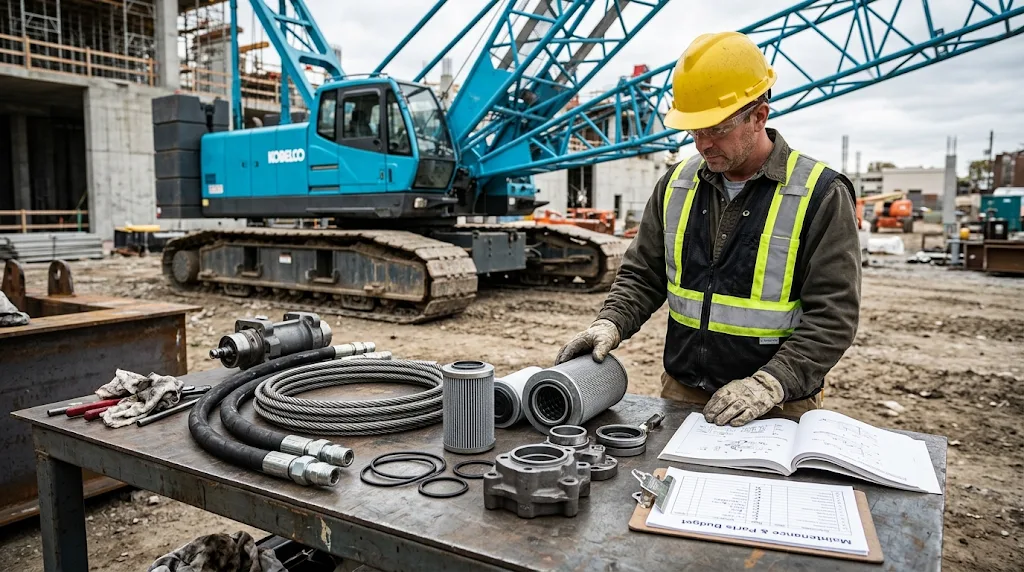
Every operator has months when the machine behaves and months when it does not. A good year might mean filters, grease, and one hose. A bad year can consume a wire rope, a swing motor seal, and a hydraulic pump before the quarter closes.
No spreadsheet prevents those failures. What a spreadsheet does is absorb them. You draw from funds already earmarked for Kobelco parts instead of paying a rush price the morning something breaks. Whether you own a single unit or twenty, the framework below applies.
Start From the Service Schedule
Ignore the parts catalog for now. Open the service manual and find the periodic maintenance table. It records what gets inspected and replaced at every interval, from the daily walkaround to the heaviest annual tasks.
Separate the consumables from that table first: filters, hydraulic oil, grease, fuel filters, cabin items. They recur on a fixed rhythm regardless of how the machine performs, which makes them the easiest section to price. One call to your dealer’s counter returns everything you need for the year.
Transcribing the table into a simple spreadsheet takes an hour and pays for itself by December. Item, interval, last replacement date — three columns are enough.
The schedule cannot tell you when a wear component will fail. That problem requires a different tool.
Sort the Spending Three Ways
Everything you purchase this year belongs to one of three categories, and each category demands a different treatment.
Consumables are the scheduled purchases: filters, fluids, grease, bulbs, wipers. Their timing follows the calendar, and their quantities follow the manual.
Wear items deteriorate through use rather than through dates. Wire rope, brake components, hydraulic hoses, seals and O-rings, pins, bushings, and crawler undercarriage all qualify. Monitor them on a schedule; replace them when measurements reach the limit.
Breakdowns are the unplanned events. The sensor that dies without a hint. The pump that starts howling in November. Nobody predicts these. The budget can only hold reserves against them.
Blending the three into one number is the common failure. A filter follows a schedule; a pump follows chance. Keep them separate and the plan begins to reflect reality.
Factor In Age, Hours, and Conditions
Two machines of the identical model rarely cost the same to keep running. Three variables explain nearly all of the difference.
Age and hours come first. A crane under five years old with modest hours mostly requires consumables. Past 10,000 hours, the wear list lengthens considerably. Hoses hardened by years of heat cycles begin weeping, seals dry out, and pins develop play. Budget accordingly, and expect the annual figure to rise with each passing year.
Duty cycle shapes how quickly components disappear. Heavy demolition consumes parts far faster than steel erection performed a few months each year. Rough terrain compounds the damage to the undercarriage.
Environment completes the estimate. Dust shortens filter life and contaminates hydraulic circuits. Salt air attacks wire rope and exposed pins. If your sites are unforgiving, the totals should say so.
Average two years of invoices and add 10 to 15 percent for aging to get a working base. With no history available, consult the dealer’s parts counter or an operator running the same model.
Match Each System to a Supplier
Three sourcing routes are realistic, and each belongs somewhere in the plan.
Factory-original components carry the highest cost and the least doubt. They are the sensible default for hydraulics, safety devices such as the load moment indicator, and anything sealed inside a winch or swing drive. When a failure would sideline the crane for a week, the premium shrinks into nothing. For core systems, genuine Kobelco parts remain the low-risk choice.
The aftermarket spans a wide range. Quality crane parts from a specialist who actually understands these machines can reduce spend on filters, hoses, pins, and undercarriage wear. Weak vendors push cheap components that fail early and sometimes drag seals and pumps down with them. Judge a supplier on whether it stands behind what it sells, not on the tag.
Used and rebuilt units from dismantled cranes suit older machines whose replacement value approaches the machine’s worth. Cabs, covers, and cosmetic panels are reasonable candidates. Anything carrying load or holding pressure is not.
Most fleets blend all three routes, and the blending reflects sound judgment rather than compromise. Decide your sourcing policy per system before the year opens. The choice reshapes every line that follows.
Assemble the Numbers Machine by Machine
Estimating per fleet produces fiction. A five-year-old crawler and an older rough terrain crane share almost nothing, and their Kobelco parts costs will look nothing alike.
Begin with the fixed line: consumables priced through your supplier. Add the wear items due this year, where inspection records prove their worth. The rope nearing its discard limit, the hoses with cracked covers, the brakes flagged last quarter — price them now, even when the date remains uncertain. If a major service falls due, request the parts list and obtain a written quote.
Then apply contingency: ten to twenty percent of the running total. Older cranes and heavier duty cycles justify the upper figure. This reserve covers the pump that dies in November. Omit it, and one difficult quarter dismantles the plan.
Keep labor out of this budget; mixing them muddies both. Track freight separately as well. Ordering a wire rope two weeks ahead costs far less than expediting it after a failed inspection, and the lesson generalizes across the whole year.
The output is an annual figure for each machine. It will not be exact, but it will be honest.
Weigh the Cost of an Idle Crane
Here is the piece people skip. A parts budget is not really about parts. It is about keeping a machine earning. An idle crane costs you every day: lost rental income, contract penalties, a crew standing around.
When a six-week-old seal fails and the replacement takes two weeks to arrive, the saving has already evaporated before the job finishes. That arithmetic should reinforce three habits. Order ahead rather than pay for expedited freight, and hold a small shelf of critical spares — filters and common seals — when utilization stays high.
Suppliers who carry quality crane parts shorten those waits considerably, because the item is already on the shelf rather than in transit. Choosing them is a form of downtime insurance, not merely a purchasing decision. The payoff shows up most clearly in weeks when the schedule has no slack.
Revisit the Plan Every Three Months
A budget stays theoretical until it meets actual spending. Put a recurring reminder on the calendar.
Compare projected figures against real outlays. Note what failed early and what slipped into the following year. Two quiet quarters in a row suggest your estimates ran high. A reserve emptied by June suggests the fleet is aging faster than assumed. Adjust the assumptions in response.
The review also tests your supply chain. Consistent delays from any vendor, including those providing quality crane parts, signal a need to reorder earlier. After two or three cycles, the numbers settle near reality, reflecting your machines, sites, and crews rather than generalizations.
What Steady Budgeting Delivers
Annual parts budgeting is unglamorous work. Read the schedule, divide the spending, quote each sourcing route, add a cushion for the unforeseen, and check the figures four times a year.
Handle it well, and Kobelco parts stop being a string of emergencies and become an ordinary planned expense. The office finds the year easier to forecast. So do you, the week a winch motor fails in March.