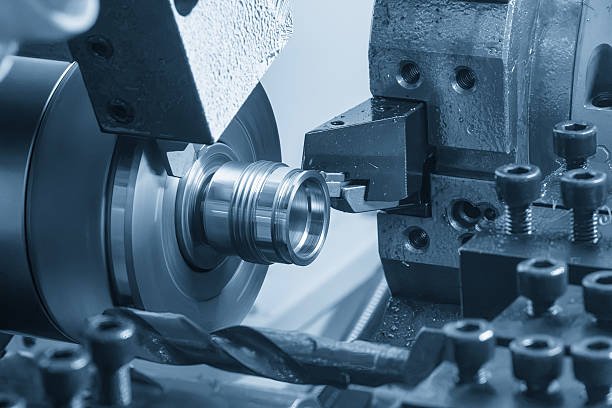
From a drawing, choosing a machining operation can seem quite straightforward. However, look at the feature sizes, and you’ll often see something unexpected. Perhaps a part has a very small diameter and a few tiny features, with tight tolerances and a surface finish that doesn’t allow much margin for error. At this point, we bring into the conversation: swiss type turning. Both swiss type turning and traditional CNC turning use computer-controlled cutting tools to make components accurately; you just have to know the difference. Design engineers would want to know what that difference is because it affects the quality of the part, how long it takes to produce, tooling cost, and how easily the part can be scaled up. Let’s be honest, you wouldn’t want to try machining an aesthetically designed part in the shop that is not easy to machine.
Standard CNC Turning Process
Standard CNC turning is a very popular manufacturing method for producing bar-shaped parts. The workpiece is held in a chuck, and a cutting tool removes material as the part rotates. CNC turning centers are programmed to precisely follow instructions, which means that the dimensions, profiles, grooves, threads, and other features can be achieved with very high repeatability. CNC turning is suitable for a wide range of shaft, bushing, spacer, fitting, and related components where the length-to-diameter ratio of the part is reasonable. Live tooling and multiple axes can be employed to enable milling, drilling, and other types of machining operations as well, all in the same machine, avoiding the need to move the component between different centers and so on. This can be an advantage when manufacturing related components or multiple different parts for an assembly. With that being said, extremely long, skinny pieces are more difficult to machine on a CNC turning center. As the cutting tool presses against the component, a long, unsupported section can flex or vibrate. This can lead to dimensional inaccuracies, chatter marks, and an irregular surface finish, especially on longer and narrower components. Although it’s not always an issue, engineers should be cautious of the geometry of the part.
How is Swiss-Type Turning Different?
Swiss-type turning takes an alternative approach to provide some rigidity support to the workpiece. The material bar stock is fed through a guide bushing that supports it near the cutting zone. Instead of a chuck-based setup that often dominates turning with support, the machine feeds the material through the guide bushing while the tooling is cutting the exposed portion of the workpiece. Why does that matter? The shorter unsupported length will help improve the rigidity of the process, helping reduce deflection in small-diameter and long workpieces. This can be used when controlling a feature along the full length of a reasonably long workpiece. It can also be used to help maintain the quality of a surface finish when cutting into more fragile features. Modern Swiss-type machines can have multiple axes, multiple tools, and even significant secondary capabilities, depending on the part’s design. This can often reduce further handling and secondary machining. Swiss turning is commonly used for medical components, fasteners, electronic connectors, aerospace parts, and other small, precision components. But the right application is not for everyone, so its capability, materials, batch size, feature geometry, and cost should all be taken into account. Guide bushing support is a powerful technique when it’s the correct process.
Comparing the Two Processes: Accuracy, Geometry, and Part Size
The real difference between the two types is in the workpiece support and the geometry being machined. Conventional CNC turning has advantages when machining for longer and short diameter components or general CNC turning applications. Swiss turning is best when working with a thinner or smaller diameter or if multiple features are desired along the length of the part. Let’s take a second look at accuracy. Both operations are capable of close tolerances when the right combination of the right machine, tooling, material, and inspection techniques exists. Swiss-type turning isn’t necessarily more accurate across all features. Its real benefit is that the guide bushing can minimize part movement and deflection during machining, a potential boon for longer, slender parts. Surface finish is influenced by more than machine choice, too. Cutting conditions, geometry, material, coolant, and tool wear are certainly factors. The same applies to repeatability through the run. And of course, design engineers should consider how features are distributed on the parts. Cross-holes, threads, and small diameters may be produced efficiently on a multi-axis Swiss, as well as multiple grooves. A standard CNC lathe with live tooling might get the job done just as well. Ultimately, it’s about the part as a whole.
Material Selection, Production Volume, and Manufacturing Cost
Material choice can impact your decision as heavily as geometry, with stainless steel, aluminium, brass, titanium, and some high-performance alloys all being machinable on the same turning equipment, but the material behaviour is very different. Some materials may cut well but generate a lot of heat; some may produce a lot of tool wear; some may not be quite as user-friendly when turning small features. With more difficult materials, such as titanium or nickel-based alloys, it is worth consulting the machine house on cutting strategy, tooling, inspection, and chip control requirements. A process that works well for aluminium may need significant modification to work well on a tougher alloy. Volume of production is another factor. Swiss-type turning can be incredibly productive when a small component needs multiple operations and is quickly processed to completion in a single setup. This reduces handling and multiple-fixture processing, but setup time, programming, tooling, and the initial bar-stock consumption all impact the final cost. A short run of relatively simple parts may be more economically done on a traditional CNC lathe. A long run of complex, slim components is more likely to be cost-effective on a Swiss machine. Both options can be advantageous, but don’t assume either based purely on pricing per piece. Many high-precision manufacturing methods cost money to set up; ask for a machining consultancy on the actual drawing and volume.
Design Considerations Engineers Should Discuss Before Production
A little design-for-manufacturing can go a long way. Start with tolerances. Not all part dimensions need to be held so tightly that inspection becomes more time-consuming. Sometimes tolerances are tighter than necessary and increase machining cost and cycle time. Engineers may need to revisit tolerances and determine if they are necessary for assembly or function. Next, check length versus diameter. Longer, thinner components often benefit from the support of a Swiss-type machine, while shorter or thicker geometries could be done on a traditional CNC turning machine. Check internal bores, thread depths and sizes, groove width, cross-holes, and access for tooling. Certain features may require secondary operations or additional tooling in either machine. Also, consider internal bore conditions. Certain materials lend themselves to easier operation, or different conditions should be discussed at the beginning of the project, such as bar stock straightness, hardness, or uniformity. Engineers should also ask machine shops about the tolerances they can realistically achieve, the surface finish they can get, and inspection capabilities, and whether they can hold the same tolerance throughout the run. Lastly, have a discussion with the manufacturer before the end of the design phase. Sometimes a small change to the design can reduce cycle time or machining cost while not compromising the integrity of the part. For example, a minor change to the groove or reducing or eliminating a tight tolerance on a feature.
Conclusion: Match the Process to the Part
Swiss-type turning and conventional CNC turning of the same material and using the same processing methods solve many similar manufacturing issues; however, they are not always a substitute for one another. Conventional CNC turning is still an effective means to process a wide variety of cylindrical parts and, where the size and shape of the part are compatible with standard machine tools, it remains a viable option. Swiss-type turning provides value-added benefits when small diameters, long, thin sections, complex features, and tight tolerances coincide. For design engineers, the answer isn’t necessarily the newest machine out there. The answer is to find a process that can reliably produce the part at a reasonable cost and at the quantities required. That’s done by reviewing geometry, tolerances, material, volume, inspection requirements, and more as a unified package. Finding the right machine and process from an experienced manufacturer can actually help answer those questions before they become costly production issues. An experienced supplier will review the drawing, offer an explanation of its limitations, and recommend an approach rather than trying to force all parts through the same process. Whether it’s conventional turning or precision Swiss machining, a discussion at the design stage is probably worth having. Get the process right at the start, and the rest of the job will seem much more manageable.