Two summers ago, I was lounging on the porch of a good friend’s house in Jaipur, quenching my thirst with masala tea and enjoying the sound of three gigantic diesel generators humming in a very rhythmic and powerful way that drowned out the neighbors. It was a scorching day that pushed the temperature to 44°C, while the local DISCOM announced yet another two-hour load shedding. In the process, the electricity had to be switched off without giving a prior notice.
He ran to get his mobile and handed it to me to see the utility bill of his standalone villa. It was a shocking ₹18, 500 just for one month.
“I am not just wasting my resources for air conditioning but only to enable my family to sleep peacefully, and I think half of this power supply is being generated from dirty generators”, my friend commented to me.
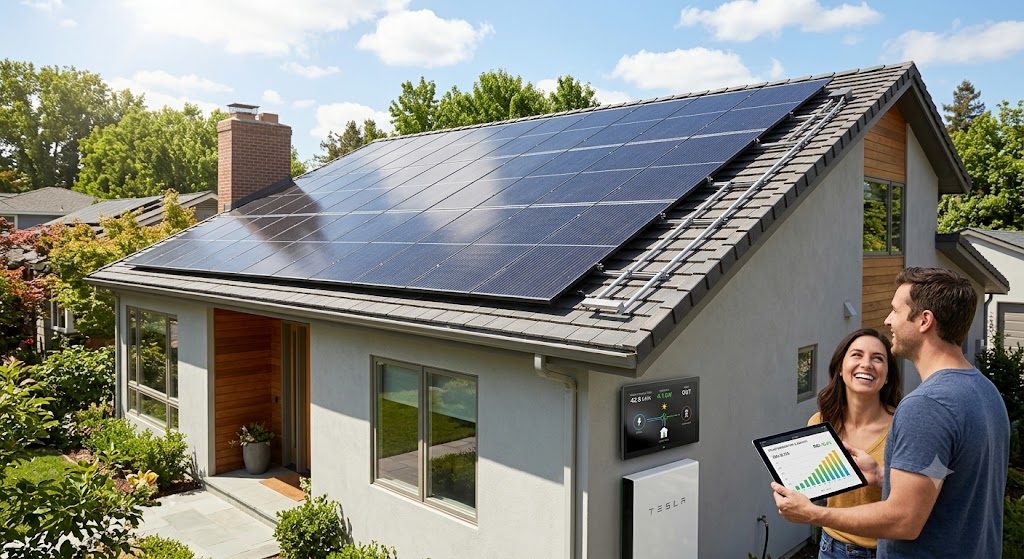
The instant was exactly when we decided to examine his sun-baked and unused roof of the size of 1, 200 square feet. He didn’t need another inverter battery or a bigger genset; it only required that he treat the roof as productive estate. It only took us a minute at the end of the day to reach the conclusion that he only needed solar panels to get rid of this problem.
Now that the day has come, he has reduced the utility payment that the house is making to about 85%. Also, his consumption of energy from the grid at daylight hours is basically zero. In short, besides being a liability that the family will constantly have, it has also become a high-yield investment asset that is appreciating the capital.
If you are a resident of India with your house having an unshaded rooftop, maybe you are asking yourself the very same question as my friend was: is making a residential investment by means of acquiring a solar rooftop system for home something worth doing today besides giving a good feeling for the environment?
The truth is that even when we just look at the numbers as they stand and consider the national PM Surya Ghar initiative policies on an ongoing basis or the speed at which electricity prices are going up, there is definitely a case for being enthusiastic not just to be agreeing with saying yes but at least the financial advantage is multi-layers of the response that we should come up with. Let us first take a look at how solar energy is generated for a house as a power system, the areas of weakness, and the way that can help you make a smooth transition without going through the sub-standard setups.
Closer Look: How a change from Grid Powered Electricity to Solar Rooftop Makes Financial Sense
Cities and towns throughout India have traditionally taken electricity for granted as an expense that needs to be paid on the monthly billing cycle with no choice. You just sit back and hope for the best, receiving the electricity bill at the end of the month, complaining about the increasing slab rates, paying it, and repeating this all over again.
Actually, take a close look at the billing for residential electricity in most of the Indian states. In effect, the electricity companies offer their customers electricity with the help of their slab tariff system, meaning that you pay more and more the heavier the electric consumption, or the further the usage, the more the bill. For states like Maharashtra, Delhi or Uttar Pradesh, it is quite common for high electricity usage families to be getting charged as much as ₹8 to ₹11 for each power consumption unit (kWh). It means that you pay not only for the energy, but also the extra cost as a kind of punishment for needing more comfort than average citizens.
When shifting the energy generation mode to producing your own clean energy, you can limit the long-term energy cost. By not continuously renting electricity from a state-owned utility company, you will commit yourself to an energy payback level (LCOE) that often turns on an electricity cost as low as ₹2.50 per unit on top of that, within the 25 years of the device’s use.
It is not always the case to me that people consider home improvements as a pure expenditure such as for example kitchen renovation or the purchase of a fresh sofa that loses value the moment it is installed. Conversely, a well-planned and designed home energy source operates like an ultra-high-yielding, tax-free, fixed deposit, directly transferring the cash to you in the form of avoided utility payments in your pocket month after month.
The Financial Aspects: The Breakdown of Cost, Subsidies, and Actual Return
We will speak about money, plain, simple, honest numbers since without proper math an ‘Ultimate Guide’ will be just a collection of words.
The residential solar initial investment (CAPEX) in India has declined significantly over the past five years even with the panel efficiency increase. However, at this point in time, the game-changing factor is the direct financial support offered by the central government through the PM Surya Ghar: Muft Bijli Yojana.
Understanding the PM Surya Ghar Subsidy Scheme
The scheme offers the Central Financial Assistance (CFA), specially tailor-made to heavily subsidize small domestic systems:
- Capacity: A capacity below 1 kilowatt (kW) will get a central government subsidy of ₹30 thousand as direct financial assistance under the PM Surya Ghar Scheme
- Capacity: Under the PM Surya Ghar Scheme, a capacity from 1 kW to 2 kW will get a Central Government subsidy of ₹60 thousand directly from the Centre.
- Capacity: Under PM Surya Ghar Scheme, for a capacity between 3kW and 10 kW, the subsidy given by the central government will maximum be up to ₹78 thousand. So it’s a fixed maximum level.
This means on paper you are getting a huge subsidy and a very fair financial incentive is covered 40% 50% at least of the cost if a normal 3 kW setup is used, the main thing being that the standard system capacity of around 3kW is the perfect choice for the vast majority of 3 BHK house in our country in which two ACs are being used, fridge and washing machines are the major appliances other than regular appliances.
Important Remark: The amount of the subsidies depends on the benchmark rates and will be released straight to your account which is linked with your Aadhaar number through direct benefit transfer (DBT) only after the net meter is commissioned and yourDISCOM has done the verification. Do not accept the offer of local shops which say they ‘subtract the subsidy first hand’ using unapproved items!
Payback Scenario: A sample of 3 kW system
Let us calculate how a net-metered 3 kW solar system installed in a house in India would perform financially after the initial investment.
Consider that the investment required after the grant will amount to about ₹1.02 million, while your return will take about three years to recover the cost. Beyond the first three years, all electricity that the installation produces during the 22 years left under your warranty is pure profit.
Let any company sell me equity or lease commercial real estate offering me virtually risk-free and without tax Internal Rate of Return (IRR) around 25-30% yearly, I won’t believe, no way!
Right Sizing the System: Real Power Consumption
One of the things driving me crazy, apart from anything else, is when homeowners blindly decide to go for a certain system size either because a neighbor installed it or a talkative salesperson recommended a one-size-fits-all.
Solar capacity determination is not a matter of random guessing; instead, it is a well-researched and scientifically backed calculation that takes into consideration your actual load curves, seasonal fluctuations, and physical conditions of the roof surface.
Step 1: Review of Annual Electricity Consumption
Take a look at all your electricity bills for the last twelve months. Don’t stop yourself at the peak summer bill May, for instance!. See the whole year for getting average monthly electricity consumption (in kWh).
- Below 150 Units/Month: Usually, a 1 kW to 2 kW system will suffice.
- 150 to 300 Units/Month: 2 kW to 3 kW capacity will suit you well.
- 300 to 500 Units/Month: Your best bet would be a 4 kW to 5 kW unit.
- Above 500 Units/Month: You will need 6 kW to 10+ kW with three-phase connection maybe.
To summarize: 1 kW of solar capacity oriented perfectly facing east or south in India would result in 4 kWh on an average day (monsoons included). In case the requirement of your house is 12 kWh daily, 3 kW will meet your annual power needs almost spot on.
Step 2: Inspection of Roof Surface and Structural Condition
Roughly 80-100 sq. ft. of unshaded, clear space is required for a regular 1 kW solar system installation. A normal 3 kW system, however, calls for 250-300 sq. ft. area.
Nevertheless, and that being a big one, it is all not about just the square footage you have; it’s about orientation and shading. If you are in the Northern Hemisphere, the panels will have to face the direction of true South as far as possible, and will be pitched to angle equal to roughly to the latitude of your city (e.g., approximately 27 degrees for New Delhi or 19 degrees for Mumbai) to capture the maximum solar irradiation throughout the year.
The production will definitely be affected if your roof is shadowed by rooftop water tanks, parapets, stairwell walls, or neighboring high-rise buildings, and so on, during the solar peak window: between 10:00am and 4:00 pm
Technical Vetting: Component Selection Beyond the Brochure
Digging deep into technical jargon will be the only way to figure out whether you are getting a durable 25 years’ installation or a system likely to fail right before your eyes in 4 years. The solar installation people will present to you quotations containing words like TOPCon, Mono PERC, On-Grid, Microinverters ALMM not knowing what it is yourself.
Here is the short guide to the components of solar energy equipment which is intended for the user who is knowledgeable of purchasing.
1. Choice of Solar Module Technology: Mono PERC vsTOPCon
In the meanwhile, we have left behind Polycrystalline modules (which used to be blue and speckled panels 10 years ago). It’s a decision whether to go for two primary technologies:
- Mono PERC (Passivated Emitter and Rear Cell): Most solar systems nowadays come with these panels. They yield about 20% 21.5%. Apart from being very durable, the price is quite affordable.
- TOPCon (Tunnel Oxide Passivated Contact): TOPCon technology is what homeowners are turning to in order to have the best home solar set up nowadays. Efficiency of these panels is in the range of 22.5% 24%. Also, the temperature coefficient how much the efficiency will drop as the temperature increases is much better for TOPCon panels. Which means that if your roof heats up to 45 degrees Celsius during the summer peak, TOPCon panels will lose a lot less energy than other kinds of panels. These also perform much better when it is cloudy and raining heavily.
Rule No.-2: According to the Indian government regulation, if your solar panel is not the type that you can qualify for Central Subsidy of Solar, your solar panel must be one manufactured by MNRE (Ministry of New and Renewable Energy) ALMM (Approved List of Models and Manufacturers) and it should use Domestic Content Requirement (DCR) cells where specified. Do not be a customer for a vendor, who is selling an imported (non- ALMM) panel at a discounted price. Not only will you lose your subsidy, there is every chance that DISCOM will say No to net-metering approval.
-
Brain Behind the System: Inverter
The electricity produced by the AC can be used to operate all the loads connected to it.
String Inverters: One central unit wherein all panels are connected in series. It is an economical, highly efficient choice for roofs where you can get uniform sunlight all the time.
- Microinverters: They are small in size and located behind each panel. These allow the unshaded panels to still generate electricity at maximum level even if only one panel within the whole string is shaded, for example, shaded due to a chimneypiece or due to bird droppings.
- Hybrid Inverters: It connects the battery along with the inverter. If there are power outages, you will still be getting energy to some loads such as fans, lights, and wifi.
3. Balance of System (BOS): The Unsung Heroes
Do not allow the sellers to give poor quality hardware or to cut corners on protection equipment while selling you a complete solar system.
Insist on galvanised steel or anodized aluminium mounts that can carry a load for 150 km/h strong winds. Require flame resistant, solar resistant DC cables (with the standard cross-section of 4 sqm or 6 sqm) and get proper earthing protection by using 3 earthing pits (a pit each for solar panels, solar inverter & a Lightning Arrester). You really don’t want a lightning strike to destroy your expensive equipment and even your house.
Ongrid vs Hybrid vs OffGrid: Which Kind of the HomeSolar Suitcase Is Suitable for You?
Whether it is a grid-linked, hybrid or a battery based system, the final decision is a reflection of the level of trust you have in the local utility grid.
Option A: On-GridSolar Installation
This is by far the most convenient, economical setup for an urban Indian home. Solar power from your PV panels first goes into your own home’s switchboard and any extra electricity produced is released into the grid via the two-way net meter. Your meter automatically draws the power from the grid when solar power generation has stopped at night. In the end, you will be billed by the DISCOM for just the balance or the net difference (Units Consumed Units Exported).
- Pros: Lowest investment needed, quicker return on investment (about 3 years), easy maintenance, eligible for complete government of PM Surya Ghar.
- Cons: If the grid is down, your solar system will shut down for the safety of line workers who repair grid cables.
Option B: Hybrid System
A solar system with grid power and batteries is called a hybrid system. Any excess daytime electricity you produce first charges your batteries. Only then, the remaining is exported to the grid.
- Pros: During grid failures, you will not face any power interruptions.
- Cons: Higher initial cost due to lithium battery packs; batteries have to be replaced every 8 to 10 years; overall, total ROI percentage is lower compared to pure on-grid.
Option C: Off-Grid System
This system is entirely independent from the utility grid and depends solely on big battery arrays. This is practically the only way for very remote farmhouses, hill stations, or villages where there is no grid line at all. Due to the high battery replacement cost and low efficiency, it is hardly advised for urban home installation.
From Site Survey to Net Metering: Step Guide
Congratulations, you’ve gone through all the numbers, you’ve done a roof audit, and you’ve decided to go for a Home Solar Rooftop system. Now, what happens after? Implementation-wise, what is the real, actual process in the field?
Honestly, things were a bit hectic earlier involving endless documentation, meeting up with engineers at the local DISCOM, etc. But thank god for the central scheme of PM Surya Ghar that has done away with all the hassle and the entire process from beginning to end is being handled digitally through a portal at each clear stage:
- Register on the Portal: Go to the PM Surya Ghar site (pmsuryaghar.gov.in) and get yourself registered by using your mobile number, choose your state and DISCOM, and then your latest electricity bill will give you your Consumer Account Number.
- TechnicalFeasibilityReport (TFR): Your local DISCOM assesses whether your transformer is big enough to handle this, and whether technically feasible, all via the digital platform. That is why you should count on this part taking 7 to 14 days only.
- Appointment of an Empanelled Vendor: You can select an authorized vendor from the portal’s directory of vendors. It is very important that they carry out a physical site inspection to identify the shadows’ profile for each panel and assess whether there’s enough structural capacity to bear the weight of panels, before entering into any agreement.
- Installation & Commissioning: The contractor/ vendor would be the one to put up the solar panels, inverter (converter) device, mounting structures, AC / DC power distribution boxes and safety grounding. This phase generally takes about 2 to 4 days.
- Net Metering & Inspection: The DISCOM inspector checks site, installation, and checks for safety compliance, then installs bidirectional net meter. Lastly, a Commissioning Certificate is given.
- Subsidy Credit: The vendor sends the Project Completion Report (PCR) with images of your solar setup on the portal. Approval of the subsidy is the final step and after that it’s just a matter of 30-45 days for the money to come straight to your bank account via Direct Benefit Transfer (DBT).
Vendors to Go With: Checklist of Questions that You Definitely Have to Ask the Vendors before you Sign Off
Before you are handing over the booking token or signing the EPC (Engineering, Procurement and Construction contract), give the following checklist to your prospective installer and insist that the replies be in writing:
- ALMM Listing: Is the supplier company or model of the solar modules that they have mentioned actually registered with the MNRE’s ALMM registry in the current list? Ask for the exact name of the manufacturer plus the model number.
- Battery Warranty Documentation: Are the units being offered coming with a minimum 10-year warranty for the product itself and also carrying a 25-year linear performance warranty which means you will be assured of at least 80% to 84% output level even at the 25th year?
- Inverter Protection: Does the inverter have a comprehensive warranty which is the replacement of the new one for a minimum of one 5-year or 10-year period?
- Mounting Structure Certification: Is the mounting structure wind-speed, hot-dip galvanized (minimum coating of 80 microns) certified, and has it been installed keeping in mind that there should be an elevated level so that a roof access is facilitated?
- Disclosure Of Net metering: Is the vendor bound by the contract for the DISCOM (Distribution Company) end-to-end coordination and net meter procurement? Otherwise, you could be stuck chasing local linesmen for help.
- Maintenance Agreement: Is the maintenance part of a solar plant in which at least 1 to 2 years, post-installation, you will be given free preventative maintenance? Things like cleaning checks, thermographical checks of the connections and cable tension checks will be included.
Final Verdict: Is Home Solar Worth It Today?
Let’s have a broader look.
Energy prices in India can’t go down. Alongside increased electrification, we will also experience electric vehicles on our roads, the summer heat waves will result in longer usage of air conditioning, hence, the power demand will only rise. On the other hand, the electricity tariff is secretly going up every year by 5% to 8%.
Putting up a home Solar Rooftop System is not merely a green choice or a change of fashion. It is a well thought-out, well strategized financial decision that makes your roof which is otherwise idle a power plant that generates money. This protects your family’s finances from inflation, it significantly brings down your expenditures which are your monthly living, it makes you the top performer in terms of ROI which most conventional investment options can’t beat and at the same time you’ll be comfortable daily without worrying about utility bills.
There is a very high level of technical reliability in the solar PV industry today. Moreover, the policy incentives for solar installation have reached a record level and the system of installation, sale and maintenance is getting more and more transparent from day to day.
If you want, stop your roof getting heat without giving you anything in return. Take your terrace back, your energy sovereignty and your rooftop into a money-printing machine which it always wanted to be.