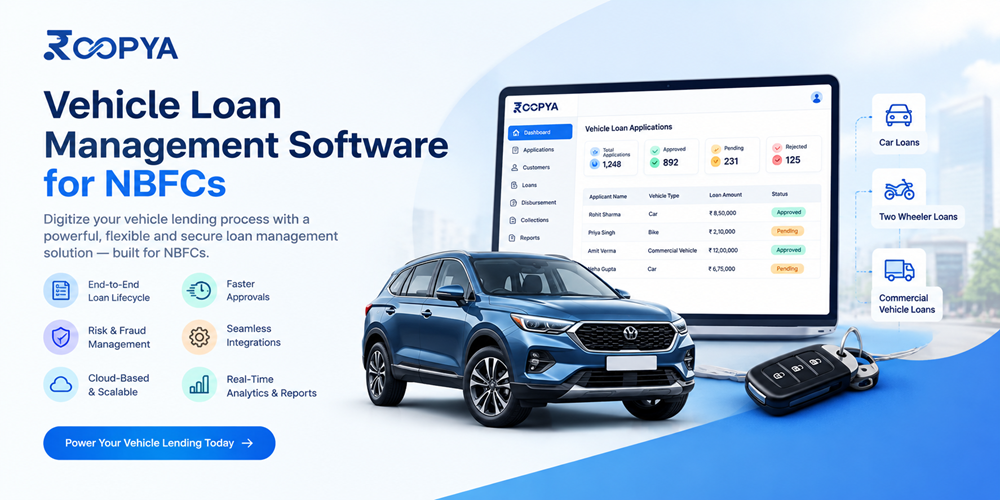
Manage vehicle loans end-to-end with Roopya's LMS for NBFCs - EMI collection, RC & hypothecation tracking, GPS-based recovery and RBI-compliant reporting
India’s vehicle finance market is one of the largest lending categories NBFCs serve, spanning two-wheelers, used cars, commercial vehicles, tractors and a fast-growing electric vehicle segment. Winning the loan is only half the job. What actually determines profitability is what happens after disbursement: EMI collection, hypothecation and RC tracking, insurance renewals, delinquency management, repossession and recovery. This is the job of vehicle loan management software (LMS) – the system of record that runs a vehicle loan from disbursement to closure.
Many NBFCs still run this post-disbursement lifecycle on spreadsheets, generic accounting tools or loan systems built for unsecured personal loans. Vehicle loans are different. They carry a physical, depreciating, mobile asset as collateral, involve dealers and DSAs, need vehicle tracking device (VTD) integration, and require repossession workflows that a generic LMS simply was not built for. This guide covers what vehicle loan management software actually does, the features an NBFC should insist on, and how a purpose-built platform changes collection efficiency, NPA levels and operating cost.
The Vehicle Lending Landscape for NBFCs
Vehicle finance NBFCs operate in a segment that behaves very differently from personal or business lending. Ticket sizes range from under ₹1 lakh for a two-wheeler to several crores for a fleet of commercial vehicles. A large share of the borrower base is self-employed, first-time-borrower or has thin credit files, which pushes up early delinquency risk. Add to this used-vehicle deals where valuation and title verification are harder, and a dealer/DSA-led origination model where loan management has to reconcile payouts, subvention and channel incentives.
RBI’s Scale Based Regulation framework, and the more recent Digital Lending Guidelines, have also tightened expectations around data security, disclosure, and default loss guarantee (DLG) arrangements for NBFCs that co-lend or partner with fintechs. On top of this, the asset itself – the vehicle – depreciates, can be moved across states, and needs to be tracked, insured and eventually repossessed if a loan goes bad. None of this is optional detail; it is the operating reality every vehicle loan management system has to be designed around.
What Is Vehicle Loan Management Software?
Vehicle loan management software is the platform that manages a vehicle loan for its entire life after disbursement – amortization and EMI scheduling, payment collection across multiple modes, hypothecation and RC hypothecation-removal tracking, insurance and renewal management, delinquency bucketing, collections workflow, repossession and asset recovery, NPA classification, and provisioning (ECL) reporting. Where a Loan Origination System (LOS) decides whether to lend, the LMS decides how well that loan is serviced once the money is out the door.
For an NBFC, this distinction matters commercially. Origination determines how many loans you can book. Loan management determines what you actually collect, how quickly you recognize risk, and how much you recover when a borrower stops paying. A well-run vehicle LMS directly protects net interest margin and portfolio quality – two numbers that show up on every board deck.
Why a Generic LMS Falls Short for Vehicle Loans
Loan management platforms built for personal loans or SME credit rarely handle the specifics of a secured, physical, moving asset well. Four gaps show up repeatedly when NBFCs try to force-fit a generic system onto a vehicle book:
- Hypothecation and RC tracking: A vehicle loan is only properly secured when the RC reflects the lender’s hypothecation. Generic systems have no workflow to track RC status, chase pending hypothecation entries with RTOs, or flag hypothecation removal after foreclosure.
- Collateral that moves: Unlike property or gold, the collateral can be driven anywhere, resold informally, or hidden ahead of repossession. Systems without GPS/VTD integration lose visibility the moment a loan turns delinquent.
- Dealer and DSA economics: Vehicle loans are heavily channel-driven. Payouts, subvention schemes and dealer incentive slabs need to be tracked against disbursement and repayment performance, which most generic LMS platforms don’t model.
- Repossession as a formal workflow: Recovery on a vehicle loan often ends in repossession and resale of the asset – a multi-step legal and operational process (notice, repossession, valuation, auction, waterfall of proceeds) that a spreadsheet or a personal-loan LMS was never designed to run.
Must-Have Features of Vehicle Loan Management Software for NBFCs
- Amortization, EMI Scheduling and Payment Processing
The core of any LMS is an accurate amortization engine that supports the repayment structures common in vehicle finance – reducing balance, flat rate, bullet/balloon repayments for commercial vehicles, and step-up EMIs for seasonal cash flows (common in tractor and CV loans). It should reconcile payments received through NACH, UPI Autopay, e-mandates, cash collection by field agents, and dealer-collected EMIs, updating the loan ledger in real time.
- Hypothecation, RC and Document Lifecycle Management
The system should track RC hypothecation status end-to-end – pending, endorsed, and removed on foreclosure – with automated reminders for the operations team when an RC endorsement is overdue. Insurance policy numbers, expiry dates and renewal reminders should sit against each loan, since a lapsed policy directly increases the NBFC’s asset risk.
- Vehicle Tracking Device (VTD) and GPS Integration
For higher-risk segments (used vehicles, CVs, higher LTV two-wheelers), integration with GPS/VTD providers lets the collections and recovery teams see live vehicle location the moment an account rolls into an early delinquency bucket, rather than only after it’s already a non-performing asset.
- Delinquency Bucketing, Collections and Recovery Workflow
A vehicle LMS should automatically bucket accounts (0-30, 31-60, 61-90, 90+ DPD), trigger the right treatment for each bucket – SMS/WhatsApp/IVR reminders for early buckets, field agent allocation for mid buckets, legal notice and repossession workflow for later buckets – and let collection managers track agent-wise and branch-wise recovery performance.
- Repossession and Asset Recovery Management
When repossession becomes necessary, the system should manage the full sequence: notice generation, repossession agent assignment, vehicle condition and valuation capture, auction or resale, and the waterfall calculation that applies sale proceeds against outstanding principal, interest and recovery costs, with the shortfall or surplus posted back to the borrower’s account automatically.
- Dealer and DSA Management
Loan management software should track dealer/DSA-wise disbursement volumes, incentive slabs, subvention payouts and clawback triggers (for example, early foreclosure within a defined window), so channel partner payouts reconcile automatically against actual loan performance instead of being managed on a separate spreadsheet.
- NPA Classification and ECL/Provisioning
The system should apply RBI’s NPA classification norms automatically based on DPD, and feed Expected Credit Loss (ECL) computation under Ind AS 109, so the finance team gets provisioning numbers without a manual reconciliation exercise every month-end.
- Early Warning Signals and Portfolio Analytics
Beyond reactive collections, a modern vehicle LMS should surface early warning signals – bounce patterns, partial payment behavior, sudden change in usage pattern from GPS data – so risk teams can intervene before an account actually turns delinquent, along with portfolio-level dashboards on vintage curves, roll-rate analysis and branch/product-wise performance.
- Regulatory Compliance and Data Security
The platform should be built to RBI’s Scale Based Regulation and Digital Lending Guidelines requirements – consent-based data collection, clear disclosure of all-in cost (APR), grievance redressal workflows, and secure handling of borrower and vehicle data – so compliance doesn’t have to be bolted on separately.
- Customer Self-Service Portal
Borrowers should be able to view their loan statement, download interest certificates, pay EMIs, request foreclosure quotes and track their outstanding balance without calling a branch, reducing servicing load on operations teams.
Benefits of Implementing Vehicle Loan Management Software
Faster, more consistent collections. Automated bucketing and treatment workflows mean every delinquent account gets the right action at the right time, instead of depending on an individual collection officer’s memory or discipline.
Lower credit losses. Early warning signals and GPS-based visibility let recovery teams act before an account is fully lost, directly protecting the NBFC’s NPA ratio and provisioning cost.
Reduced operating cost per loan. Automating RC tracking, insurance renewals, dealer payout reconciliation and NPA classification removes manual, error-prone work that otherwise scales linearly with portfolio size.
Better audit and regulatory readiness. A single system of record with a complete audit trail makes RBI inspections, statutory audits and rating agency reviews significantly less painful.
Improved customer experience. Self-service payment options and transparent statements reduce complaint volumes and improve renewal/repeat-loan rates – an important growth lever in vehicle finance, where repeat and referral business is common.
Scalability without proportional headcount growth. As loan book size grows, automation in collections, reconciliation and reporting means the operations team doesn’t need to grow at the same pace as disbursement volume.
How Roopya’s Vehicle Loan Management Platform Helps NBFCs
Roopya is built as a no-code, unified lending infrastructure covering the full loan lifecycle – origination, servicing, collections and early warning – specifically for banks, NBFCs and loan service providers, with dedicated configuration for vehicle and auto loan products.
- Fast go-live: NBFCs can go live on Roopya’s platform in as little as a day, using pre-configured vehicle loan products instead of a multi-month implementation cycle.
- Loan Management System module: Handles portfolio management, payment processing, amortization schedules and a customer self-service portal out of the box.
- Collections System: Runs automated reminders, delinquency-bucket-based collection workflows, structured payment plans and field/agent management, so recovery teams work off a single queue rather than manual call sheets.
- Early Warning System: Uses behavioral analytics and predictive risk models to flag accounts likely to default before they roll into a hard delinquency bucket, with configurable alerts and intervention workflows.
- No-code Business Rule Engine: Lets risk and operations teams configure delinquency treatment rules, escalation triggers, and dealer payout logic themselves, without waiting on engineering changes.
- 300+ pre-integrated APIs: Including credit bureaus, payment gateways and verification services, so RC status checks, e-mandate collections and KYC re-verification don’t need custom integration work.
- AI-powered document analysis and fraud detection: Automates verification of RC, insurance and KYC documents with high accuracy, flagging anomalies before they become collection problems later in the loan’s life.
- Lending analytics and reporting: Gives portfolio managers real-time dashboards on vintage performance, roll rates and branch/product-level trends, plus exportable regulatory reports.
- Compliant by design: The platform is continuously updated to reflect RBI’s evolving Scale Based Regulation and Digital Lending Guidelines, reducing the compliance burden on the NBFC’s own tech and legal teams.
Because the platform is no-code, NBFCs can configure new vehicle loan variants – a new two-wheeler scheme, a used-CV product, a co-lending arrangement – without a fresh development cycle, and adjust collection or repossession workflows as portfolio behavior and regulation change.
Choosing the Right Vehicle Loan Management Software: A Checklist
Before selecting a platform, NBFCs should evaluate vendors against a short, concrete list rather than a generic feature comparison:
- Does it support hypothecation and RC lifecycle tracking natively, not as a manual add-on?
- Can it integrate with GPS/VTD providers already used by your collections and recovery teams?
- Does it automate NPA classification and ECL computation to RBI and Ind AS 109 norms?
- Can dealer/DSA payouts and clawbacks be configured and reconciled automatically?
- Does the collections workflow support multi-channel treatment (SMS, WhatsApp, IVR, field agent) by delinquency bucket?
- Is a structured repossession and asset-recovery workflow built in, including the sale-proceeds waterfall?
- How long is implementation, and does the vendor support your specific vehicle loan variants out of the box?
- Is the platform built to keep pace with RBI’s Digital Lending Guidelines and Scale Based Regulation requirements?
- Can business and risk teams change rules themselves, or does every change require a vendor development cycle?
- What does the pricing model look like as loan book volume scales – fixed licence, per-loan, or usage-based?
Vehicle loans are won at origination but made or lost in servicing. For an NBFC, the difference between a healthy vehicle finance book and a stressed one usually comes down to how well the loan is managed after disbursement – how fast delinquency is caught, how well the hypothecated asset is tracked, and how efficiently recovery happens when it’s needed. Purpose-built vehicle loan management software, with hypothecation tracking, GPS integration, automated collections and RBI-aligned compliance, turns that servicing function from a cost center into a genuine competitive advantage.
Roopya brings origination, loan management, collections and early warning together on a single no-code platform built for exactly this – so NBFCs can launch vehicle loan products fast and manage them well for the life of the loan. Request a demo at roopya.money/contact-us/ to see how it fits your vehicle finance book.
FAQ
Q1. What is vehicle loan management software?
It is a platform that manages a vehicle loan through its entire post-disbursement life – EMI scheduling and collection, hypothecation and RC tracking, insurance renewals, delinquency management, repossession and NPA classification – as distinct from a loan origination system, which handles the application and approval stage.
Q2. How is a vehicle LMS different from a general-purpose loan management system?
A vehicle LMS adds capabilities generic systems don’t have: RC hypothecation lifecycle tracking, GPS/vehicle tracking device integration, dealer/DSA payout reconciliation, and a formal repossession-and-resale workflow for the physical collateral.
Q3. Does vehicle loan management software help reduce NPAs?
Yes. Early warning signals, GPS-based visibility into asset location, and automated, bucket-wise collection treatment let NBFCs act on risk earlier, which directly reduces roll rates into higher delinquency buckets and non-performing status.
Q4. Can vehicle loan management software handle two-wheeler, car, and commercial vehicle loans on one platform?
Yes, a well-designed platform supports multiple vehicle loan variants – two-wheeler, car, used vehicle, commercial vehicle, tractor and EV loans – each configured with its own repayment structure, risk rules and collateral workflow.
Q5. How does the software manage repossession?
It runs repossession as a structured workflow: notice generation, agent assignment, vehicle condition and valuation capture, auction or resale, and automatic calculation of the sale-proceeds waterfall against the outstanding loan balance.
Q6. Is vehicle loan management software compliant with RBI regulations?
Platforms built for Indian NBFCs, like Roopya, are designed around RBI’s Scale Based Regulation and Digital Lending Guidelines, covering areas like data security, cost disclosure, and grievance redressal, and are updated as regulations change.
Q7. How long does it take to implement vehicle loan management software?
Implementation time varies by vendor and complexity. No-code, pre-configured platforms can go live in as little as a day for standard vehicle loan products, while heavily customized enterprise implementations can take several weeks.
Q8. Can this software integrate with GPS or vehicle tracking devices?
Yes, modern vehicle LMS platforms integrate with GPS/VTD providers so collections and recovery teams get real-time location visibility on financed vehicles once an account shows delinquency risk.