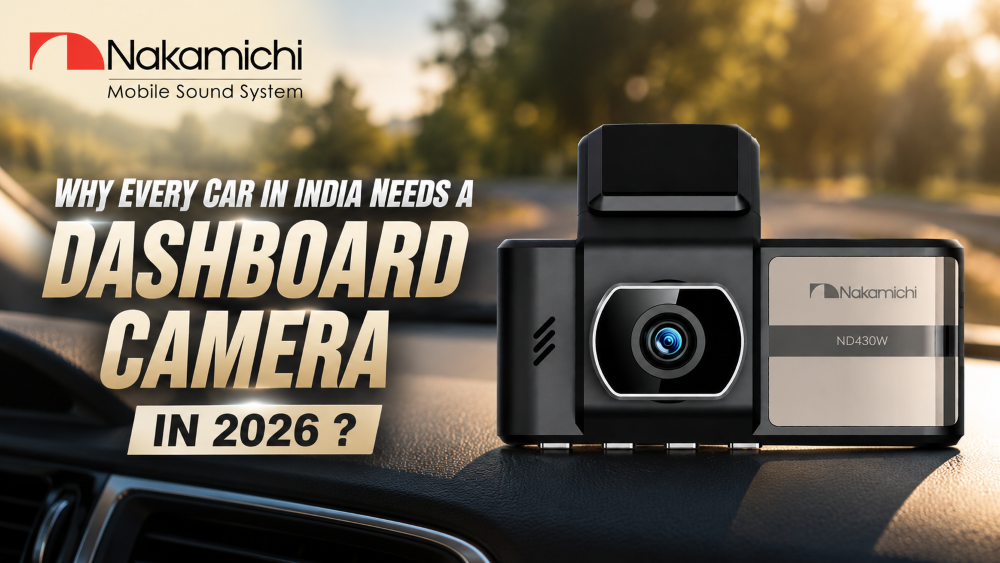
A minor scrape at a signal, two drivers, zero footage, and suddenly it’s a shouting match about who changed lanes first. Traffic police in most Indian cities see this exact scene daily. A smart dash cam for car exists mainly to end that argument before it starts.
Ten years ago, hardly anyone fitted one. The shift didn’t happen because of some big awareness campaign — it happened because insurance claims kept getting stuck on he-said-she-said disputes, and footage settled them in minutes instead of weeks.
Beyond Just Recording the Road: Car Dashboard Camera Recorder
People generally think a car dashboard camera recorder just films whatever’s ahead. It does, obviously. What most buyers don’t realize until later is how much runs quietly underneath that basic function. Loop recording keeps storage from ever filling up. A G-sensor locks footage automatically the moment it detects impact, so a crucial clip doesn’t get overwritten by the next day’s drive.
Nakamichi’s lineup pushes dual-channel recording specifically because rear-end and reversing incidents happen constantly in Indian parking lots and narrow society lanes. A front-only camera leaves half the story missing when an insurer starts asking questions.
The India-Specific Case for a Car Dashboard Camera
Uneven road surfaces. Riders cutting across three lanes without warning. Autos stopping mid-junction without any real reason. None of this is rare here — it’s traffic. A smart dash cam for car in India has stopped being an accessory people add later and started being something buyers ask about at the showroom itself now.
Insurance is where the value shows fastest, though. I’ve heard from a few car owners whose claims cleared within days because they simply attached dash cam footage instead of arguing over a verbal account. One claims adjuster friend told me footage basically ends the negotiation phase entirely — there’s nothing left to dispute once video exists.
What Actually Matters When Buying One
Resolution gets overlooked more than it should. Anything recording under 1080p tends to blur number plates the second there’s distance or dim lighting involved, and that defeats the whole purpose of owning one. Full HD is the realistic minimum. Night vision correction matters too, since streetlighting outside major highways in India is inconsistent at best.
Storage format is worth checking as well. Automatic loop overwrite means nobody has to manually clear space every week like it’s 2015. Don’t ignore mount quality either. A dash cam for car in India roads specifically needs to handle constant vibration from potholes without turning every clip into a shaky mess nobody can actually read.
Nakamichi builds its units with wide-angle lenses in the 140 to 170 degree range. That’s not a random spec. Anything narrower misses side-swipe incidents entirely, and anything wider starts warping number plates once they’re more than a few car-lengths away.
Is It Actually Worth Buying
For the price, yes. A few Indian insurers have quietly started offering marginal premium discounts for cars fitted with dash cams, treating it roughly the way they treat anti-theft alarms. That’s a small financial nudge stacked on top of the obvious safety case.
This isn’t really about being paranoid on the road. It’s about having something objective to point to when two people remember the same five seconds completely differently.
FAQs
Do I need a professional to install a car dashboard camera?
Not really. Most Nakamichi units use suction or adhesive mounts simple enough to fit yourself in under fifteen minutes.
How much storage is enough?
A 64GB card generally covers a full week of daily commuting on loop recording. Heavier city driving might push that to 128GB.
Can it record while the car’s parked?
Yes, if the unit supports parking mode with motion or impact detection — most mid-range Nakamichi dash cams for cars in India include this now as standard.
Will it drain my car battery?
Only if it runs constantly without a hardwire kit. Most setups pull power through the cigarette lighter socket and activate only with the ignition on, so this usually isn’t a real concern.
Is the night recording actually good, or just a spec sheet claim?
Depends entirely on the sensor. Budget units genuinely struggle after dark. Anything with real night vision correction and a wider aperture handles low light noticeably better, though nothing quite matches daylight clarity.