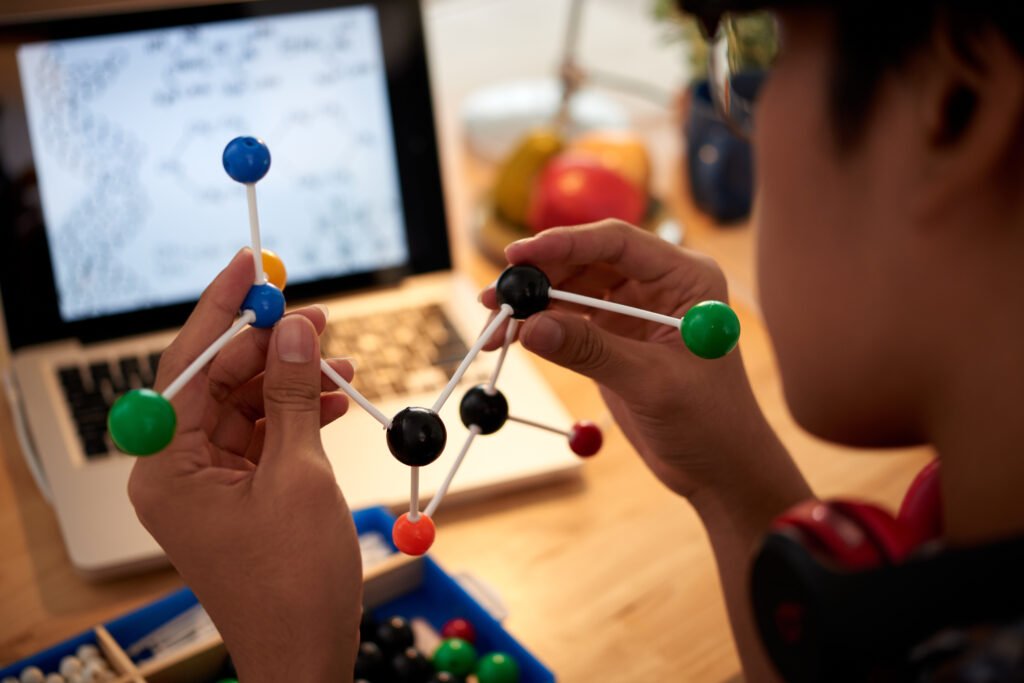
Close-up image of chemical element model in hands on student
STEAM education is bringing a new energy to modern classrooms. A science lesson may involve building a model, while a maths activity may lead to a creative design. Children learn by doing, testing ideas, and finding solutions instead of only reading from a book. This makes lessons more active and easier to connect with real life.
It brings science education, technology education, engineering education, arts integration, and mathematics education together in one connected way of learning. Many schools that follow a strong British curriculum approach are now including STEAM into everyday lessons. It is not just an extra activity. It is becoming an important part of how children learn and prepare for the future.
What Does STEAM Education Actually Mean?
STEAM Education is not a separate subject. It connects science, technology, engineering, arts, and mathematics through practical activities. Students learn by doing projects, testing ideas, and finding solutions.
For example, a bridge-building project can bring different subjects together. Students use mathematics education for measurements, science education to understand materials, and arts integration to improve the design. This makes learning more practical and engaging.
This approach also supports inquiry-based learning. Students ask questions, explore ideas, and learn through activities instead of only reading from a book. It can also help develop engineering skills, creativity, and problem-solving abilities.
How STEAM Is Different From STEM
STEM focuses on science, technology, engineering, and mathematics. STEAM adds the “A” for arts.
Arts integration brings creativity and design into technical learning. Students can use creative education to improve how they design, present, and explain their ideas. This makes STEAM a more balanced approach to practical education.
How STEAM Education Improves Problem-Solving Skills
One of the biggest strengths of STEAM is how it helps students solve problems. Instead of getting an answer directly from the teacher, students work through a problem and find a solution themselves.
Here is how the skill develops:
- Students face a real problem instead of a textbook question with only one answer.
- They research and test ideas, using scientific learning to see what works.
- They make changes when something does not work as planned.
- They explain their solution, which also builds confidence and communication skills.
For example, a class may be asked to build a rain shelter for a school garden. Students test different materials, measure angles, and sketch their designs. If the first version leaks, they make changes and try again. This combines engineering skills, practical education, and creative education in one activity.
Benefits of STEAM Education for Students
The benefits of STEAM education for students go beyond better grades. It helps children build useful skills that can support them in school and later in their careers.
- Stronger critical thinking: Students learn to ask questions and understand why something works instead of only accepting information.
- Better teamwork: Many STEAM projects involve groups, helping children share ideas, listen to others, and work together.
- Real-world readiness: Science, technology, design, and engineering all need creative thinking and practical skills.
- More confidence: Trying, making mistakes, and trying again helps students become more confident and resilient.
Schools that offer extra-curricular and co-curricular activities also give students more chances to practise these skills outside regular lessons.
It is also worth noting that STEAM is more than a classroom trend. The Connecticut STEAM initiative explains how combining arts with science, technology, engineering, and mathematics can support creative thinking and design in learning.
STEAM Education in Modern Schools
STEAM education in modern schools can look different at each age. The activities change as students grow, but the focus stays on practical learning, creativity, and problem-solving.
Early Years and Primary
At this stage, STEAM is mostly play-based. Children can use building blocks, try simple experiments, or create drawings. These activities help them understand basic ideas through fun and simple learning.
Upper Primary and Secondary
As students grow, projects become more structured. They may code a simple app, design a model, or carry out a science activity. They can also use data and visual design to present their work.
The Role of Teachers
Teachers act more as guides than lecturers in a STEAM classroom. They give students space to explore ideas and find solutions. Instead of giving every answer, teachers ask questions that encourage students to think and work independently.
Common Misconceptions About STEAM
There are a few common ideas about STEAM that are not completely true. Clearing them up can help parents and teachers understand what STEAM education is really about.
- STEAM is just STEM with an art class added. Not really. The arts are connected with technical subjects to support creativity, design, and better ideas.
- You need expensive gadgets to do STEAM. Not at all. Simple materials like paper, cardboard, and basic tools can also be used for STEAM activities.
- STEAM only suits science-minded kids. STEAM can be useful for creative thinkers too. Design, storytelling, and imagination are also important parts of the learning process.
Simple Ways Parents Can Support STEAM Learning at Home
Parents do not need a science lab at home to support STEAM learning. Simple daily activities can give children more chances to explore, create, and solve problems.
- Let your child build something with recycled materials and explain how it works.
- Cook together and talk about measurements, timing, and how ingredients change.
- Encourage your child to sketch or plan a design before building it.
- Ask “why” and “how” questions instead of giving the answer straight away.
- Visit a science centre or maker space together on weekends for more hands-on learning.
Final Thoughts
STEAM education is more than a passing trend. It helps students learn through creativity, practical learning, and problem-solving. By connecting different subjects, it prepares children to think, create, and adapt in a changing world. Schools that focus on innovation education can help students build skills that go beyond exams and support them in the future.
Frequently Asked Questions
Is STEAM only for older students?
No. STEAM can start in preschool through simple, play-based activities and become more structured as children grow.
Does STEAM replace regular subjects?
No. It connects science, technology, engineering, arts, and maths with other subjects rather than replacing them.
How is STEAM learning assessed?
Teachers may assess projects, presentations, teamwork, creativity, and how students approach a problem, not only the final result.
Do children need special STEAM kits at home?
No. Simple materials like paper, cardboard, and recycled items can support STEAM learning.
Can children who struggle with maths benefit from STEAM?
Yes. Hands-on projects can make maths and other technical subjects easier to understand and more engaging.