Crane downtime doesn’t announce itself. One moment your machine is lifting a load; the next, a warning light appears and the operator shuts it down. What follows is a cascade of consequences that extends well beyond the worksite.
Labor costs continue to accrue while the machine sits motionless. Project deadlines compress, forcing overtime or weekend work to recover lost time. Client trust — once shaken — takes much longer to rebuild than any mechanical component.
The most effective insurance against this scenario is having a replacement available before you need it. Of course, no operation can warehouse every conceivable item. Storage space carries costs, and immobilizing funds in seldom-used inventory is wasteful.
The answer lies in a structured strategy that separates indispensable stock from items better ordered on demand. Developing that strategy for a Grove fleet takes commitment, but it transforms reactive chaos into a controlled process.
The following guidance explains how to build and sustain that approach.
Understand Why a Small Number of Components Causes Most of Your Headaches
The Pareto Principle, sometimes referred to as the 80/20 rule, offers a powerful framework for inventory decisions. In equipment maintenance, approximately one-fifth of your stock generates the vast majority of emergency situations.
Those high-frequency troublemakers are almost always consumables and wear items — the elements that degrade steadily under operational stress until they can no longer perform their function. Keeping these in permanent supply is the single most impactful step you can take.
Consider a practical illustration. A hydraulic hose bursts at sunrise on a workday. If the replacement is sitting in your parts room, the crane returns to service within a couple of hours. Without it, you face multiple days of inactivity while waiting for delivery. The financial gap between those two outcomes is enormous.
Direct Your Investment Toward the Systems That Suffer the Most
Every assembly on your Grove equipment degrades at a different rate. Targeting your stocking resources toward the most vulnerable systems delivers the greatest return on investment.
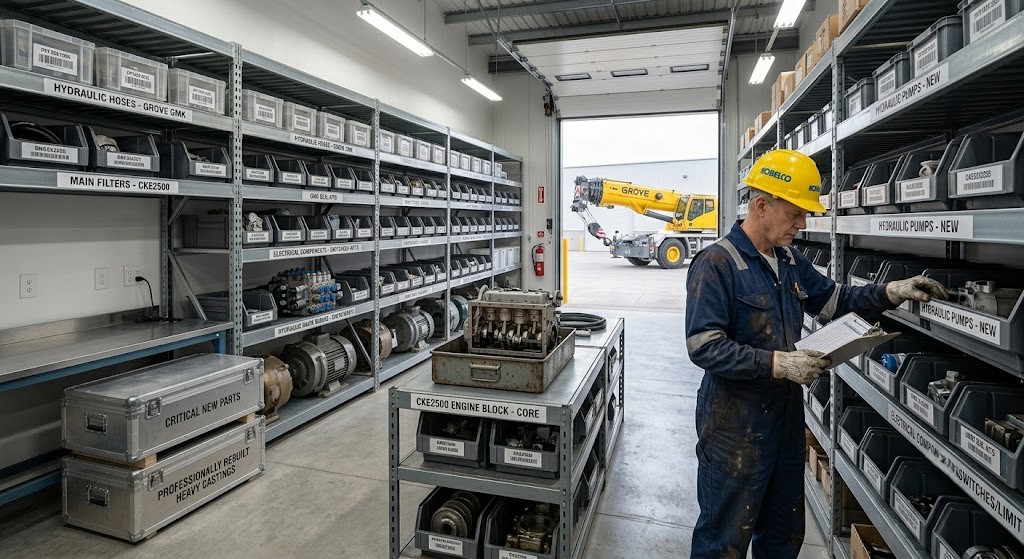
Hydraulic circuits typically generate the most urgent demand for replacements. Hoses develop surface fatigue and eventually split. O-rings harden and lose their sealing ability under temperature fluctuation. Cylinders accumulate internal wear that demands new seals. Keep a rotating supply of the most commonly needed hose sizes and seal kits matched to your specific models.
Filters represent another high-value stocking category. Engine oil, fuel, and hydraulic return filters follow predictable replacement cycles. Their individual cost is negligible, and purchasing in bulk is economically sensible. Discovering you lack a basic filter during a scheduled service is an embarrassing and entirely preventable error.
Electrical parts also deserve dedicated attention. Boom-mounted limit switches communicate with the onboard control system to regulate travel boundaries. Exposed to weather and vibration, their service life is naturally limited. Having a small reserve accessible in the cab or nearby tool locker eliminates unnecessary diagnostic delays.
Consult the Documentation Your Manufacturer Provided
Every crane ships with a comprehensive operator’s manual that includes a recommended spares list. These recommendations carry significant weight because they emerge from engineering analysis combined with field performance data collected across thousands of units.
Locate the preventative maintenance chapter and its associated parts recommendations. Treat this as your starting framework for stocking decisions. It represents what the engineers who designed your machine believe you’re most likely to need.
The important refinement comes from layering your own operational experience onto that baseline. If the manual recommends carrying an extra swing motor but your fleet has never experienced that failure, redirect those resources. If it recommends surplus boom alignment hardware and your crews consume them regularly, stock accordingly. The manual provides authority; your history provides precision.
Extract Lessons From Your Own Service Records
No external reference matches the predictive power of your own maintenance data. Your work order history captures the specific failure patterns your equipment produces under your unique operating conditions.
Retrieve at least two years of repair records and categorize them by component and frequency. Search for repetition. Did a particular sensor fail multiple times during winter months? Did one machine consume structural pins at a rate far exceeding the rest of your fleet?
Use a two-strike criterion. A single replacement could be random. Two or more replacements of the same part within a condensed timeframe indicate a reliable pattern. Promote those items to your critical inventory list without hesitation.
Your fleet’s age profile introduces additional nuance. Older machines consume wiring, sensors, and mechanical hardware at higher rates. Newer units primarily need routine consumables. Shape your stockroom holdings to match the actual wear characteristics of the equipment you operate, not a generic industry template.
Factor in How Long Different Components Take to Procure
Understanding delivery timelines is essential to making intelligent stocking decisions. Not every replacement can be sourced quickly or locally.
Many common Grove crane parts sit on shelves at regional dealerships and can be collected or delivered within hours. For those readily accessible items, maintaining an extensive personal reserve may not justify the cost of the shelf space and tied-up capital.
Other replacement items present a radically different procurement reality. Specialty components, particular control modules, or parts manufactured overseas can require weeks or months to obtain. When you know a specific hydraulic motor carries a thirty-day lead time, a backup unit already in your possession is the only responsible choice. Telling a client that their project will stall for four weeks while you wait for an international shipment is unacceptable.
Make it a standing practice to verify lead times with every supplier on a regular schedule. Prioritize your most critical shelf space around whichever items take the longest to arrive. This single habit prevents the most devastating and costly disruptions from materializing.
Prevent Your Stock From Aging Out
Inventory management is not a set-and-forget endeavor. Components sitting in a climate-controlled room still deteriorate over time. Rubber seals craze and harden. Electrical terminals corrode. Lubricants separate and lose their protective characteristics.
Implement a First-In, First-Out discipline throughout your storeroom. When a new shipment arrives, position it behind the older stock so that the oldest units get consumed first. This simple habit prevents materials from silently passing their useful service life.
Conduct a comprehensive review of your parts room every six months. Any item that has been sitting untouched for three years demands an honest assessment. The machine it originally served may no longer be in your fleet, or your operating demands may have changed. Remove what no longer serves a realistic purpose rather than letting it drain capital and consume space.
Develop a Genuine Relationship With Your Distributor
Complete self-reliance is not achievable in parts management. The manufacturing and distribution ecosystem for heavy equipment components is global, complex, and subject to disruption at many points.
Your parts distributor functions as a critical extension of your maintenance operation. Seek out a partner with demonstrated expertise in Grove crane parts — someone who can engage in a technically meaningful conversation about your equipment without needing to consult a reference guide.
Share your fleet details, operating environment, and historical consumption patterns. A knowledgeable supplier can help you prioritize your stocking decisions, provide early warning about factory backorders, and propose alternative solutions when original components face extended unavailability.
Those partnerships reveal their greatest value during emergencies. A critical failure on a Friday afternoon demands someone who takes immediate action and secures overnight delivery — not a recorded message suggesting you reconnect after the weekend.
Get Every Technician Aligned With the System
The most精心设计 inventory plan is only as reliable as the people who interact with it daily. Every member of your maintenance crew needs to understand the room layout, know where specific items are stored, and follow a uniform process for recording what they take.
The most important behavior is reporting consumption honestly and promptly. When the last component leaves its assigned bin, that fact must be recorded. An empty bin that nobody flags creates a dangerous false impression of readiness, and the next failure involving that part turns into a frantic rush order.
Streamline the documentation process to minimize friction. Barcode scanners, sign-out sheets, or lightweight digital tools all work. The simpler the process, the higher the compliance. Pair this with automated reorder thresholds that trigger purchase requests before stock reaches critically low levels.
Find Your Optimal Balance Point
At its core, parts inventory management is a balancing exercise between two competing financial pressures. Holding costs — storage, insurance, immobilized capital — argue for carrying less. Downtime consequences — lost revenue, penalties, reputational damage — argue for carrying more.
A perfect equilibrium does not exist. You will inevitably stock something that never gets touched, and you will periodically face an empty shelf when you need it most. Accepting this reality prevents paralysis and keeps the process moving forward.
The real objective is minimizing both types of misses as consistently as possible. By studying your failure patterns, tracking procurement timelines, and concentrating resources on the components most prone to failure, you build a system where advance preparation consistently outpaces reactive scrambling. Measured analysis replaces guesswork.
When a hydraulic line fails on a Tuesday afternoon, your technician retrieves the replacement, completes the repair, and returns the crane to productive service before the shift ends. That quiet, efficient outcome is the standard worth pursuing — sustained uptime that keeps your equipment earning and your operation financially stable across every project you undertake.