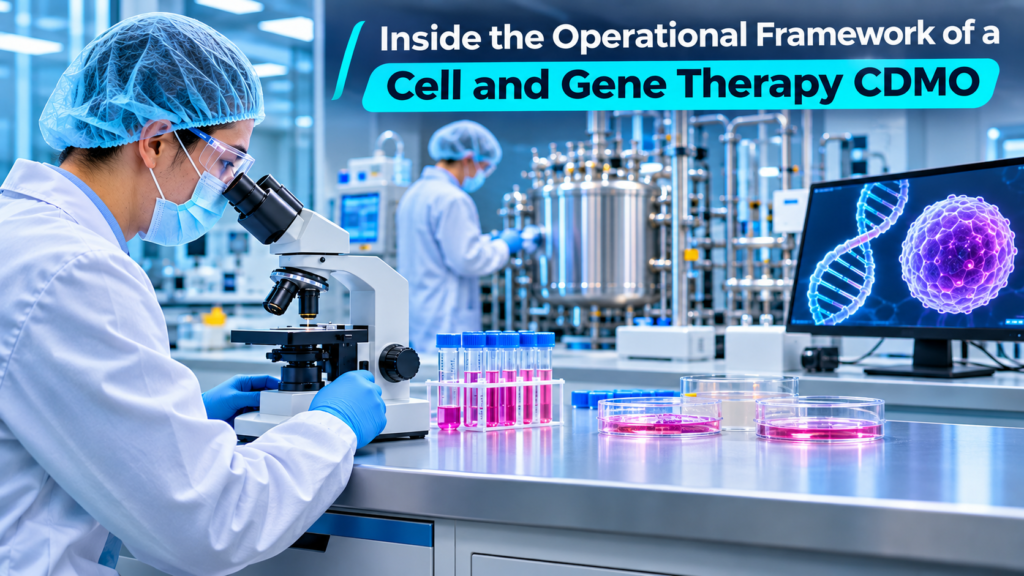
A cell and gene therapy CDMO manages specialized development, manufacturing, and quality activities to help biotechnology companies advance complex therapies. Its operational framework connects process development, GMP production, analytical testing, and quality management. Understanding how these functions work together helps pharmaceutical companies and therapy developers plan manufacturing requirements, manage technical risks, and prepare products for clinical development.
What Does a Cell and Gene Therapy CDMO Do?
A cell and gene therapy CDMO provides specialized manufacturing and development support for companies working on advanced biological therapies. It helps transform research-stage processes into controlled manufacturing workflows suitable for clinical development.
Unlike conventional pharmaceutical manufacturing, advanced therapies often involve living cells, genetic materials, or biological vectors. Each product requires specific production conditions, equipment, analytical methods, and quality controls.
For example, CAR-T manufacturing involves collecting and processing immune cells, modifying them, expanding the cells, and evaluating the final product. Viral vector manufacturing follows a different workflow that requires suitable production systems, purification, and product characterization.
A CDMO coordinates these activities while maintaining documentation and quality oversight throughout the project.
How Does a Cell and Gene Therapy CDMO Structure Its Operations?
A cell and gene therapy CDMO structures its operations around interconnected technical, manufacturing, and quality functions. Each department contributes to maintaining process consistency and meeting project requirements.
Process Development and Technology Transfer
Process development establishes the production conditions needed to manufacture a specific therapeutic product. Teams evaluate materials, equipment, processing parameters, and analytical requirements before transferring the process into a manufacturing environment.
Technology transfer connects development activities with GMP production. It requires clear documentation of procedures, critical process parameters, material specifications, and testing methods.
A well-managed transfer helps reduce misunderstandings between development scientists and manufacturing personnel.
GMP Manufacturing Operations
GMP manufacturing provides controlled production environments supported by qualified equipment, trained personnel, and documented procedures.
For cell-based therapies, manufacturing teams must manage sensitive biological materials and maintain appropriate environmental controls. For viral vectors, production and purification workflows require platform-specific controls.
A specialized CDMO should align its manufacturing infrastructure with the requirements of each therapeutic product rather than applying identical procedures across different platforms.
Why Are Quality Management Systems Essential in CDMO Operations?
Quality management systems are essential because they establish consistent procedures for identifying, documenting, investigating, and controlling manufacturing risks. They also support compliance with applicable GMP requirements.
Quality teams oversee documentation, deviations, change control, equipment qualification, and material traceability. These activities help ensure that manufacturing decisions follow approved procedures.
For example, if a production batch shows unexpected variation, the quality team coordinates an investigation to understand the cause and assess its potential impact.
Important quality activities include:
- Document control and standard operating procedures.
- Raw material qualification and traceability.
- Environmental monitoring and contamination control.
- Deviation investigation and corrective actions.
- Equipment qualification and maintenance.
- Batch record review and quality oversight.
Strong quality systems support reliable manufacturing decisions and help companies prepare for regulatory inspections.
How Does Analytical Testing Support Advanced Therapy Manufacturing?
Analytical testing supports advanced therapy manufacturing by evaluating product identity, purity, potency, and safety-related characteristics. It provides information that helps teams monitor production and assess whether materials meet predefined specifications.
Different therapeutic platforms require different analytical approaches. Flow cytometry can help characterize cell populations, while PCR-based methods can support genetic testing and contamination detection.
Mycoplasma testing also plays an important role in contamination control. Because mycoplasma may not produce visible changes in cell cultures, appropriate analytical methods help identify potential contamination during manufacturing.
Bioanalytical testing services support this process by developing and performing suitable assays for product characterization and quality assessment. Method suitability, sample compatibility, and appropriate controls should guide testing decisions.
How Can CDMOs Support Different Advanced Therapy Platforms?
CDMOs support different advanced therapy platforms by adapting manufacturing processes, technical expertise, and quality controls to the biological characteristics of each product.
CAR-T therapies require specialized cell processing and genetic modification workflows. Their production also involves careful management of cell identity, viability, and functional characteristics.
Stem cell-based therapies, including products derived from induced pluripotent stem cells (iPSCs), require controlled cell culture and differentiation processes. Manufacturers must monitor cell characteristics and assess the consistency of the resulting populations.
Viral vector programs involve different production and purification requirements. Their analytical strategies may include vector identity, genome content, potency, and impurity assessment.
Custom manufacturing services help companies address these differences by aligning production approaches with individual project requirements.
What Should Companies Evaluate When Selecting a CDMO?
Companies should evaluate technical expertise, manufacturing facilities, quality systems, analytical capabilities, and communication before selecting a manufacturing partner.
A practical assessment should cover the following areas:
- Platform experience: Does the provider understand your specific therapy type?
- Manufacturing readiness: Are its facilities and equipment suitable for your production requirements?
- Quality oversight: Does it maintain documented GMP procedures and effective quality systems?
- Analytical capabilities: Can it support the testing requirements of your product?
- Technology transfer: Does it have a clear approach to transferring development processes?
- Future planning: Can its capabilities support your expected clinical development needs?
Companies should also discuss project responsibilities, timelines, documentation expectations, and communication procedures before beginning manufacturing activities.
Conclusion
The operational framework of a cell and gene therapy CDMO brings together process development, GMP manufacturing, analytical testing, and quality management. Each function supports a different part of advanced therapy development, but their coordination determines how effectively a manufacturing program operates. For biotechnology and pharmaceutical companies, the key takeaway is to select a manufacturing partner whose technical capabilities, quality systems, and operational structure match the specific requirements of their therapeutic program.
Frequently Asked Questions
What services does a cell and gene therapy CDMO provide?
A cell and gene therapy CDMO may provide process development, technology transfer, GMP manufacturing, analytical testing, and quality support. Available services depend on the provider’s facilities and technical capabilities.
Why is GMP manufacturing important for cell and gene therapies?
GMP manufacturing establishes controlled procedures for producing advanced therapies and managing quality risks. It supports consistency, documentation, traceability, and compliance with applicable manufacturing requirements.
How do companies choose a cell and gene therapy manufacturing partner?
Companies should assess platform-specific expertise, facility capabilities, analytical testing, quality systems, and technology transfer experience. A detailed technical evaluation helps determine whether a CDMO can support the product’s development stage and manufacturing needs.