You are running your eCommerce store every day.You answer customer questions. You check your inventory. You write product descriptions. You watch customers leave without buying. You guess which products to put on sale.
And while you are doing all of this manually your competitor, who runs the same type of store is doing all of it automatically. Not because they have a bigger team. Not because they have more money. Because they are using AI.
This is not something that is coming in the future. It is happening right now, in 2026. Traffic from AI tools to online retail stores increased by 693% at the end of 2025. Stores that are using AI in eCommerce are growing faster, spending less on operations, and keeping more customers than stores that are not.
The good news? You do not need a big budget or a technical team to start.With modern eCommerce platforms like Scriptzol, businesses can integrate AI-powered features to automate operations, improve customer experiences, and scale their online stores more efficiently.
This blog explains exactly what AI is doing for eCommerce stores today, which problems it solves, how to use it, and where to begin in simple, clear language that anyone can understand and act on.
The Problems Every eCommerce Store Owner Faces
Before we talk about solutions, let us be honest about the problems.
If you run an online store, you know these feelings well.
Problem 1: Customer questions never stop.
Customers ask the same questions every single day. “Where is my order?” “What size should I buy?” “Do you do returns?” You cannot afford to hire someone to answer these 24 hours a day, 7 days a week. But if nobody answers, customers leave and never come back.
Here is a hard fact: 43% of customers stop buying from a store after just one bad customer service experience. One bad experience. That is how thin the margin is between keeping a customer and losing them forever.
Problem 2: Inventory is always wrong
You run out of stock on your best products. You have too much stock of products nobody wants. You only find out there is a problem when a customer complains or when you check manually. By then, money is already lost.
Problem 3: Writing product descriptions takes too long
If your store has 200 products, writing good descriptions for all of them takes weeks. Most store owners either rush it, skip it, or write the same thing for every product. Bad descriptions mean customers do not understand what they are buying – so they do not buy.
Problem 4: People add to cart and then leave
This is one of the biggest silent problems in eCommerce. On average, 7 out of 10 people who add a product to their cart leave without completing the purchase. That is 70% of your almost-customers disappearing. Most stores send one generic “You forgot something!” email. Most buyers ignore it.
Problem 5: Pricing is pure guesswork
How do you know if your price is right? Too high and customers go to a competitor. Too low and you lose margin. Checking competitor prices manually every day is a full-time job.
Problem 6: Fraud is invisible until it hurts you
Fake orders look exactly like real orders. By the time you discover a fraudulent transaction, you have already shipped the product, lost the money, and received a chargeback that damages your payment account.
These are not small problems. Every single one of them costs you real money every single month.
7 Ways AI Is Changing How eCommerce Stores Are Managed?
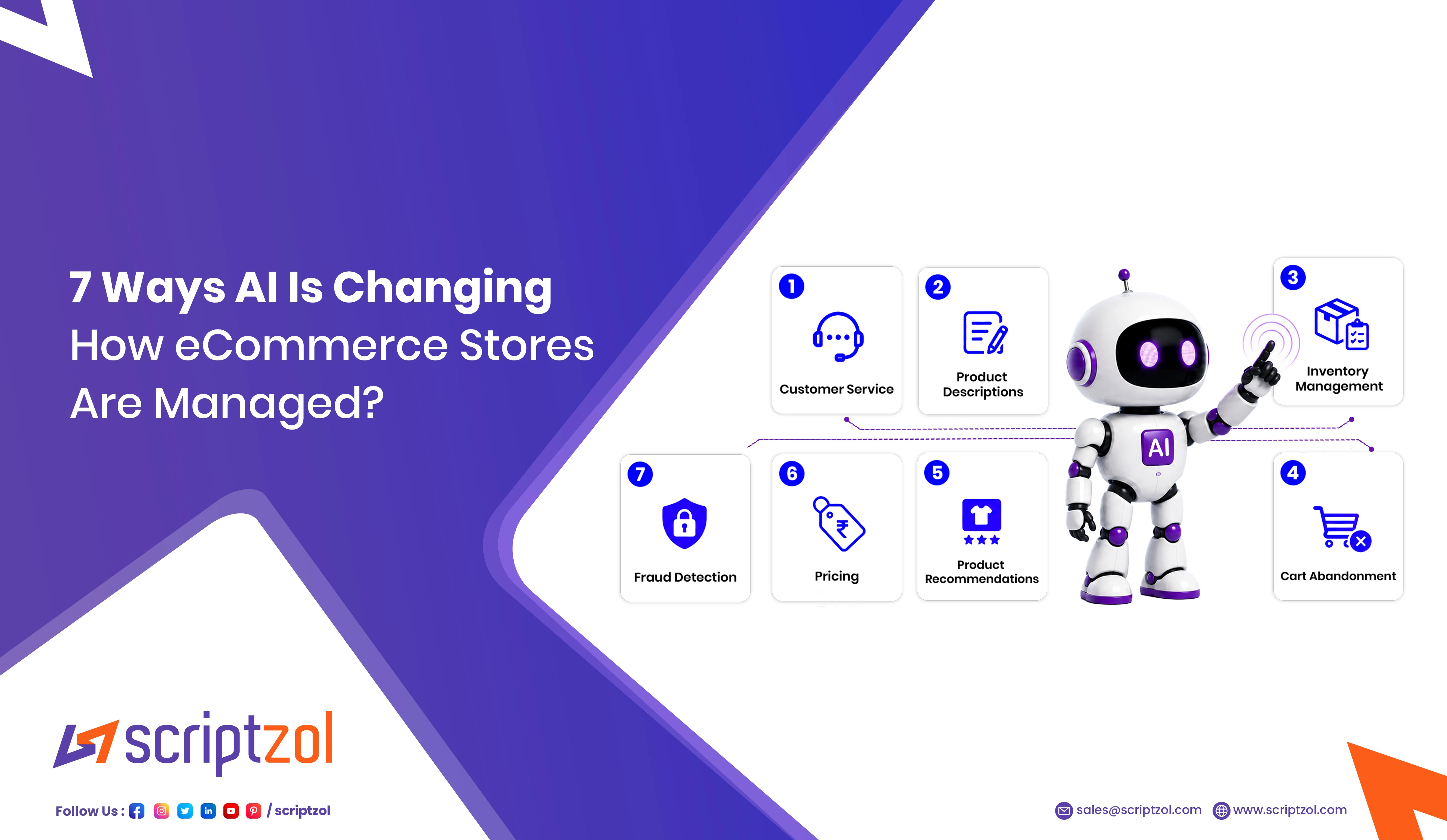
1. Customer Service – 24 Hours, No Staff Needed
Your store is open all night. Your support team is not.
Every unanswered question at midnight is a sale that goes to a competitor by morning.
AI-powered chatbots and virtual assistants are now capable of handling complex inquiries with speed and accuracy – translating directly to better customer experiences and reduced operational costs.
A good AI chatbot handles order tracking, return requests, product questions, and stock queries – instantly. When something is too complex for the bot, it passes the conversation to your team. Your team only handles cases that genuinely need a human.
Where to start: Install a chatbot plugin on your store. Configure it to answer your 10 most common questions. Most Magento and WooCommerce stores can do this in a weekend without a developer.
2. Product Descriptions – Faster, Better, Higher Ranked
Writing product descriptions for 200+ products takes weeks. Most store owners rush it. Some copy from the supplier. The result is thin content that Google ignores and customers do not trust.
AI generates compelling, SEO-friendly product descriptions tailored to different customer segments – improving both rankings and conversions.
Give the AI tool your product name and key features. It writes a full, clear, persuasive description in seconds. You review it, adjust anything needed, and publish.
A 300-product catalog that took three weeks to write properly now takes three days.
Where to start: Find your 20 worst-performing product pages. Rewrite them using an AI writing tool. Check rankings and conversion rate after 30 days.
3. Inventory Management – Know Before You Run Out
Manual inventory management has one fatal flaw – you only discover problems after they happen.
Out of stock on your best product? You find out when a customer complains. Too much slow stock? Your money sits in a warehouse earning nothing.
AI-powered inventory management analyses historical sales data and forecasts future demand – reducing inventory requirements by 20 to 30 percent without hurting service levels and freeing up working capital.
Instead of reacting to stock problems, you prevent them. The system alerts you before you run out – with time to reorder before customers are affected.
Where to start: Turn on demand forecasting in your eCommerce platform settings. For Magento and WooCommerce, AI inventory extensions add more accurate prediction on top of built-in features.
4. Cart Abandonment – Recover Sales You Are Currently Losing
70% of people who add a product to their cart leave without buying.
That is not a small problem. For a store doing ₹10 lakh per month, 70% cart abandonment means ₹23 lakh in potential revenue is walking out the door every month.
The old solution – a generic “you forgot something” email the next morning – has a very low recovery rate because it feels automated and impersonal. Because it is.
AI monitors real-time signals – prolonged browsing, repeated comparisons, stalled carts – and steps in before abandonment happens with personalised, timed messages about the exact product the customer was considering.
Stores using intelligent cart recovery report recovering 15 to 20% of abandoned carts – with no extra ad spend.
Where to start: Check your cart abandonment rate in your analytics today. Then install a smart recovery tool that sends personalised messages – not generic ones.
5. Product Recommendations – Show People What They Want
Every visitor to your store sees the same homepage. The same featured products. The same promotions.
Whether they want them or not.
AI helps eCommerce brands move from reactive to proactive decision-making – using data-backed insights that directly impact revenue.
eCommerce personalisation AI tracks each visitor’s behaviour and shows every person a different, relevant version of your store. The customer who buys sports products sees sports on the homepage. The first-time visitor who searched for office furniture sees office furniture.
This increases average order value because customers see products that are actually relevant to them – and add more to their cart.
Where to start: Add “Customers also bought” and “You might also like” sections to your product pages. Available as standard features or low-cost plugins on most platforms.
6. Pricing – Stop Guessing, Start Winning
Too high – customers buy from a competitor. Too low – you earn less than you should.
The right price changes constantly. Checking competitors manually every day is a full-time job most store owners cannot afford.
AI helps eCommerce brands make data-backed pricing decisions that directly impact revenue and efficiency – monitoring competitor prices in real time and adjusting within rules you set.
You stay competitive automatically. You protect your margin where you can. No manual checking needed.
This increases average order value because customers see products that are actually relevant to them – and add more to their cart.
Where to start: Check your top 10 products against three main competitors twice a week. Even this small habit beats guessing. Then move to an automated pricing tool as your store grows.
7. Fraud Detection – Stop Fake Orders Before You Ship
A fraudulent order looks exactly like a real one.
The address is real. The payment goes through. You ship the product. Then a chargeback arrives – you have lost the product, the money, and your payment gateway flags your account.
AI excels at real-time fraud detection – monitoring transactions across multiple dimensions including payment behaviour, device fingerprints, geolocation, and order velocity – flagging anomalies within milliseconds.
Good AI fraud detection does not block real customers. It identifies the specific patterns that indicate genuine fraud – invisible to the human eye – while letting legitimate orders through without friction.
Where to start: Enable fraud detection in your payment gateway settings today. It is usually free and just needs to be switched on.
The Mistake to Avoid When Starting With AI
Most store owners make one of two mistakes.
Mistake 1 – Trying everything at once.
The fragmentation problem – merchants running six to eight separate AI tools – is now the primary drag on ROI in 2026, not adoption itself.
More tools do not mean better results. Pick the biggest problem your store has right now. Solve it with one tool. Measure the result. Then move to the next proble
Mistake 2 – Starting before your data is clean.
AI learns from your data. Messy product listings, incomplete customer records, and inconsistent order history produce unreliable results. Before installing any AI tool, make sure your catalog and records are accurate and consistent.
Building an AI-Ready eCommerce Store
If you are launching a new store or marketplace in 2026, the platform you choose determines how easily AI tools can be added as you grow.
Scriptzol builds eCommerce scripts and extensions for Magento 2, WooCommerce, PrestaShop, OpenCart, and CS-Cart – designed for store owners who want a clean, modern foundation that works with the tools the industry is moving toward.
Whether you need a multi-vendor marketplace, a checkout optimisation extension, or a retail finance integration for your customers – Scriptzol’s products are built to grow with your business.Explore the full catalog at scriptzol.com
Frequently Asked Questions
Is AI expensive for a small eCommerce store?
No. Most basic AI tools, chatbots, cart recovery, and product recommendations cost under ₹5,000 per month or are free as platform plugins. Each typically recovers more than its cost within the first 30 days.
Will AI replace my customer service team?
No. AI handles repetitive, common questions. Complex complaints, refund disputes, and relationship management still need a human. AI removes routine work from your team’s day so they can focus on cases that actually need human judgment.
Do I need a developer to set up AI tools?
For most tools in this blog no. They are configured through settings panels and do not require coding. More advanced integrations may need developer support, but the tools delivering the biggest early results are designed for non-technical users.
How long before I see results?
Customer service improvements are visible within the first week. Cart recovery results appear within the first month. Inventory and personalization results build over 60 to 90 days as the system learns from your store’s data.
Which eCommerce platform works best with AI in 2026?
Magento 2, WooCommerce, and PrestaShop all support AI integration well through their extension marketplaces. The key is a platform with an active developer community so new AI tools are available as the market evolves.
This article was originally published by – https://www.scriptzol.com/blog/how-ai-changing-ecommerce-store-management-2026