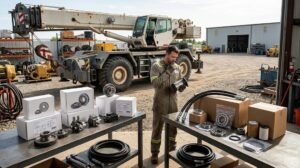
When a crane stops, the meter keeps running. Crews stand idle while the schedule slips. Owners feel it in lost billable hours and missed deadlines. That pressure usually forces a fast decision about replacement parts.
The choice generally comes down to two routes. OEM components come from the maker of the machine. Aftermarket components come from independent manufacturers. Each side has defenders, and each side has valid points.
Neither option wins across the board. The smart call depends on the component, the machine’s age, and the budget in front of you. What follows compares cost, quality, and availability. Use it to set a clear sourcing policy for your fleet.
When OEM Makes Sense
OEM components come off the same drawings used on the assembly line. Steel grades, tolerances, and heat treatments match the factory standard. Nothing is adapted or reverse-engineered. That consistency is the whole appeal.
Fit is the clearest advantage. Parts bolt on without shimming, drilling, or modification. Warranty coverage is included as well. If a defect surfaces right away, the claim process is simple.
Resale value deserves a thought too. Buyers reviewing a service log like seeing consistent brands. Factory-sourced Grove parts in that history signal careful upkeep. That record can support a stronger asking price later.
Price is the main drawback, and it is a significant one. You are funding the brand name and its support network. Availability is the second hurdle. When a hydraulic valve or control board sits on backorder, the machine idles for weeks.
What Aftermarket Really Offers
Third-party manufacturers produce these parts to fit and function like the originals. Grove does not make them. The engineering target is interchangeability with the factory component.
A myth needs clearing first. Aftermarket does not automatically mean cheap or flimsy. Reputable makers work to the same specifications, using comparable materials and testing. Some improve on the original design, such as a harder alloy on a gear tooth known to wear early.
Price drives most purchases in this category. The same repair often costs noticeably less. That difference matters on tight-margin jobs.
Stock depth is another advantage. A dependable crane parts supplier usually carries a broad aftermarket catalog. When a factory item is six weeks out, a substitute may arrive in two days. Reduced waiting protects your schedule.
Quality is where caution belongs. The range between best and worst is wide. Bargain parts from unknown sources may fail within months. Always verify who actually manufactured what you are buying.
Deciding Part by Part
There is no single rule that covers every purchase. The function of the part should guide you. So should its location on the machine. Risk level is the real dividing line.
Start with safety-critical components. Load indicators, hoist brakes, and structural pins belong in this group. For these, factory Grove parts are the sensible default. Anything holding suspended tonnage should not be an experiment.
Wear items are a different matter. Filters, hoses, lights, wiper blades, and cab glass fit here. Aftermarket versions handle these duties well at lower cost. Paying premium prices for a hydraulic filter rarely adds value.
Engine parts and hydraulic pumps sit between the two groups. A proven aftermarket brand with a long track record is reasonable. For an unfamiliar brand, ask your mechanic for input. Trial it on a low-risk system before trusting it on the main hoist.
Sourcing for Older Machines
Age changes the equation more than most people expect. Parts availability narrows as a model gets older. Support priorities shift at the factory. Your sourcing strategy has to shift with them.
A five-year-old crane usually presents no problem. Components are still in production, and the dealer stocks them. Ordering is quick and predictable.
Older units tell a different story. Take a GMK5130 from the late 1990s. Original Grove parts for that model may be out of production entirely. At that point, aftermarket is not a preference; it is the only path.
Finding the right substitute takes specialized help. The right crane parts supplier stocks rare components or knows how to fabricate them. Relying on the dealer alone can mean months of searching. Specialists know which current parts cross-reference to older assemblies.
The Role of Your Supplier
Debate over part brands often skips a key variable. The seller matters as much as the manufacturer. Sourcing decisions fail when the seller adds nothing beyond a checkout page. Support is the difference.
A capable crane parts supplier advises rather than just ships. They know which aftermarket brands perform and which to avoid. They can also locate scarce factory components. Their guidance helps you weigh cost against risk.
Once you find that kind of partner, keep them close. Share your fleet list and your maintenance calendar. When a breakdown hits late on a Friday, familiarity speeds everything up. The relationship works like an extra arm of your shop.
Lowest-price listings from unknown sellers carry hidden risk. If a part fails, there is no one accountable. A dependable seller stands behind what they ship, factory or aftermarket.
Cost Versus Value
The invoice price is only one line in the real equation. Total cost is what matters. A five-hundred-dollar saving can vanish quickly. Run the numbers across the full service life.
Labor repeats every time a part fails. Four hours to swap a pump becomes eight if it fails again. Downtime stacks on top of that bill. A bargain that fails early becomes the expensive option.
Overspending has its own cost. Paying factory prices for a trivial item wastes budget. Match the spend to the consequence of failure.
Record what you buy and how long it survives. Patterns emerge within a year or two. The log will show which aftermarket brands endure and which Grove parts earn their premium. Over a fleet, those lessons compound into real savings.
Final Takeaway
There is no universal winner in this debate. Treat the OEM versus aftermarket question as a tool, not a doctrine. Apply it case by case, based on risk and availability. Flexibility beats loyalty to any single source.
Match the component to the consequence of failure. Use factory parts for critical, high-load systems. Choose proven aftermarket options for wear items and legacy equipment. Confirm you have a crane parts supplier you trust before the next breakdown.
Uptime, operator safety, and controlled spending are the real measures. Weigh each purchase against those three goals. Decisions made that way tend to hold up over time.