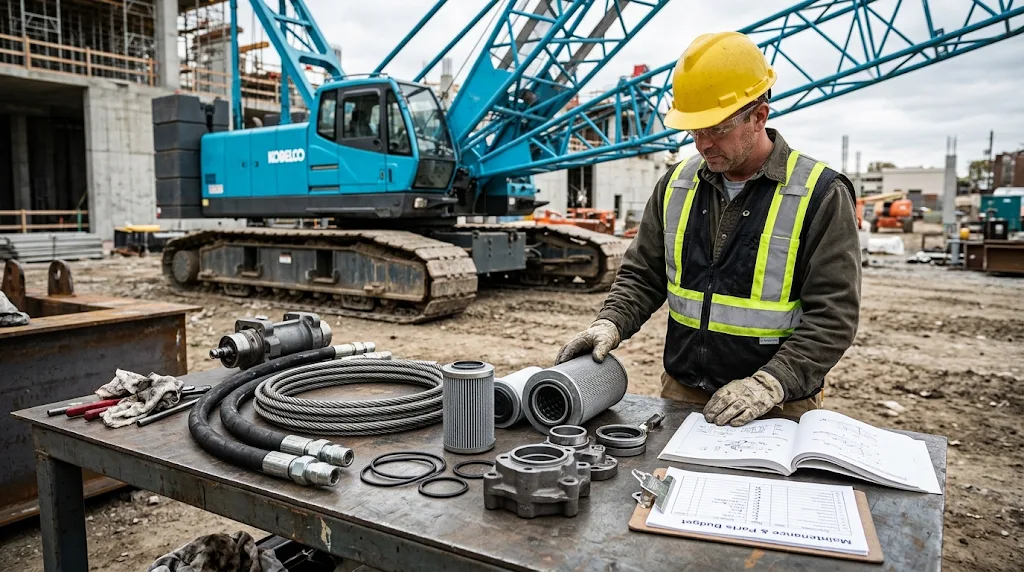
Maintenance costs are the part of ownership people avoid putting on paper. Sometimes a Kobelco behaves beautifully for twelve months, needing only routine filters and a bit of grease. Other times a single quarter claims a wire rope, a swing motor seal, and a hydraulic pump while the site stands idle.
Nobody predicts those seasons in advance. A budget simply changes the way they arrive. Rather than paying a rush price at the counter, you draw on funds assigned to Kobelco parts long before anything failed. The approach that follows applies equally to a single unit or a whole yard of machines.
Begin With the Manufacturer’s Schedule
Before contacting anyone for figures, read the periodic maintenance table in the service manual. That chart functions as a twelve-month shopping list, covering inspections and replacements from the daily walkaround to the largest annual tasks.
List every consumable it names: filters, lubricants, hydraulic oil, wipers, bulbs. Those items arrive on schedule regardless of how the machine performs, so they form the predictable base of the plan. One conversation with your dealer’s counter yields the current figures.
Scheduling the recurring items takes an afternoon. The harder question — when a wear component will actually let go — cannot be answered from the same page.
Divide the Spending Into Three Groups
Each item you buy this year belongs to one of three groups, and each group needs its own treatment.
Consumables are the calendar-driven purchases: filters, fluids, grease, bulbs, wipers. Their timing is fixed, and their quantities can be estimated directly from the service chart.
Wear items deteriorate with use rather than with dates. Wire rope, brake parts, hoses, seals, pins, bushings, and crawler undercarriage fall here. Inspect them on a schedule; replace them when measurements reach the limit.
Breakdowns include the surprises: a sensor that dies without warning, a pump that begins howling in the middle of a job. No one forecasts these events. The budget can only hold reserves for them.
Collapsing all three into a single figure is the classic mistake. Scheduling and insurance operate on different logic, so keep them apart.
Weigh Age, Usage, and Conditions
Identical models rarely cost the same to maintain. Three factors explain most of the spread.
Hours and age set the baseline. A machine with fewer than five years and light hours mostly consumes filters and fluids. Beyond 10,000 hours, the wear list lengthens: hoses hardened by heat cycles weep, seals dry, pins and bushings develop play. Expect the annual figure to rise as the crane matures.
Duty cycle determines how fast parts disappear. Continuous demolition work consumes components far more quickly than seasonal steel erection. Rough, uneven ground compounds the effect on the undercarriage.
Environment rounds out the estimate. Dust cuts air filter life and contaminates hydraulic systems. Salt air corrodes wire rope and exposed pins. Harsh sites must be reflected in the totals.
Two years of invoices, averaged and increased by 10 to 15 percent, give a solid working base. With no history, consult the dealer’s parts counter or an operator running the same model.
Decide Where Each Item Comes From
Three sourcing routes are realistic, and each has a defined role.
Factory-original components carry the highest cost and the least uncertainty. Reserve them for hydraulics, safety devices such as the load moment indicator, and anything sealed inside a winch or swing drive. When a failure would park the crane for a week, the premium shrinks into insignificance.
The aftermarket offers far more variety. A specialist who understands these machines supplies quality crane parts that suit filters, hoses, pins, and undercarriage wear at reasonable cost. Poor vendors, however, push cheap components that fail early and sometimes drag seals and pumps down with them. Evaluate a supplier by its willingness to stand behind what it sells.
Salvaged and rebuilt units from dismantled cranes suit older machines whose replacement value approaches the machine’s own worth. Body panels, cabs, and covers are fine candidates. Load-bearing or pressure-holding parts are not.
Most operators blend the routes, and that blending is sound practice rather than compromise. Fix your policy for each system before the calendar year opens, because the choice reshapes the budget. It also keeps you from paying a premium for items that never needed one.
Put Actual Figures on the Page
Build the estimate machine by machine. A five-year-old crawler and an older rough terrain unit share few common needs, and their Kobelco parts costs will look nothing alike.
Start with the fixed line: consumables priced through your supplier. Follow with the wear items due this year, where inspection records prove their worth. The rope approaching its discard limit, the hoses with split covers, the brakes flagged last quarter — price them now, even when the date remains uncertain. If a major service falls due, request the parts list and obtain a written quote.
Then add contingency, somewhere between ten and twenty percent of the total. Older machines and heavier duty cycles justify the upper figure. This reserve covers the pump that fails in November. Leave it out and a single bad quarter erases the plan.
Labor stays outside this budget; blending the two distorts both. Freight deserves its own line as well. Buying a wire rope two weeks early costs less than expediting it after an inspection failure, and that discipline applies throughout the year.
The result is an annual figure for each machine. It will not be exact, but it will be grounded in your own operation.
Account for Idle Days
A parts budget ultimately protects revenue rather than inventory. Every day an idle crane sits in the yard, money leaves: rental income, penalty clauses, a crew waiting on the ground.
When a six-week-old seal fails and the replacement takes two weeks to arrive, any saving has already evaporated. That arithmetic should reinforce three habits. Order in advance instead of paying for expedited freight. Keep a modest shelf of critical spares when utilization stays high — filters and common seals at minimum.
Suppliers holding quality crane parts shorten those wait times, since the item leaves their shelf the same day. Choosing them is a form of downtime insurance as much as a purchasing decision. The payoff appears most clearly in the weeks when the schedule has no slack.
Revisit the Numbers Quarterly
A budget remains theoretical until it meets actual spending. Mark your calendar every three months for a review.
Compare what you projected with what you spent. Note components that failed ahead of schedule and those deferred into the following year. Two quiet quarters in a row suggest your estimates ran high. A reserve emptied by June suggests the fleet is aging faster than assumed. Revise the assumptions in response.
The quarterly review also confirms whether your suppliers of quality crane parts are meeting lead-time expectations. Consistent delays are a signal to adjust the ordering calendar. After two or three cycles, the figures settle close to reality. They reflect your machines, your sites, and your crews rather than generalizations.
What This Discipline Produces
Annual parts budgeting is unglamorous work. Read the schedule, sort the items into groups, quote each sourcing route, add a cushion for the unforeseen, and review everything four times a year.
Handle it well, and Kobelco parts shift from a series of emergencies into an ordinary planned expense. The office finds the year easier to forecast. So do you, when a winch motor fails in the middle of March.