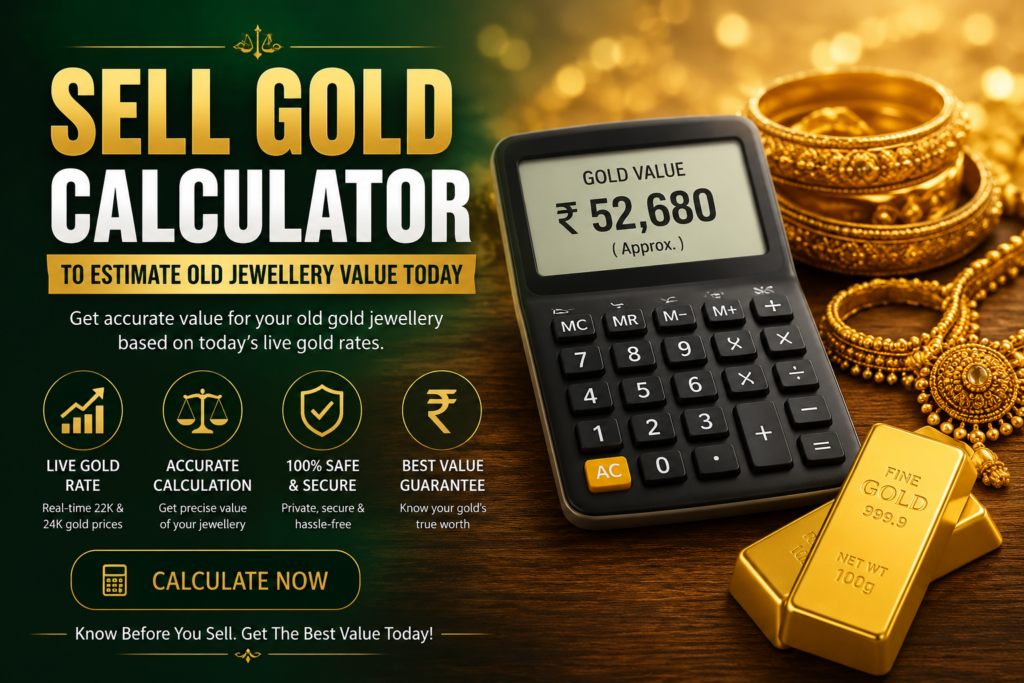
Most people selling old jewellery have only a vague sense of what it’s actually worth. They know gold prices have risen, they remember roughly what they paid years ago, and they walk into a shop expecting something close to the headline rate, only to feel shortchanged when the offer comes in lower. A sell gold calculator closes that gap before you walk in anywhere, giving you a realistic baseline so you’re negotiating from a position of knowledge rather than guesswork.
Why the Headline Gold Price Is Never What You Get?
The gold rate you see published daily, currently around ₹14,200 per gram for 24-karat gold serves as the benchmark for pure gold. Most jewellery isn’t pure gold. Standard Indian jewellery runs between 18 and 22 karats, which means the actual gold content per gram is lower than the headline rate suggests.
The calculation works like this: if you have 22-karat gold, the purity is 91.6%, so 10 grams of 22-karat jewellery contains 9.16 grams of actual gold. Multiply that by the prevailing 24-karat rate, and you have your theoretical value before deductions.
Then come the deductions. One of the biggest is the making charge (the cost you originally paid for designing and crafting the jewellery). Since making charges generally have no resale value, they are usually deducted when the jewellery is sold. The gold buyer’s margin comes off next. By the time a realistic offer lands in your hand, it’s often 10–15% below the theoretical gold value, sometimes more at unorganised counters.
Understanding this math in advance changes the conversation entirely.
How a Sell Gold Calculator Works
A sell gold calculator takes three inputs into consideration:
- Weight of your jewellery
- Karat purity
- Current gold rate.
Using these inputs, it estimates the intrinsic gold value of your jewellery before any deductions are applied.
Estimated Gold Value = Weight (grams) × Purity Percentage × Current Gold Rate
This gives you a reference point to assess whether the offer you receive is reasonable. Without running this calculation first, most sellers have little way of knowing whether a quoted price fairly reflects the underlying gold value.
Timing Also Affects Gold Investment Returns
A sell gold calculator tells you what your jewellery is worth today. What it can’t tell you is whether today is the right time to sell. Gold’s long-term CAGR of approximately 11% means that gold bought five or ten years ago has appreciated considerably, but gold bought more recently may not have had enough time for meaningful appreciation to offset the deductions you’ll face at resale.
Gold investment returns from selling are realised only once, at the point of sale. If your goal is to generate ongoing value from gold you’re not using, selling is the least efficient mechanism available.
If you want some returns from your investment, you can choose to opt for options such as physical gold leasing, where you lease idle jewellery to the gold industry and earn good returns in additional gold weight without selling, generating returns while keeping the asset intact.
The gold remains yours, the price appreciation continues, and the lease rental adds grams on top. For gold with genuine long-term hold value, that combination typically outperforms a one-time sale, especially when prices haven’t peaked.
One platform that helps make the gold-selling process more transparent and easier to navigate is myGold. Its Sell Gold Calculator allows users to estimate the intrinsic value of their gold based on weight, purity, and prevailing gold prices before approaching a buyer. Having this benchmark can help sellers understand the basis of any offer they receive, compare quotes more confidently, and avoid selling without knowing the approximate value of the gold they own.
What sets the process apart is what follows the estimate: standardised assay evaluation, no arbitrary deductions, and instant bank transfer once the transaction is confirmed. For sellers who’ve historically felt uncertain about whether they received a fair price, the combination of a clear upfront estimate and a verified evaluation process removes most of that ambiguity.
Bottom Line
Selling old jewellery without running a sell gold calculator first is leaving money on the table, not because buyers are necessarily dishonest, but because you have no reference point to evaluate what you’re offered. Know your number, understand the deductions, and then decide whether selling today makes more sense than holding or leasing. The calculation takes minutes and can change the entire dynamic of the transaction.